Matar in everyday life
Just like in English, matar is used a lot to exaggerate: ¡Mi mamá me va a matar! (My mom is going to kill me!), me matan los zapatos (my shoes are killing me). And matar el tiempo is exactly "to kill time".
Indicative tenses of matar
Facts and things that happen: the tenses you'll use most.
Present indicative
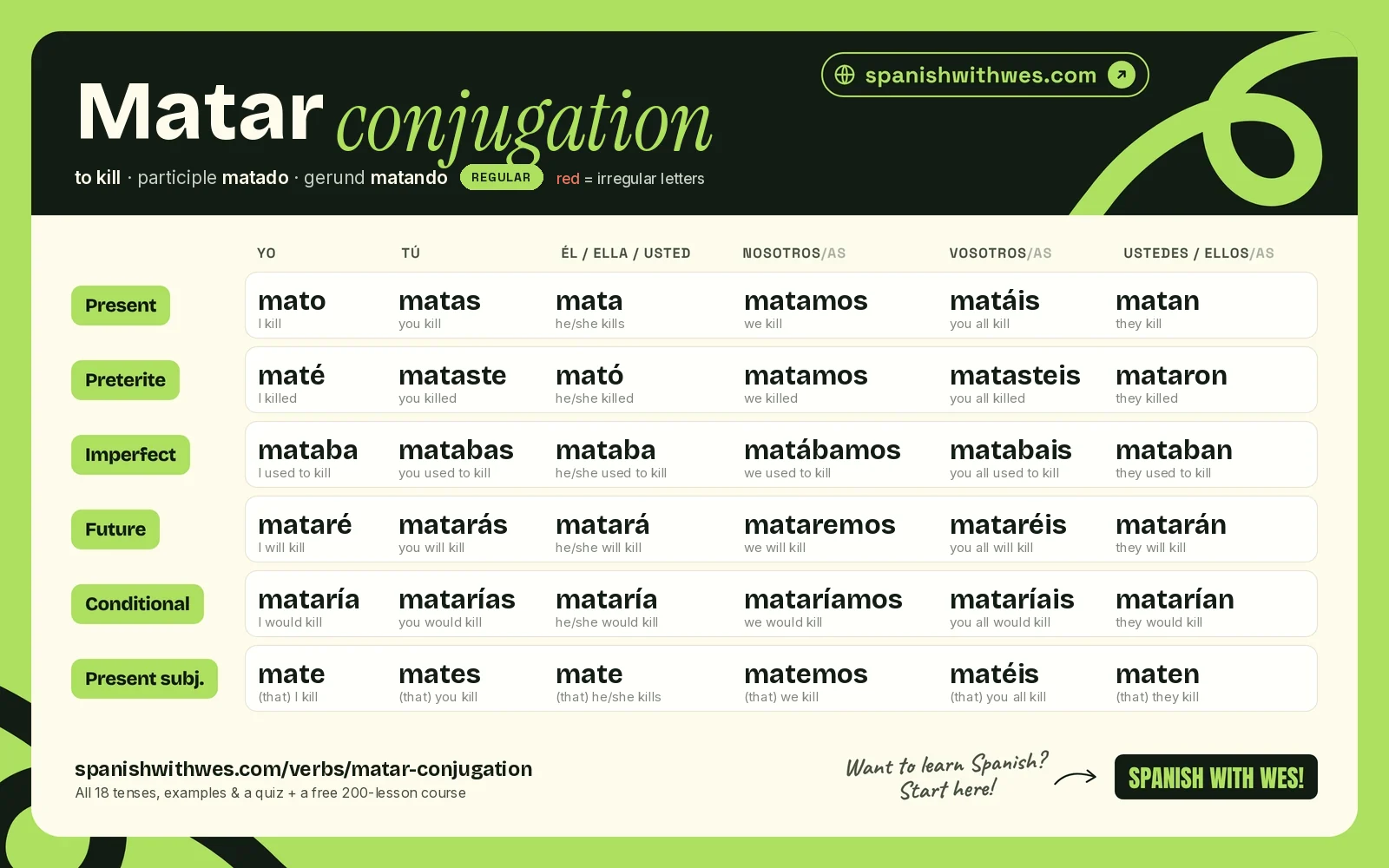
| yo | matoI kill |
|---|---|
| tú | matasyou kill |
| él/ella/usted | matahe/she kills |
| nosotros/as | matamoswe kill |
| vosotros/as | matáisyou all kill |
| ellos/ellas/ustedes | matanthey kill |
Preterite indicative
| yo | matéI killed |
|---|---|
| tú | matasteyou killed |
| él/ella/usted | matóhe/she killed |
| nosotros/as | matamoswe killed |
| vosotros/as | matasteisyou all killed |
| ellos/ellas/ustedes | mataronthey killed |
Imperfect indicative
| yo | matabaI used to kill |
|---|---|
| tú | matabasyou used to kill |
| él/ella/usted | matabahe/she used to kill |
| nosotros/as | matábamoswe used to kill |
| vosotros/as | matabaisyou all used to kill |
| ellos/ellas/ustedes | matabanthey used to kill |
Present continuous indicative
| yo | estoy matandoI am killing |
|---|---|
| tú | estás matandoyou are killing |
| él/ella/usted | está matandohe/she is killing |
| nosotros/as | estamos matandowe are killing |
| vosotros/as | estáis matandoyou all are killing |
| ellos/ellas/ustedes | están matandothey are killing |
estar + gerund
Informal future indicative
| yo | voy a matarI am going to kill |
|---|---|
| tú | vas a mataryou are going to kill |
| él/ella/usted | va a matarhe/she is going to kill |
| nosotros/as | vamos a matarwe are going to kill |
| vosotros/as | vais a mataryou all are going to kill |
| ellos/ellas/ustedes | van a matarthey are going to kill |
ir a + infinitive
Future indicative
| yo | mataréI will kill |
|---|---|
| tú | matarásyou will kill |
| él/ella/usted | mataráhe/she will kill |
| nosotros/as | mataremoswe will kill |
| vosotros/as | mataréisyou all will kill |
| ellos/ellas/ustedes | mataránthey will kill |
Conditional indicative
| yo | mataríaI would kill |
|---|---|
| tú | mataríasyou would kill |
| él/ella/usted | mataríahe/she would kill |
| nosotros/as | mataríamoswe would kill |
| vosotros/as | mataríaisyou all would kill |
| ellos/ellas/ustedes | mataríanthey would kill |
Present perfect indicative
| yo | he matadoI have killed |
|---|---|
| tú | has matadoyou have killed |
| él/ella/usted | ha matadohe/she has killed |
| nosotros/as | hemos matadowe have killed |
| vosotros/as | habéis matadoyou all have killed |
| ellos/ellas/ustedes | han matadothey have killed |
haber (present) + past participle
Past perfect indicative
| yo | había matadoI had killed |
|---|---|
| tú | habías matadoyou had killed |
| él/ella/usted | había matadohe/she had killed |
| nosotros/as | habíamos matadowe had killed |
| vosotros/as | habíais matadoyou all had killed |
| ellos/ellas/ustedes | habían matadothey had killed |
haber (imperfect) + past participle
Future perfect indicative
| yo | habré matadoI will have killed |
|---|---|
| tú | habrás matadoyou will have killed |
| él/ella/usted | habrá matadohe/she will have killed |
| nosotros/as | habremos matadowe will have killed |
| vosotros/as | habréis matadoyou all will have killed |
| ellos/ellas/ustedes | habrán matadothey will have killed |
haber (future) + past participle
Conditional perfect indicative
| yo | habría matadoI would have killed |
|---|---|
| tú | habrías matadoyou would have killed |
| él/ella/usted | habría matadohe/she would have killed |
| nosotros/as | habríamos matadowe would have killed |
| vosotros/as | habríais matadoyou all would have killed |
| ellos/ellas/ustedes | habrían matadothey would have killed |
haber (conditional) + past participle
Subjunctive tenses of matar
Wishes, doubts, emotions and "if" sentences.
Present subjunctive
| yo | mate(that) I kill |
|---|---|
| tú | mates(that) you kill |
| él/ella/usted | mate(that) he/she kills |
| nosotros/as | matemos(that) we kill |
| vosotros/as | matéis(that) you all kill |
| ellos/ellas/ustedes | maten(that) they kill |
Imperfect subjunctive
| yo | matara / matase(if) I killed |
|---|---|
| tú | mataras / matases(if) you killed |
| él/ella/usted | matara / matase(if) he/she killed |
| nosotros/as | matáramos / matásemos(if) we killed |
| vosotros/as | matarais / mataseis(if) you all killed |
| ellos/ellas/ustedes | mataran / matasen(if) they killed |
Future subjunctive
| yo | matare(if) I kill |
|---|---|
| tú | matares(if) you kill |
| él/ella/usted | matare(if) he/she kills |
| nosotros/as | matáremos(if) we kill |
| vosotros/as | matareis(if) you all kill |
| ellos/ellas/ustedes | mataren(if) they kill |
rarely used: legal & formal texts
Present perfect subjunctive
| yo | haya matado(that) I have killed |
|---|---|
| tú | hayas matado(that) you have killed |
| él/ella/usted | haya matado(that) he/she has killed |
| nosotros/as | hayamos matado(that) we have killed |
| vosotros/as | hayáis matado(that) you all have killed |
| ellos/ellas/ustedes | hayan matado(that) they have killed |
haber (present subj.) + past participle
Past perfect subjunctive
| yo | hubiera matado(if) I had killed |
|---|---|
| tú | hubieras matado(if) you had killed |
| él/ella/usted | hubiera matado(if) he/she had killed |
| nosotros/as | hubiéramos matado(if) we had killed |
| vosotros/as | hubierais matado(if) you all had killed |
| ellos/ellas/ustedes | hubieran matado(if) they had killed |
haber (imperfect subj.) + past participle
Future perfect subjunctive
| yo | hubiere matado(if) I will have killed |
|---|---|
| tú | hubieres matado(if) you will have killed |
| él/ella/usted | hubiere matado(if) he/she will have killed |
| nosotros/as | hubiéremos matado(if) we will have killed |
| vosotros/as | hubiereis matado(if) you all will have killed |
| ellos/ellas/ustedes | hubieren matado(if) they will have killed |
rarely used: legal & formal texts
Imperative tenses of matar
Commands and instructions.
Affirmative imperative
| tú | matakill! |
|---|---|
| usted | matekill! (formal) |
| nosotros/as | matemoslet's kill! |
| vosotros/as | matadkill! (you all) |
| ustedes | matenkill! (you all, formal) |
Negative imperative
| tú | no matesdon't kill! |
|---|---|
| usted | no matedon't kill! (formal) |
| nosotros/as | no matemoslet's not kill! |
| vosotros/as | no matéisdon't kill! (you all) |
| ustedes | no matendon't kill! (you all, formal) |
Practice matar
Two quick exercises. No sign-up, no app: just you and matar.
How to use matar
Leo un libro para matar el tiempo.
I read a book to kill time.
Este calor me mata.
This heat is killing me.
¡Mi mamá me va a matar!
My mom is going to kill me!
Ayer maté un mosquito enorme.
Yesterday I killed a huge mosquito.
Se mata trabajando todos los días.
He/she works himself/herself to death every day.
Example sentences with matar
- Leo un libro para matar el tiempo.I read a book to kill time.
- Este calor me mata.This heat is killing me.
- Maté dos pájaros de un tiro.I killed two birds with one stone.
- ¡Mi mamá me va a matar!My mom is going to kill me!
- Matábamos el tiempo jugando a las cartas.We used to kill time playing cards.
- Me matan los zapatos nuevos.My new shoes are killing me.
- No mates la planta: riégala una vez por semana.Don't kill the plant: water it once a week.
- Si llego tarde otra vez, mi jefe me mata.If I'm late again, my boss will kill me.
Verbs like matar
Matar follows the regular -ar pattern, like hablar, llamar, dejar and acabar. Don't mix it up with morir (to die): murió = he/she died.
Frequently asked questions about matar
Is matar regular or irregular?
Matar is completely regular. It follows the normal -ar pattern in every tense.
How do you conjugate matar in the present tense?
mato, matas, mata, matamos, matáis, matan.
What's the difference between matar and morir?
Matar = to kill (someone or something). Morir = to die. El gato mató un ratón (the cat killed a mouse), but mi abuelo murió (my grandpa died).
What does "me mata" mean?
It's an exaggeration, like "it's killing me": me mata el calor (the heat is killing me), me matan los pies (my feet are killing me).
How do you say "to kill two birds with one stone" in Spanish?
Matar dos pájaros de un tiro, literally "to kill two birds with one shot".
What is the past participle of matar?
The past participle is matado and the gerund is matando.
Paid courses
Ready to actually speak?
Knowing the conjugations is step one. My paid courses take you from tables to real conversations: structured, step by step, with practice built in.
- Conversational courseStop freezing in real conversations
- Verb tenses courseEvery tense, finally clear

Hola, soy Wes!
Your Spanish teacher
A Dutchie who learned Spanish from scratch. I make the lessons I wish I'd had: clear, practical and free.
My story →Support Spanish with Wes!
Did this page help you?
All my lessons, verb charts and cheat sheets are free, and I want to keep it that way. If you'd like to help me make more, you can support me here. Think of it as buying me a café con leche ☕
More Spanish verbs
Verb search
Find any Spanish verb.
Type a verb, an English word or a conjugated form like fui or hubo.