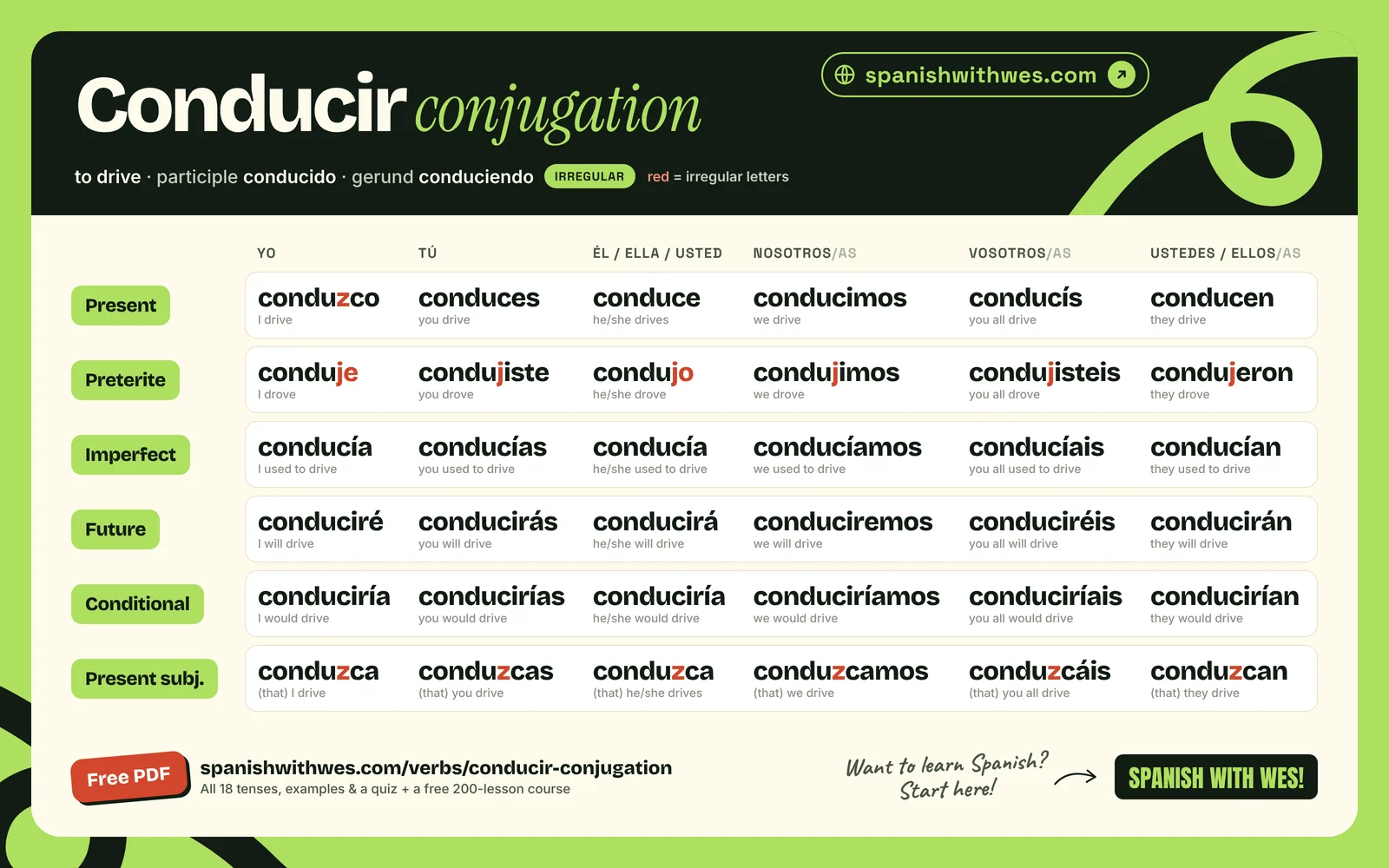
Conducir or manejar?
In Spain you conducir a car and get a carné de conducir (driving licence). In most of Latin America people say manejar and licencia de manejar. Both are understood everywhere. Every verb ending in -ducir works like conducir: traducir (traduzco, traduje), producir, reducir.
Indicative tenses of conducir
Facts and things that happen: the tenses you'll use most.
Present indicative
| yo | conduzcoI drive |
|---|---|
| tú | conducesyou drive |
| él/ella/usted | conducehe/she drives |
| nosotros/as | conducimoswe drive |
| vosotros/as | conducísyou all drive |
| ellos/ellas/ustedes | conducenthey drive |
Only the yo form is irregular: conduzco.
Preterite indicative
| yo | condujeI drove |
|---|---|
| tú | condujisteyou drove |
| él/ella/usted | condujohe/she drove |
| nosotros/as | condujimoswe drove |
| vosotros/as | condujisteisyou all drove |
| ellos/ellas/ustedes | condujeronthey drove |
Irregular conduj- stem with no accents. Note condujeron, not condujieron.
Imperfect indicative
| yo | conducíaI used to drive |
|---|---|
| tú | conducíasyou used to drive |
| él/ella/usted | conducíahe/she used to drive |
| nosotros/as | conducíamoswe used to drive |
| vosotros/as | conducíaisyou all used to drive |
| ellos/ellas/ustedes | conducíanthey used to drive |
Present continuous indicative
| yo | estoy conduciendoI am driving |
|---|---|
| tú | estás conduciendoyou are driving |
| él/ella/usted | está conduciendohe/she is driving |
| nosotros/as | estamos conduciendowe are driving |
| vosotros/as | estáis conduciendoyou all are driving |
| ellos/ellas/ustedes | están conduciendothey are driving |
estar + gerund
Informal future indicative
| yo | voy a conducirI am going to drive |
|---|---|
| tú | vas a conduciryou are going to drive |
| él/ella/usted | va a conducirhe/she is going to drive |
| nosotros/as | vamos a conducirwe are going to drive |
| vosotros/as | vais a conduciryou all are going to drive |
| ellos/ellas/ustedes | van a conducirthey are going to drive |
ir a + infinitive
Future indicative
| yo | conduciréI will drive |
|---|---|
| tú | conducirásyou will drive |
| él/ella/usted | conduciráhe/she will drive |
| nosotros/as | conduciremoswe will drive |
| vosotros/as | conduciréisyou all will drive |
| ellos/ellas/ustedes | conduciránthey will drive |
Conditional indicative
| yo | conduciríaI would drive |
|---|---|
| tú | conduciríasyou would drive |
| él/ella/usted | conduciríahe/she would drive |
| nosotros/as | conduciríamoswe would drive |
| vosotros/as | conduciríaisyou all would drive |
| ellos/ellas/ustedes | conduciríanthey would drive |
Present perfect indicative
| yo | he conducidoI have driven |
|---|---|
| tú | has conducidoyou have driven |
| él/ella/usted | ha conducidohe/she has driven |
| nosotros/as | hemos conducidowe have driven |
| vosotros/as | habéis conducidoyou all have driven |
| ellos/ellas/ustedes | han conducidothey have driven |
haber (present) + past participle
Past perfect indicative
| yo | había conducidoI had driven |
|---|---|
| tú | habías conducidoyou had driven |
| él/ella/usted | había conducidohe/she had driven |
| nosotros/as | habíamos conducidowe had driven |
| vosotros/as | habíais conducidoyou all had driven |
| ellos/ellas/ustedes | habían conducidothey had driven |
haber (imperfect) + past participle
Future perfect indicative
| yo | habré conducidoI will have driven |
|---|---|
| tú | habrás conducidoyou will have driven |
| él/ella/usted | habrá conducidohe/she will have driven |
| nosotros/as | habremos conducidowe will have driven |
| vosotros/as | habréis conducidoyou all will have driven |
| ellos/ellas/ustedes | habrán conducidothey will have driven |
haber (future) + past participle
Conditional perfect indicative
| yo | habría conducidoI would have driven |
|---|---|
| tú | habrías conducidoyou would have driven |
| él/ella/usted | habría conducidohe/she would have driven |
| nosotros/as | habríamos conducidowe would have driven |
| vosotros/as | habríais conducidoyou all would have driven |
| ellos/ellas/ustedes | habrían conducidothey would have driven |
haber (conditional) + past participle
Subjunctive tenses of conducir
Wishes, doubts, emotions and "if" sentences.
Present subjunctive
| yo | conduzca(that) I drive |
|---|---|
| tú | conduzcas(that) you drive |
| él/ella/usted | conduzca(that) he/she drives |
| nosotros/as | conduzcamos(that) we drive |
| vosotros/as | conduzcáis(that) you all drive |
| ellos/ellas/ustedes | conduzcan(that) they drive |
Imperfect subjunctive
| yo | condujera / condujese(if) I drove |
|---|---|
| tú | condujeras / condujeses(if) you drove |
| él/ella/usted | condujera / condujese(if) he/she drove |
| nosotros/as | condujéramos / condujésemos(if) we drove |
| vosotros/as | condujerais / condujeseis(if) you all drove |
| ellos/ellas/ustedes | condujeran / condujesen(if) they drove |
Future subjunctive
| yo | condujere(if) I drive |
|---|---|
| tú | condujeres(if) you drive |
| él/ella/usted | condujere(if) he/she drives |
| nosotros/as | condujéremos(if) we drive |
| vosotros/as | condujereis(if) you all drive |
| ellos/ellas/ustedes | condujeren(if) they drive |
rarely used: legal & formal texts
Present perfect subjunctive
| yo | haya conducido(that) I have driven |
|---|---|
| tú | hayas conducido(that) you have driven |
| él/ella/usted | haya conducido(that) he/she has driven |
| nosotros/as | hayamos conducido(that) we have driven |
| vosotros/as | hayáis conducido(that) you all have driven |
| ellos/ellas/ustedes | hayan conducido(that) they have driven |
haber (present subj.) + past participle
Past perfect subjunctive
| yo | hubiera conducido(if) I had driven |
|---|---|
| tú | hubieras conducido(if) you had driven |
| él/ella/usted | hubiera conducido(if) he/she had driven |
| nosotros/as | hubiéramos conducido(if) we had driven |
| vosotros/as | hubierais conducido(if) you all had driven |
| ellos/ellas/ustedes | hubieran conducido(if) they had driven |
haber (imperfect subj.) + past participle
Future perfect subjunctive
| yo | hubiere conducido(if) I will have driven |
|---|---|
| tú | hubieres conducido(if) you will have driven |
| él/ella/usted | hubiere conducido(if) he/she will have driven |
| nosotros/as | hubiéremos conducido(if) we will have driven |
| vosotros/as | hubiereis conducido(if) you all will have driven |
| ellos/ellas/ustedes | hubieren conducido(if) they will have driven |
rarely used: legal & formal texts
Imperative tenses of conducir
Commands and instructions.
Affirmative imperative
| tú | conducedrive! |
|---|---|
| usted | conduzcadrive! (formal) |
| nosotros/as | conduzcamoslet's drive! |
| vosotros/as | conduciddrive! (you all) |
| ustedes | conduzcandrive! (you all, formal) |
Negative imperative
| tú | no conduzcasdon't drive! |
|---|---|
| usted | no conduzcadon't drive! (formal) |
| nosotros/as | no conduzcamoslet's not drive! |
| vosotros/as | no conduzcáisdon't drive! (you all) |
| ustedes | no conduzcandon't drive! (you all, formal) |
Practice conducir
Two quick exercises. No sign-up, no app: just you and conducir.
How to use conducir
Conduzco al trabajo cada día.
I drive to work every day.
Todavía no tengo el carné de conducir.
I don't have my driving licence yet.
Este camino conduce al pueblo.
This path leads to the village.
Conduces muy rápido.
You drive really fast.
Ella conduce un programa de radio.
She hosts a radio show.
Example sentences with conducir
- ¿Sabes conducir?Can you drive?
- Conduje seis horas sin parar.I drove six hours without stopping.
- ¿Quién condujo anoche?Who drove last night?
- Mi padre conducía un camión.My father used to drive a truck.
- Mañana conduciré yo.Tomorrow I'll drive.
- No conduzcas si has bebido.Don't drive if you've been drinking.
- Es mejor que conduzca ella.It's better if she drives.
- Nunca he conducido en Inglaterra.I've never driven in England.
Verbs like conducir
All -ducir verbs follow conducir: traducir, producir, reducir. The -zco yo form is shared with conocer, and the j-preterite with traer and decir.
Frequently asked questions about conducir
Is conducir regular or irregular?
Conducir is irregular: conduzco in the present and a conduj- preterite.
How do you conjugate conducir in the present tense?
conduzco, conduces, conduce, conducimos, conducís, conducen.
How do you conjugate conducir in the preterite?
conduje, condujiste, condujo, condujimos, condujisteis, condujeron.
What is the difference between conducir and manejar?
Same meaning. Conducir is used in Spain, manejar in most of Latin America.
How do you say "driving licence"?
Carné de conducir (Spain) or licencia de manejar (Latin America).
What is the past participle of conducir?
It's regular: conducido. The gerund is conduciendo.
Free cheat sheet
All 18 tenses of conducir, on one page.
Print it, stick it on your fridge, or keep it on your phone. Fill in your name and email and I'll send it straight to your inbox.
📩 Check your inbox! The conducir cheat sheet is on its way.
Paid courses
Ready to actually speak?
Knowing the conjugations is step one. My paid courses take you from tables to real conversations: structured, step by step, with practice built in.
- Conversational courseStop freezing in real conversations
- Verb tenses courseEvery tense, finally clear

Hola, soy Wes!
Your Spanish teacher
A Dutchie who learned Spanish from scratch. I make the lessons I wish I'd had: clear, practical and free.
My story →Support Spanish with Wes!
Did this page help you?
All my lessons, verb charts and cheat sheets are free, and I want to keep it that way. If you'd like to help me make more, you can support me here. Think of it as buying me a café con leche ☕
More Spanish verbs
Verb search
Find any Spanish verb.
Type a verb, an English word or a conjugated form like fui or hubo.