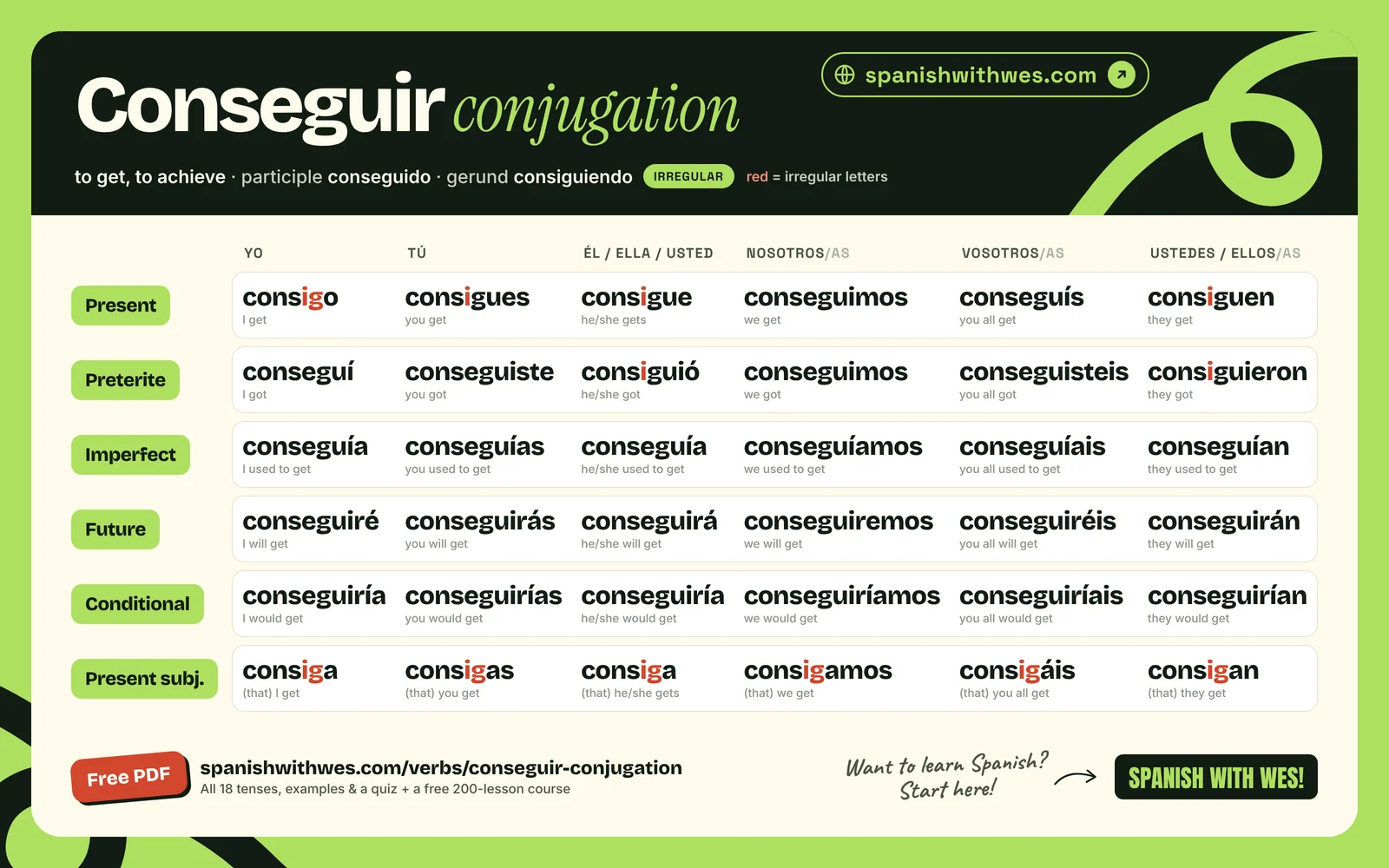
Conseguir = manage to
Conseguir + infinitive = to manage to do something: ¡lo conseguí! (I did it!), no consigo dormir (I can't get to sleep). Conseguir + noun = to get / obtain: conseguí trabajo (I got a job), ¿dónde consigo entradas?
Indicative tenses of conseguir
Facts and things that happen: the tenses you'll use most.
Present indicative
| yo | consigoI get |
|---|---|
| tú | consiguesyou get |
| él/ella/usted | consiguehe/she gets |
| nosotros/as | conseguimoswe get |
| vosotros/as | conseguísyou all get |
| ellos/ellas/ustedes | consiguenthey get |
Conjugated exactly like seguir: e → i and consigo without the u.
Preterite indicative
| yo | conseguíI got |
|---|---|
| tú | conseguisteyou got |
| él/ella/usted | consiguióhe/she got |
| nosotros/as | conseguimoswe got |
| vosotros/as | conseguisteisyou all got |
| ellos/ellas/ustedes | consiguieronthey got |
Only él/ella and ellos change: consiguió, consiguieron.
Imperfect indicative
| yo | conseguíaI used to get |
|---|---|
| tú | conseguíasyou used to get |
| él/ella/usted | conseguíahe/she used to get |
| nosotros/as | conseguíamoswe used to get |
| vosotros/as | conseguíaisyou all used to get |
| ellos/ellas/ustedes | conseguíanthey used to get |
Present continuous indicative
| yo | estoy consiguiendoI am getting |
|---|---|
| tú | estás consiguiendoyou are getting |
| él/ella/usted | está consiguiendohe/she is getting |
| nosotros/as | estamos consiguiendowe are getting |
| vosotros/as | estáis consiguiendoyou all are getting |
| ellos/ellas/ustedes | están consiguiendothey are getting |
estar + gerund
Informal future indicative
| yo | voy a conseguirI am going to get |
|---|---|
| tú | vas a conseguiryou are going to get |
| él/ella/usted | va a conseguirhe/she is going to get |
| nosotros/as | vamos a conseguirwe are going to get |
| vosotros/as | vais a conseguiryou all are going to get |
| ellos/ellas/ustedes | van a conseguirthey are going to get |
ir a + infinitive
Future indicative
| yo | conseguiréI will get |
|---|---|
| tú | conseguirásyou will get |
| él/ella/usted | conseguiráhe/she will get |
| nosotros/as | conseguiremoswe will get |
| vosotros/as | conseguiréisyou all will get |
| ellos/ellas/ustedes | conseguiránthey will get |
Conditional indicative
| yo | conseguiríaI would get |
|---|---|
| tú | conseguiríasyou would get |
| él/ella/usted | conseguiríahe/she would get |
| nosotros/as | conseguiríamoswe would get |
| vosotros/as | conseguiríaisyou all would get |
| ellos/ellas/ustedes | conseguiríanthey would get |
Present perfect indicative
| yo | he conseguidoI have got |
|---|---|
| tú | has conseguidoyou have got |
| él/ella/usted | ha conseguidohe/she has got |
| nosotros/as | hemos conseguidowe have got |
| vosotros/as | habéis conseguidoyou all have got |
| ellos/ellas/ustedes | han conseguidothey have got |
haber (present) + past participle
Past perfect indicative
| yo | había conseguidoI had got |
|---|---|
| tú | habías conseguidoyou had got |
| él/ella/usted | había conseguidohe/she had got |
| nosotros/as | habíamos conseguidowe had got |
| vosotros/as | habíais conseguidoyou all had got |
| ellos/ellas/ustedes | habían conseguidothey had got |
haber (imperfect) + past participle
Future perfect indicative
| yo | habré conseguidoI will have got |
|---|---|
| tú | habrás conseguidoyou will have got |
| él/ella/usted | habrá conseguidohe/she will have got |
| nosotros/as | habremos conseguidowe will have got |
| vosotros/as | habréis conseguidoyou all will have got |
| ellos/ellas/ustedes | habrán conseguidothey will have got |
haber (future) + past participle
Conditional perfect indicative
| yo | habría conseguidoI would have got |
|---|---|
| tú | habrías conseguidoyou would have got |
| él/ella/usted | habría conseguidohe/she would have got |
| nosotros/as | habríamos conseguidowe would have got |
| vosotros/as | habríais conseguidoyou all would have got |
| ellos/ellas/ustedes | habrían conseguidothey would have got |
haber (conditional) + past participle
Subjunctive tenses of conseguir
Wishes, doubts, emotions and "if" sentences.
Present subjunctive
| yo | consiga(that) I get |
|---|---|
| tú | consigas(that) you get |
| él/ella/usted | consiga(that) he/she gets |
| nosotros/as | consigamos(that) we get |
| vosotros/as | consigáis(that) you all get |
| ellos/ellas/ustedes | consigan(that) they get |
Imperfect subjunctive
| yo | consiguiera / consiguiese(if) I got |
|---|---|
| tú | consiguieras / consiguieses(if) you got |
| él/ella/usted | consiguiera / consiguiese(if) he/she got |
| nosotros/as | consiguiéramos / consiguiésemos(if) we got |
| vosotros/as | consiguierais / consiguieseis(if) you all got |
| ellos/ellas/ustedes | consiguieran / consiguiesen(if) they got |
Future subjunctive
| yo | consiguiere(if) I get |
|---|---|
| tú | consiguieres(if) you get |
| él/ella/usted | consiguiere(if) he/she gets |
| nosotros/as | consiguiéremos(if) we get |
| vosotros/as | consiguiereis(if) you all get |
| ellos/ellas/ustedes | consiguieren(if) they get |
rarely used: legal & formal texts
Present perfect subjunctive
| yo | haya conseguido(that) I have got |
|---|---|
| tú | hayas conseguido(that) you have got |
| él/ella/usted | haya conseguido(that) he/she has got |
| nosotros/as | hayamos conseguido(that) we have got |
| vosotros/as | hayáis conseguido(that) you all have got |
| ellos/ellas/ustedes | hayan conseguido(that) they have got |
haber (present subj.) + past participle
Past perfect subjunctive
| yo | hubiera conseguido(if) I had got |
|---|---|
| tú | hubieras conseguido(if) you had got |
| él/ella/usted | hubiera conseguido(if) he/she had got |
| nosotros/as | hubiéramos conseguido(if) we had got |
| vosotros/as | hubierais conseguido(if) you all had got |
| ellos/ellas/ustedes | hubieran conseguido(if) they had got |
haber (imperfect subj.) + past participle
Future perfect subjunctive
| yo | hubiere conseguido(if) I will have got |
|---|---|
| tú | hubieres conseguido(if) you will have got |
| él/ella/usted | hubiere conseguido(if) he/she will have got |
| nosotros/as | hubiéremos conseguido(if) we will have got |
| vosotros/as | hubiereis conseguido(if) you all will have got |
| ellos/ellas/ustedes | hubieren conseguido(if) they will have got |
rarely used: legal & formal texts
Imperative tenses of conseguir
Commands and instructions.
Affirmative imperative
| tú | consigueget! |
|---|---|
| usted | consigaget! (formal) |
| nosotros/as | consigamoslet's get! |
| vosotros/as | conseguidget! (you all) |
| ustedes | consiganget! (you all, formal) |
Negative imperative
| tú | no consigasdon't get! |
|---|---|
| usted | no consigadon't get! (formal) |
| nosotros/as | no consigamoslet's not get! |
| vosotros/as | no consigáisdon't get! (you all) |
| ustedes | no consigandon't get! (you all, formal) |
Practice conseguir
Two quick exercises. No sign-up, no app: just you and conseguir.
How to use conseguir
Conseguí entradas para el concierto.
I got tickets for the concert.
No consigo dormir.
I can't get to sleep.
¡Lo hemos conseguido!
We did it!
Mi hermana consiguió trabajo.
My sister got a job.
Seguro que lo consigues.
I'm sure you'll make it.
Example sentences with conseguir
- ¡Lo conseguí!I did it!
- ¿Dónde consigo un taxi?Where can I get a taxi?
- Al final consiguió el trabajo.In the end he got the job.
- No conseguía entenderlo.I couldn't manage to understand it.
- Conseguirás hablar español.You'll manage to speak Spanish.
- Ojalá consigas lo que quieres.I hope you get what you want.
- ¡Lo hemos conseguido!We did it!
- Consigue el número de teléfono.Get the phone number.
Verbs like conseguir
Conseguir is conjugated exactly like seguir. Its synonym lograr (to achieve) is regular: logré terminar.
Frequently asked questions about conseguir
Is conseguir regular or irregular?
Conseguir is a stem-changing verb, conjugated like seguir: consigo, consigue, consiguió, consiga, consiguiendo. The imperfect, future and conditional are regular.
How do you conjugate conseguir in the present tense?
consigo, consigues, consigue, conseguimos, conseguís, consiguen.
How do you conjugate conseguir in the preterite?
conseguí, conseguiste, consiguió, conseguimos, conseguisteis, consiguieron.
How do you say "I did it!" in Spanish?
¡Lo conseguí! or ¡lo logré!
Conseguir or obtener?
Both mean "to get / obtain". Conseguir is more common in conversation and also means "to manage to".
What is the past participle of conseguir?
The past participle is conseguido and the gerund is consiguiendo.
Free cheat sheet
All 18 tenses of conseguir, on one page.
Print it, stick it on your fridge, or keep it on your phone. Fill in your name and email and I'll send it straight to your inbox.
📩 Check your inbox! The conseguir cheat sheet is on its way.
Paid courses
Ready to actually speak?
Knowing the conjugations is step one. My paid courses take you from tables to real conversations: structured, step by step, with practice built in.
- Conversational courseStop freezing in real conversations
- Verb tenses courseEvery tense, finally clear

Hola, soy Wes!
Your Spanish teacher
A Dutchie who learned Spanish from scratch. I make the lessons I wish I'd had: clear, practical and free.
My story →Support Spanish with Wes!
Did this page help you?
All my lessons, verb charts and cheat sheets are free, and I want to keep it that way. If you'd like to help me make more, you can support me here. Think of it as buying me a café con leche ☕
More Spanish verbs
Verb search
Find any Spanish verb.
Type a verb, an English word or a conjugated form like fui or hubo.