Empezar a + infinitive
To say you start doing something, use empezar a: empiezo a trabajar a las nueve (I start work at nine), empezó a llover (it started to rain). Comenzar means the same and works the same way (comienzo, comencé).
Indicative tenses of empezar
Facts and things that happen: the tenses you'll use most.
Present indicative
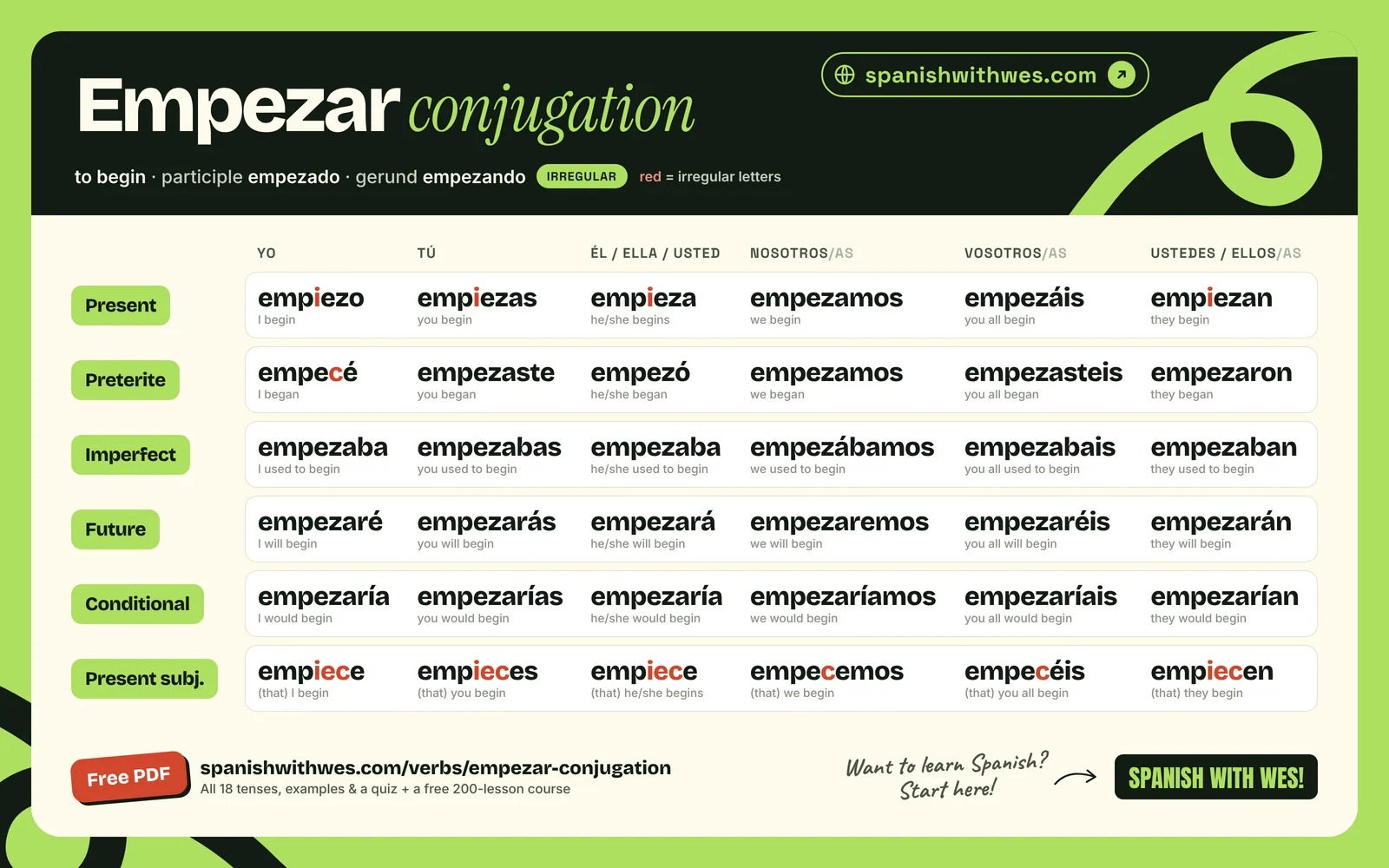
| yo | empiezoI begin |
|---|---|
| tú | empiezasyou begin |
| él/ella/usted | empiezahe/she begins |
| nosotros/as | empezamoswe begin |
| vosotros/as | empezáisyou all begin |
| ellos/ellas/ustedes | empiezanthey begin |
Stem change e → ie, except for nosotros and vosotros: empezamos.
Preterite indicative
| yo | empecéI began |
|---|---|
| tú | empezasteyou began |
| él/ella/usted | empezóhe/she began |
| nosotros/as | empezamoswe began |
| vosotros/as | empezasteisyou all began |
| ellos/ellas/ustedes | empezaronthey began |
Spelling change in the yo form: z → c before e (empecé).
Imperfect indicative
| yo | empezabaI used to begin |
|---|---|
| tú | empezabasyou used to begin |
| él/ella/usted | empezabahe/she used to begin |
| nosotros/as | empezábamoswe used to begin |
| vosotros/as | empezabaisyou all used to begin |
| ellos/ellas/ustedes | empezabanthey used to begin |
Present continuous indicative
| yo | estoy empezandoI am beginning |
|---|---|
| tú | estás empezandoyou are beginning |
| él/ella/usted | está empezandohe/she is beginning |
| nosotros/as | estamos empezandowe are beginning |
| vosotros/as | estáis empezandoyou all are beginning |
| ellos/ellas/ustedes | están empezandothey are beginning |
estar + gerund
Informal future indicative
| yo | voy a empezarI am going to begin |
|---|---|
| tú | vas a empezaryou are going to begin |
| él/ella/usted | va a empezarhe/she is going to begin |
| nosotros/as | vamos a empezarwe are going to begin |
| vosotros/as | vais a empezaryou all are going to begin |
| ellos/ellas/ustedes | van a empezarthey are going to begin |
ir a + infinitive
Future indicative
| yo | empezaréI will begin |
|---|---|
| tú | empezarásyou will begin |
| él/ella/usted | empezaráhe/she will begin |
| nosotros/as | empezaremoswe will begin |
| vosotros/as | empezaréisyou all will begin |
| ellos/ellas/ustedes | empezaránthey will begin |
Conditional indicative
| yo | empezaríaI would begin |
|---|---|
| tú | empezaríasyou would begin |
| él/ella/usted | empezaríahe/she would begin |
| nosotros/as | empezaríamoswe would begin |
| vosotros/as | empezaríaisyou all would begin |
| ellos/ellas/ustedes | empezaríanthey would begin |
Present perfect indicative
| yo | he empezadoI have begun |
|---|---|
| tú | has empezadoyou have begun |
| él/ella/usted | ha empezadohe/she has begun |
| nosotros/as | hemos empezadowe have begun |
| vosotros/as | habéis empezadoyou all have begun |
| ellos/ellas/ustedes | han empezadothey have begun |
haber (present) + past participle
Past perfect indicative
| yo | había empezadoI had begun |
|---|---|
| tú | habías empezadoyou had begun |
| él/ella/usted | había empezadohe/she had begun |
| nosotros/as | habíamos empezadowe had begun |
| vosotros/as | habíais empezadoyou all had begun |
| ellos/ellas/ustedes | habían empezadothey had begun |
haber (imperfect) + past participle
Future perfect indicative
| yo | habré empezadoI will have begun |
|---|---|
| tú | habrás empezadoyou will have begun |
| él/ella/usted | habrá empezadohe/she will have begun |
| nosotros/as | habremos empezadowe will have begun |
| vosotros/as | habréis empezadoyou all will have begun |
| ellos/ellas/ustedes | habrán empezadothey will have begun |
haber (future) + past participle
Conditional perfect indicative
| yo | habría empezadoI would have begun |
|---|---|
| tú | habrías empezadoyou would have begun |
| él/ella/usted | habría empezadohe/she would have begun |
| nosotros/as | habríamos empezadowe would have begun |
| vosotros/as | habríais empezadoyou all would have begun |
| ellos/ellas/ustedes | habrían empezadothey would have begun |
haber (conditional) + past participle
Subjunctive tenses of empezar
Wishes, doubts, emotions and "if" sentences.
Present subjunctive
| yo | empiece(that) I begin |
|---|---|
| tú | empieces(that) you begin |
| él/ella/usted | empiece(that) he/she begins |
| nosotros/as | empecemos(that) we begin |
| vosotros/as | empecéis(that) you all begin |
| ellos/ellas/ustedes | empiecen(that) they begin |
Both changes together: empiece (ie + c).
Imperfect subjunctive
| yo | empezara(if) I began |
|---|---|
| tú | empezaras(if) you began |
| él/ella/usted | empezara(if) he/she began |
| nosotros/as | empezáramos(if) we began |
| vosotros/as | empezarais(if) you all began |
| ellos/ellas/ustedes | empezaran(if) they began |
Future subjunctive
| yo | empezare(if) I begin |
|---|---|
| tú | empezares(if) you begin |
| él/ella/usted | empezare(if) he/she begins |
| nosotros/as | empezáremos(if) we begin |
| vosotros/as | empezareis(if) you all begin |
| ellos/ellas/ustedes | empezaren(if) they begin |
rarely used: legal & formal texts
Present perfect subjunctive
| yo | haya empezado(that) I have begun |
|---|---|
| tú | hayas empezado(that) you have begun |
| él/ella/usted | haya empezado(that) he/she has begun |
| nosotros/as | hayamos empezado(that) we have begun |
| vosotros/as | hayáis empezado(that) you all have begun |
| ellos/ellas/ustedes | hayan empezado(that) they have begun |
haber (present subj.) + past participle
Past perfect subjunctive
| yo | hubiera empezado(if) I had begun |
|---|---|
| tú | hubieras empezado(if) you had begun |
| él/ella/usted | hubiera empezado(if) he/she had begun |
| nosotros/as | hubiéramos empezado(if) we had begun |
| vosotros/as | hubierais empezado(if) you all had begun |
| ellos/ellas/ustedes | hubieran empezado(if) they had begun |
haber (imperfect subj.) + past participle
Future perfect subjunctive
| yo | hubiere empezado(if) I will have begun |
|---|---|
| tú | hubieres empezado(if) you will have begun |
| él/ella/usted | hubiere empezado(if) he/she will have begun |
| nosotros/as | hubiéremos empezado(if) we will have begun |
| vosotros/as | hubiereis empezado(if) you all will have begun |
| ellos/ellas/ustedes | hubieren empezado(if) they will have begun |
rarely used: legal & formal texts
Imperative tenses of empezar
Commands and instructions.
Affirmative imperative
| tú | empiezabegin! |
|---|---|
| usted | empiecebegin! (formal) |
| nosotros/as | empecemoslet's begin! |
| vosotros/as | empezadbegin! (you all) |
| ustedes | empiecenbegin! (you all, formal) |
Negative imperative
| tú | no empiecesdon't begin! |
|---|---|
| usted | no empiecedon't begin! (formal) |
| nosotros/as | no empecemoslet's not begin! |
| vosotros/as | no empecéisdon't begin! (you all) |
| ustedes | no empiecendon't begin! (you all, formal) |
Practice empezar
Two quick exercises. No sign-up, no app: just you and empezar.
How to use empezar
La clase empieza a las diez.
The class starts at ten.
Empecé a estudiar español en 2022.
I started learning Spanish in 2022.
Empecemos.
Let's start.
Vamos a empezar de nuevo.
Let's start again.
Al empezar, todo es difícil.
At the beginning, everything is hard.
Example sentences with empezar
- ¿A qué hora empieza la película?What time does the movie start?
- Empiezo mañana.I start tomorrow.
- Empecé a correr el año pasado.I started running last year.
- Empezó a llover.It started to rain.
- Siempre empezábamos a las ocho.We always used to start at eight.
- Empezaremos el lunes.We'll start on Monday.
- No empieces sin mí.Don't start without me.
- Ya ha empezado el partido.The game has already started.
Verbs like empezar
Comenzar works exactly like empezar (comienzo, comencé). Cruzar has the same z → c spelling change (crucé), and pensar the same e → ie.
Frequently asked questions about empezar
Is empezar regular or irregular?
Empezar is a stem-changing verb (e → ie: empiezo) with a spelling change before e (z → c: empecé, empiece). The imperfect, future and conditional are regular.
How do you conjugate empezar in the present tense?
empiezo, empiezas, empieza, empezamos, empezáis, empiezan.
How do you conjugate empezar in the preterite?
empecé, empezaste, empezó, empezamos, empezasteis, empezaron.
Why is it "empecé" and not "empezé"?
Spanish spelling: z becomes c before e or i (empecé, empiece, lápices). The sound stays the same.
Empezar or comenzar?
They mean the same and are conjugated the same way. Empezar is a bit more common in conversation.
What is the past participle of empezar?
The past participle is empezado and the gerund is empezando.
Free cheat sheet
All 18 tenses of empezar, on one page.
Print it, stick it on your fridge, or keep it on your phone. Fill in your name and email and I'll send it straight to your inbox.
📩 Check your inbox! The empezar cheat sheet is on its way.
Paid courses
Ready to actually speak?
Knowing the conjugations is step one. My paid courses take you from tables to real conversations: structured, step by step, with practice built in.
- Conversational courseStop freezing in real conversations
- Verb tenses courseEvery tense, finally clear

Hola, soy Wes!
Your Spanish teacher
A Dutchie who learned Spanish from scratch. I make the lessons I wish I'd had: clear, practical and free.
My story →Support Spanish with Wes!
Did this page help you?
All my lessons, verb charts and cheat sheets are free, and I want to keep it that way. If you'd like to help me make more, you can support me here. Think of it as buying me a café con leche ☕
More Spanish verbs
Verb search
Find any Spanish verb.
Type a verb, an English word or a conjugated form like fui or hubo.