Volver a = again
Instead of saying "otra vez" (again), Spanish speakers often use volver a + infinitive: vuelvo a llamarte (I'll call you again), no vuelvas a hacerlo (don't do it again). And volverse = to become (often suddenly): se volvió loco (he went crazy).
Indicative tenses of volver
Facts and things that happen: the tenses you'll use most.
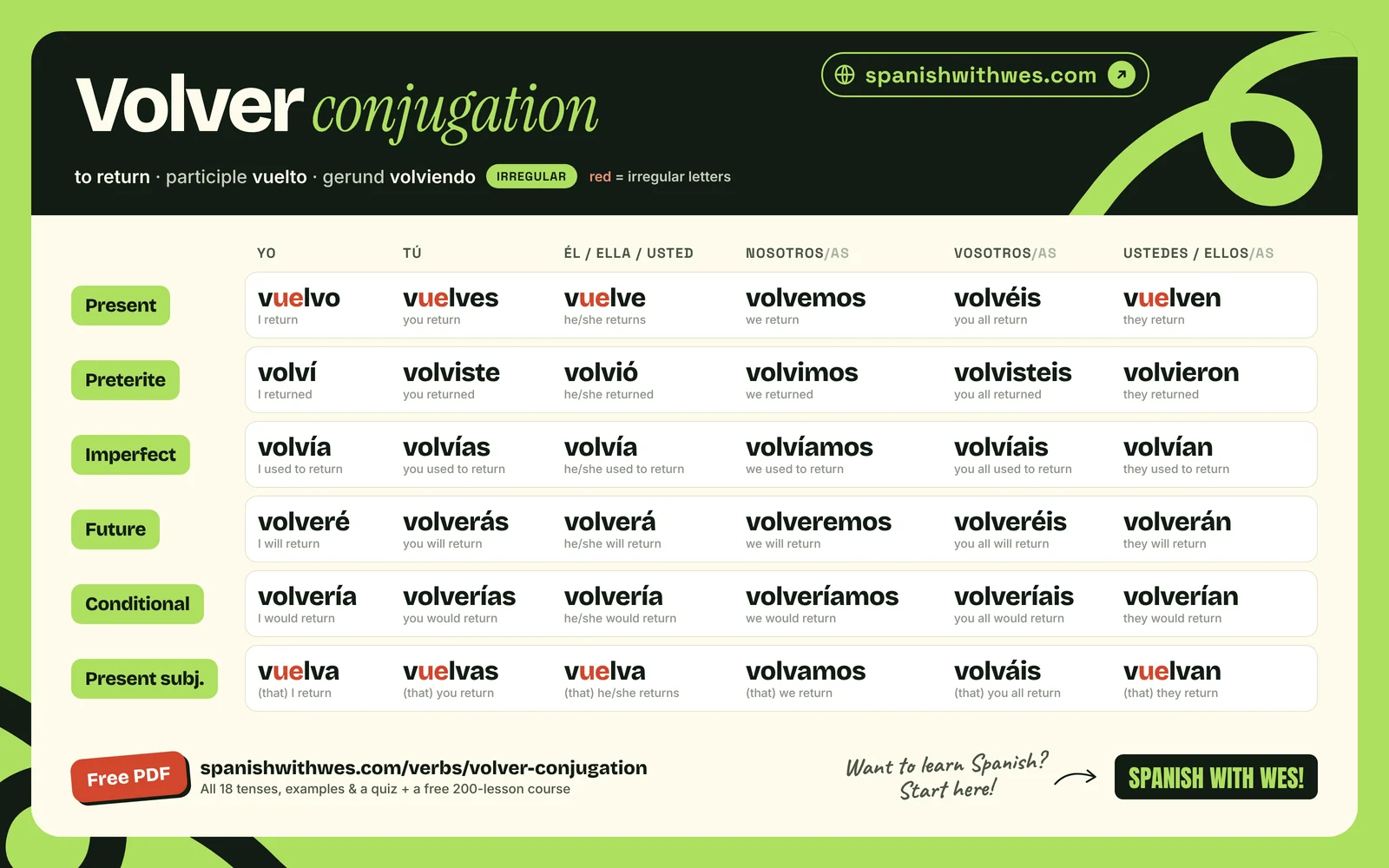
Present indicative
| yo | vuelvoI return |
|---|---|
| tú | vuelvesyou return |
| él/ella/usted | vuelvehe/she returns |
| nosotros/as | volvemoswe return |
| vosotros/as | volvéisyou all return |
| ellos/ellas/ustedes | vuelventhey return |
Stem change o → ue, except for nosotros and vosotros: volvemos.
Preterite indicative
| yo | volvíI returned |
|---|---|
| tú | volvisteyou returned |
| él/ella/usted | volvióhe/she returned |
| nosotros/as | volvimoswe returned |
| vosotros/as | volvisteisyou all returned |
| ellos/ellas/ustedes | volvieronthey returned |
Imperfect indicative
| yo | volvíaI used to return |
|---|---|
| tú | volvíasyou used to return |
| él/ella/usted | volvíahe/she used to return |
| nosotros/as | volvíamoswe used to return |
| vosotros/as | volvíaisyou all used to return |
| ellos/ellas/ustedes | volvíanthey used to return |
Present continuous indicative
| yo | estoy volviendoI am returning |
|---|---|
| tú | estás volviendoyou are returning |
| él/ella/usted | está volviendohe/she is returning |
| nosotros/as | estamos volviendowe are returning |
| vosotros/as | estáis volviendoyou all are returning |
| ellos/ellas/ustedes | están volviendothey are returning |
estar + gerund
Informal future indicative
| yo | voy a volverI am going to return |
|---|---|
| tú | vas a volveryou are going to return |
| él/ella/usted | va a volverhe/she is going to return |
| nosotros/as | vamos a volverwe are going to return |
| vosotros/as | vais a volveryou all are going to return |
| ellos/ellas/ustedes | van a volverthey are going to return |
ir a + infinitive
Future indicative
| yo | volveréI will return |
|---|---|
| tú | volverásyou will return |
| él/ella/usted | volveráhe/she will return |
| nosotros/as | volveremoswe will return |
| vosotros/as | volveréisyou all will return |
| ellos/ellas/ustedes | volveránthey will return |
Conditional indicative
| yo | volveríaI would return |
|---|---|
| tú | volveríasyou would return |
| él/ella/usted | volveríahe/she would return |
| nosotros/as | volveríamoswe would return |
| vosotros/as | volveríaisyou all would return |
| ellos/ellas/ustedes | volveríanthey would return |
Present perfect indicative
| yo | he vueltoI have returned |
|---|---|
| tú | has vueltoyou have returned |
| él/ella/usted | ha vueltohe/she has returned |
| nosotros/as | hemos vueltowe have returned |
| vosotros/as | habéis vueltoyou all have returned |
| ellos/ellas/ustedes | han vueltothey have returned |
haber (present) + past participle
The past participle is irregular: vuelto.
Past perfect indicative
| yo | había vueltoI had returned |
|---|---|
| tú | habías vueltoyou had returned |
| él/ella/usted | había vueltohe/she had returned |
| nosotros/as | habíamos vueltowe had returned |
| vosotros/as | habíais vueltoyou all had returned |
| ellos/ellas/ustedes | habían vueltothey had returned |
haber (imperfect) + past participle
Future perfect indicative
| yo | habré vueltoI will have returned |
|---|---|
| tú | habrás vueltoyou will have returned |
| él/ella/usted | habrá vueltohe/she will have returned |
| nosotros/as | habremos vueltowe will have returned |
| vosotros/as | habréis vueltoyou all will have returned |
| ellos/ellas/ustedes | habrán vueltothey will have returned |
haber (future) + past participle
Conditional perfect indicative
| yo | habría vueltoI would have returned |
|---|---|
| tú | habrías vueltoyou would have returned |
| él/ella/usted | habría vueltohe/she would have returned |
| nosotros/as | habríamos vueltowe would have returned |
| vosotros/as | habríais vueltoyou all would have returned |
| ellos/ellas/ustedes | habrían vueltothey would have returned |
haber (conditional) + past participle
Subjunctive tenses of volver
Wishes, doubts, emotions and "if" sentences.
Present subjunctive
| yo | vuelva(that) I return |
|---|---|
| tú | vuelvas(that) you return |
| él/ella/usted | vuelva(that) he/she returns |
| nosotros/as | volvamos(that) we return |
| vosotros/as | volváis(that) you all return |
| ellos/ellas/ustedes | vuelvan(that) they return |
Imperfect subjunctive
| yo | volviera(if) I returned |
|---|---|
| tú | volvieras(if) you returned |
| él/ella/usted | volviera(if) he/she returned |
| nosotros/as | volviéramos(if) we returned |
| vosotros/as | volvierais(if) you all returned |
| ellos/ellas/ustedes | volvieran(if) they returned |
Future subjunctive
| yo | volviere(if) I return |
|---|---|
| tú | volvieres(if) you return |
| él/ella/usted | volviere(if) he/she returns |
| nosotros/as | volviéremos(if) we return |
| vosotros/as | volviereis(if) you all return |
| ellos/ellas/ustedes | volvieren(if) they return |
rarely used: legal & formal texts
Present perfect subjunctive
| yo | haya vuelto(that) I have returned |
|---|---|
| tú | hayas vuelto(that) you have returned |
| él/ella/usted | haya vuelto(that) he/she has returned |
| nosotros/as | hayamos vuelto(that) we have returned |
| vosotros/as | hayáis vuelto(that) you all have returned |
| ellos/ellas/ustedes | hayan vuelto(that) they have returned |
haber (present subj.) + past participle
Past perfect subjunctive
| yo | hubiera vuelto(if) I had returned |
|---|---|
| tú | hubieras vuelto(if) you had returned |
| él/ella/usted | hubiera vuelto(if) he/she had returned |
| nosotros/as | hubiéramos vuelto(if) we had returned |
| vosotros/as | hubierais vuelto(if) you all had returned |
| ellos/ellas/ustedes | hubieran vuelto(if) they had returned |
haber (imperfect subj.) + past participle
Future perfect subjunctive
| yo | hubiere vuelto(if) I will have returned |
|---|---|
| tú | hubieres vuelto(if) you will have returned |
| él/ella/usted | hubiere vuelto(if) he/she will have returned |
| nosotros/as | hubiéremos vuelto(if) we will have returned |
| vosotros/as | hubiereis vuelto(if) you all will have returned |
| ellos/ellas/ustedes | hubieren vuelto(if) they will have returned |
rarely used: legal & formal texts
Imperative tenses of volver
Commands and instructions.
Affirmative imperative
| tú | vuelvereturn! |
|---|---|
| usted | vuelvareturn! (formal) |
| nosotros/as | volvamoslet's return! |
| vosotros/as | volvedreturn! (you all) |
| ustedes | vuelvanreturn! (you all, formal) |
Negative imperative
| tú | no vuelvasdon't return! |
|---|---|
| usted | no vuelvadon't return! (formal) |
| nosotros/as | no volvamoslet's not return! |
| vosotros/as | no volváisdon't return! (you all) |
| ustedes | no vuelvandon't return! (you all, formal) |
Practice volver
Two quick exercises. No sign-up, no app: just you and volver.
How to use volver
¿Cuándo vuelves?
When are you coming back?
Quiero volver a España.
I want to go back to Spain.
Volví a llamarla.
I called her again.
Se volvió muy famoso.
He became very famous.
Ahora vuelvo.
I'll be right back.
Example sentences with volver
- Ahora vuelvo.I'll be right back.
- Volvimos a casa muy tarde.We got back home very late.
- Cada verano volvía al pueblo.Every summer I used to go back to the village.
- Volveré pronto.I'll be back soon.
- ¿Volverías a vivir allí?Would you live there again?
- No vuelvas a hacer eso.Don't do that again.
- Ha vuelto a llover.It's started raining again.
- Espero que vuelvas pronto.I hope you come back soon.
Verbs like volver
Verbs ending in -volver (devolver, resolver) follow volver, including the participle (devuelto, resuelto). Poder and dormir have the same o → ue change.
Frequently asked questions about volver
Is volver regular or irregular?
Volver is a stem-changing verb (o → ue: vuelvo, vuelva) with an irregular past participle (vuelto). The preterite, imperfect, future and conditional are regular.
How do you conjugate volver in the present tense?
vuelvo, vuelves, vuelve, volvemos, volvéis, vuelven.
How do you conjugate volver in the preterite?
volví, volviste, volvió, volvimos, volvisteis, volvieron. The preterite is regular.
What does "volver a" + infinitive mean?
"To do something again": volví a leer el libro (I read the book again).
Volver or regresar?
Both mean "to return". Volver is more common in Spain; regresar is very common in Latin America. Regresar is regular.
What is the past participle of volver?
The past participle is irregular: vuelto (he vuelto, I have returned). The gerund is volviendo.
Free cheat sheet
All 18 tenses of volver, on one page.
Print it, stick it on your fridge, or keep it on your phone. Fill in your name and email and I'll send it straight to your inbox.
📩 Check your inbox! The volver cheat sheet is on its way.
Paid courses
Ready to actually speak?
Knowing the conjugations is step one. My paid courses take you from tables to real conversations: structured, step by step, with practice built in.
- Conversational courseStop freezing in real conversations
- Verb tenses courseEvery tense, finally clear

Hola, soy Wes!
Your Spanish teacher
A Dutchie who learned Spanish from scratch. I make the lessons I wish I'd had: clear, practical and free.
My story →Support Spanish with Wes!
Did this page help you?
All my lessons, verb charts and cheat sheets are free, and I want to keep it that way. If you'd like to help me make more, you can support me here. Think of it as buying me a café con leche ☕
More Spanish verbs
Verb search
Find any Spanish verb.
Type a verb, an English word or a conjugated form like fui or hubo.