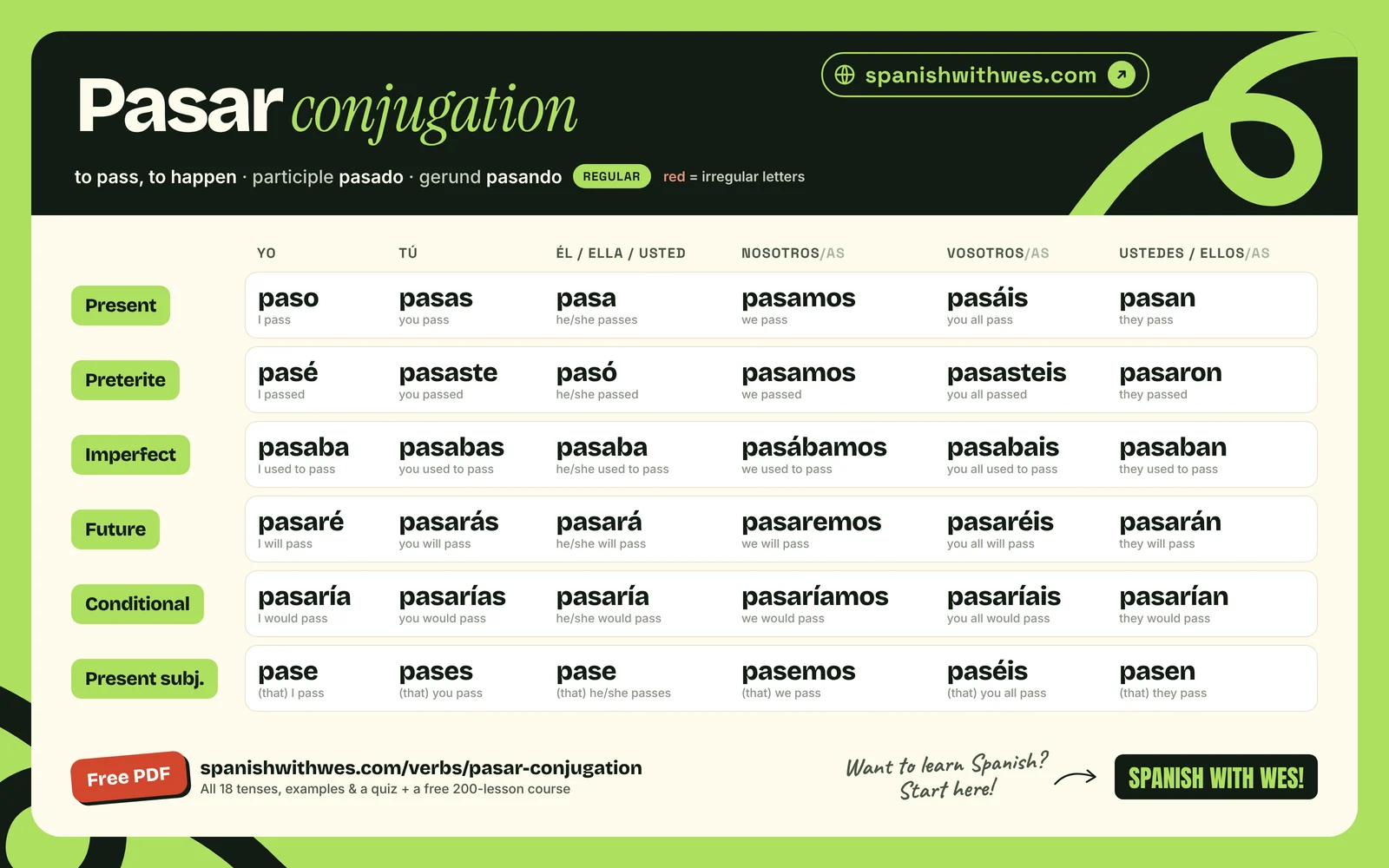
One verb, many meanings
¿Qué pasa? = what's up? / what's happening? ¿Qué te pasa? = what's wrong with you? Pasar tiempo = to spend time. ¡Pasa! = come in! Pasarlo bien = to have a good time. And no pasa nada = no worries, it's fine.
Indicative tenses of pasar
Facts and things that happen: the tenses you'll use most.
Present indicative
| yo | pasoI pass |
|---|---|
| tú | pasasyou pass |
| él/ella/usted | pasahe/she passes |
| nosotros/as | pasamoswe pass |
| vosotros/as | pasáisyou all pass |
| ellos/ellas/ustedes | pasanthey pass |
¿Qué pasa? (what's up? / what's happening?) is one of the most used phrases in Spanish.
Preterite indicative
| yo | paséI passed |
|---|---|
| tú | pasasteyou passed |
| él/ella/usted | pasóhe/she passed |
| nosotros/as | pasamoswe passed |
| vosotros/as | pasasteisyou all passed |
| ellos/ellas/ustedes | pasaronthey passed |
Imperfect indicative
| yo | pasabaI used to pass |
|---|---|
| tú | pasabasyou used to pass |
| él/ella/usted | pasabahe/she used to pass |
| nosotros/as | pasábamoswe used to pass |
| vosotros/as | pasabaisyou all used to pass |
| ellos/ellas/ustedes | pasabanthey used to pass |
Present continuous indicative
| yo | estoy pasandoI am passing |
|---|---|
| tú | estás pasandoyou are passing |
| él/ella/usted | está pasandohe/she is passing |
| nosotros/as | estamos pasandowe are passing |
| vosotros/as | estáis pasandoyou all are passing |
| ellos/ellas/ustedes | están pasandothey are passing |
estar + gerund
Informal future indicative
| yo | voy a pasarI am going to pass |
|---|---|
| tú | vas a pasaryou are going to pass |
| él/ella/usted | va a pasarhe/she is going to pass |
| nosotros/as | vamos a pasarwe are going to pass |
| vosotros/as | vais a pasaryou all are going to pass |
| ellos/ellas/ustedes | van a pasarthey are going to pass |
ir a + infinitive
Future indicative
| yo | pasaréI will pass |
|---|---|
| tú | pasarásyou will pass |
| él/ella/usted | pasaráhe/she will pass |
| nosotros/as | pasaremoswe will pass |
| vosotros/as | pasaréisyou all will pass |
| ellos/ellas/ustedes | pasaránthey will pass |
Conditional indicative
| yo | pasaríaI would pass |
|---|---|
| tú | pasaríasyou would pass |
| él/ella/usted | pasaríahe/she would pass |
| nosotros/as | pasaríamoswe would pass |
| vosotros/as | pasaríaisyou all would pass |
| ellos/ellas/ustedes | pasaríanthey would pass |
Present perfect indicative
| yo | he pasadoI have passed |
|---|---|
| tú | has pasadoyou have passed |
| él/ella/usted | ha pasadohe/she has passed |
| nosotros/as | hemos pasadowe have passed |
| vosotros/as | habéis pasadoyou all have passed |
| ellos/ellas/ustedes | han pasadothey have passed |
haber (present) + past participle
Past perfect indicative
| yo | había pasadoI had passed |
|---|---|
| tú | habías pasadoyou had passed |
| él/ella/usted | había pasadohe/she had passed |
| nosotros/as | habíamos pasadowe had passed |
| vosotros/as | habíais pasadoyou all had passed |
| ellos/ellas/ustedes | habían pasadothey had passed |
haber (imperfect) + past participle
Future perfect indicative
| yo | habré pasadoI will have passed |
|---|---|
| tú | habrás pasadoyou will have passed |
| él/ella/usted | habrá pasadohe/she will have passed |
| nosotros/as | habremos pasadowe will have passed |
| vosotros/as | habréis pasadoyou all will have passed |
| ellos/ellas/ustedes | habrán pasadothey will have passed |
haber (future) + past participle
Conditional perfect indicative
| yo | habría pasadoI would have passed |
|---|---|
| tú | habrías pasadoyou would have passed |
| él/ella/usted | habría pasadohe/she would have passed |
| nosotros/as | habríamos pasadowe would have passed |
| vosotros/as | habríais pasadoyou all would have passed |
| ellos/ellas/ustedes | habrían pasadothey would have passed |
haber (conditional) + past participle
Subjunctive tenses of pasar
Wishes, doubts, emotions and "if" sentences.
Present subjunctive
| yo | pase(that) I pass |
|---|---|
| tú | pases(that) you pass |
| él/ella/usted | pase(that) he/she passes |
| nosotros/as | pasemos(that) we pass |
| vosotros/as | paséis(that) you all pass |
| ellos/ellas/ustedes | pasen(that) they pass |
Imperfect subjunctive
| yo | pasara(if) I passed |
|---|---|
| tú | pasaras(if) you passed |
| él/ella/usted | pasara(if) he/she passed |
| nosotros/as | pasáramos(if) we passed |
| vosotros/as | pasarais(if) you all passed |
| ellos/ellas/ustedes | pasaran(if) they passed |
Future subjunctive
| yo | pasare(if) I pass |
|---|---|
| tú | pasares(if) you pass |
| él/ella/usted | pasare(if) he/she passes |
| nosotros/as | pasáremos(if) we pass |
| vosotros/as | pasareis(if) you all pass |
| ellos/ellas/ustedes | pasaren(if) they pass |
rarely used: legal & formal texts
Present perfect subjunctive
| yo | haya pasado(that) I have passed |
|---|---|
| tú | hayas pasado(that) you have passed |
| él/ella/usted | haya pasado(that) he/she has passed |
| nosotros/as | hayamos pasado(that) we have passed |
| vosotros/as | hayáis pasado(that) you all have passed |
| ellos/ellas/ustedes | hayan pasado(that) they have passed |
haber (present subj.) + past participle
Past perfect subjunctive
| yo | hubiera pasado(if) I had passed |
|---|---|
| tú | hubieras pasado(if) you had passed |
| él/ella/usted | hubiera pasado(if) he/she had passed |
| nosotros/as | hubiéramos pasado(if) we had passed |
| vosotros/as | hubierais pasado(if) you all had passed |
| ellos/ellas/ustedes | hubieran pasado(if) they had passed |
haber (imperfect subj.) + past participle
Future perfect subjunctive
| yo | hubiere pasado(if) I will have passed |
|---|---|
| tú | hubieres pasado(if) you will have passed |
| él/ella/usted | hubiere pasado(if) he/she will have passed |
| nosotros/as | hubiéremos pasado(if) we will have passed |
| vosotros/as | hubiereis pasado(if) you all will have passed |
| ellos/ellas/ustedes | hubieren pasado(if) they will have passed |
rarely used: legal & formal texts
Imperative tenses of pasar
Commands and instructions.
Affirmative imperative
| tú | pasapass! |
|---|---|
| usted | pasepass! (formal) |
| nosotros/as | pasemoslet's pass! |
| vosotros/as | pasadpass! (you all) |
| ustedes | pasenpass! (you all, formal) |
Negative imperative
| tú | no pasesdon't pass! |
|---|---|
| usted | no pasedon't pass! (formal) |
| nosotros/as | no pasemoslet's not pass! |
| vosotros/as | no paséisdon't pass! (you all) |
| ustedes | no pasendon't pass! (you all, formal) |
Practice pasar
Two quick exercises. No sign-up, no app: just you and pasar.
How to use pasar
¿Qué pasó anoche?
What happened last night?
Pasamos el verano en la playa.
We spent the summer at the beach.
El autobús pasa cada diez minutos.
The bus comes every ten minutes.
¡Pasa, pasa!
Come in, come in!
¡Que lo pases bien!
Have a good time!
Example sentences with pasar
- ¿Qué pasa?What's up?
- No pasa nada.No worries, it's fine.
- ¿Qué te pasó?What happened to you?
- Pasábamos horas hablando.We used to spend hours talking.
- El tiempo pasará rápido.Time will pass quickly.
- ¿Me pasas la sal?Can you pass me the salt?
- ¡Que lo pases bien!Have a good time!
- Lo hemos pasado genial.We've had a great time.
Verbs like pasar
Fully regular -ar verbs: once you know pasar, you can conjugate all of these the same way.
Frequently asked questions about pasar
Is pasar regular or irregular?
Pasar is completely regular. It follows the normal -ar pattern in every tense.
How do you conjugate pasar in the present tense?
paso, pasas, pasa, pasamos, pasáis, pasan.
How do you conjugate pasar in the preterite?
pasé, pasaste, pasó, pasamos, pasasteis, pasaron.
What does "¿qué pasa?" mean?
"What's up?" or "what's happening?". ¿Qué te pasa? means "what's wrong (with you)?".
What does "no pasa nada" mean?
"No worries" or "it's fine". Very common when someone apologizes.
What is the past participle of pasar?
The past participle is pasado (¿qué ha pasado?, what has happened?) and the gerund is pasando.
Free cheat sheet
All 18 tenses of pasar, on one page.
Print it, stick it on your fridge, or keep it on your phone. Fill in your name and email and I'll send it straight to your inbox.
📩 Check your inbox! The pasar cheat sheet is on its way.
Paid courses
Ready to actually speak?
Knowing the conjugations is step one. My paid courses take you from tables to real conversations: structured, step by step, with practice built in.
- Conversational courseStop freezing in real conversations
- Verb tenses courseEvery tense, finally clear

Hola, soy Wes!
Your Spanish teacher
A Dutchie who learned Spanish from scratch. I make the lessons I wish I'd had: clear, practical and free.
My story →Support Spanish with Wes!
Did this page help you?
All my lessons, verb charts and cheat sheets are free, and I want to keep it that way. If you'd like to help me make more, you can support me here. Think of it as buying me a café con leche ☕
More Spanish verbs
Verb search
Find any Spanish verb.
Type a verb, an English word or a conjugated form like fui or hubo.