Asking politely
To ask for something politely, use ¿puedes…? or even nicer, the conditional ¿podrías…? (could you…?): ¿podrías ayudarme? In a shop or restaurant: ¿me puede traer la cuenta? (could you bring me the bill?).
Indicative tenses of poder
Facts and things that happen: the tenses you'll use most.
Present indicative
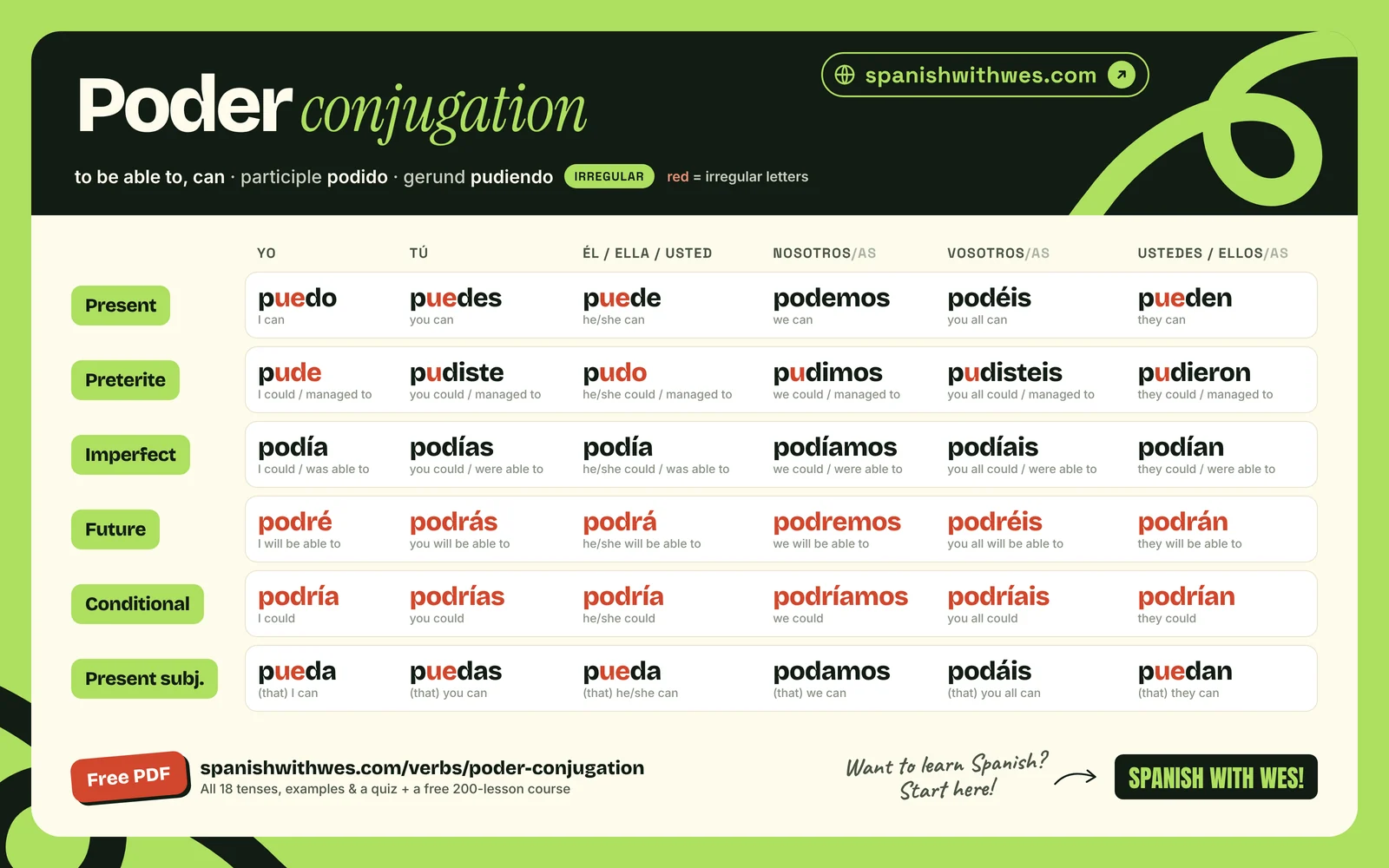
| yo | puedoI can |
|---|---|
| tú | puedesyou can |
| él/ella/usted | puedehe/she can |
| nosotros/as | podemoswe can |
| vosotros/as | podéisyou all can |
| ellos/ellas/ustedes | puedenthey can |
Stem change o → ue, except for nosotros and vosotros: podemos, podéis.
Preterite indicative
| yo | pudeI could / managed to |
|---|---|
| tú | pudisteyou could / managed to |
| él/ella/usted | pudohe/she could / managed to |
| nosotros/as | pudimoswe could / managed to |
| vosotros/as | pudisteisyou all could / managed to |
| ellos/ellas/ustedes | pudieronthey could / managed to |
Imperfect indicative
| yo | podíaI could / was able to |
|---|---|
| tú | podíasyou could / were able to |
| él/ella/usted | podíahe/she could / was able to |
| nosotros/as | podíamoswe could / were able to |
| vosotros/as | podíaisyou all could / were able to |
| ellos/ellas/ustedes | podíanthey could / were able to |
Present continuous indicative
| yo | estoy pudiendoI am being able to |
|---|---|
| tú | estás pudiendoyou are being able to |
| él/ella/usted | está pudiendohe/she is being able to |
| nosotros/as | estamos pudiendowe are being able to |
| vosotros/as | estáis pudiendoyou all are being able to |
| ellos/ellas/ustedes | están pudiendothey are being able to |
estar + gerund
Practically never used.
Informal future indicative
| yo | voy a poderI am going to be able to |
|---|---|
| tú | vas a poderyou are going to be able to |
| él/ella/usted | va a poderhe/she is going to be able to |
| nosotros/as | vamos a poderwe are going to be able to |
| vosotros/as | vais a poderyou all are going to be able to |
| ellos/ellas/ustedes | van a poderthey are going to be able to |
ir a + infinitive
Future indicative
| yo | podréI will be able to |
|---|---|
| tú | podrásyou will be able to |
| él/ella/usted | podráhe/she will be able to |
| nosotros/as | podremoswe will be able to |
| vosotros/as | podréisyou all will be able to |
| ellos/ellas/ustedes | podránthey will be able to |
Conditional indicative
| yo | podríaI could |
|---|---|
| tú | podríasyou could |
| él/ella/usted | podríahe/she could |
| nosotros/as | podríamoswe could |
| vosotros/as | podríaisyou all could |
| ellos/ellas/ustedes | podríanthey could |
¿Podrías…? is the polite way to ask for something: "could you…?"
Present perfect indicative
| yo | he podidoI have been able to |
|---|---|
| tú | has podidoyou have been able to |
| él/ella/usted | ha podidohe/she has been able to |
| nosotros/as | hemos podidowe have been able to |
| vosotros/as | habéis podidoyou all have been able to |
| ellos/ellas/ustedes | han podidothey have been able to |
haber (present) + past participle
Past perfect indicative
| yo | había podidoI had been able to |
|---|---|
| tú | habías podidoyou had been able to |
| él/ella/usted | había podidohe/she had been able to |
| nosotros/as | habíamos podidowe had been able to |
| vosotros/as | habíais podidoyou all had been able to |
| ellos/ellas/ustedes | habían podidothey had been able to |
haber (imperfect) + past participle
Future perfect indicative
| yo | habré podidoI will have been able to |
|---|---|
| tú | habrás podidoyou will have been able to |
| él/ella/usted | habrá podidohe/she will have been able to |
| nosotros/as | habremos podidowe will have been able to |
| vosotros/as | habréis podidoyou all will have been able to |
| ellos/ellas/ustedes | habrán podidothey will have been able to |
haber (future) + past participle
Conditional perfect indicative
| yo | habría podidoI would have been able to |
|---|---|
| tú | habrías podidoyou would have been able to |
| él/ella/usted | habría podidohe/she would have been able to |
| nosotros/as | habríamos podidowe would have been able to |
| vosotros/as | habríais podidoyou all would have been able to |
| ellos/ellas/ustedes | habrían podidothey would have been able to |
haber (conditional) + past participle
Subjunctive tenses of poder
Wishes, doubts, emotions and "if" sentences.
Present subjunctive
| yo | pueda(that) I can |
|---|---|
| tú | puedas(that) you can |
| él/ella/usted | pueda(that) he/she can |
| nosotros/as | podamos(that) we can |
| vosotros/as | podáis(that) you all can |
| ellos/ellas/ustedes | puedan(that) they can |
Imperfect subjunctive
| yo | pudiera / pudiese(if) I could |
|---|---|
| tú | pudieras / pudieses(if) you could |
| él/ella/usted | pudiera / pudiese(if) he/she could |
| nosotros/as | pudiéramos / pudiésemos(if) we could |
| vosotros/as | pudierais / pudieseis(if) you all could |
| ellos/ellas/ustedes | pudieran / pudiesen(if) they could |
Future subjunctive
| yo | pudiere(if) I can |
|---|---|
| tú | pudieres(if) you can |
| él/ella/usted | pudiere(if) he/she can |
| nosotros/as | pudiéremos(if) we can |
| vosotros/as | pudiereis(if) you all can |
| ellos/ellas/ustedes | pudieren(if) they can |
rarely used: legal & formal texts
Present perfect subjunctive
| yo | haya podido(that) I have been able to |
|---|---|
| tú | hayas podido(that) you have been able to |
| él/ella/usted | haya podido(that) he/she has been able to |
| nosotros/as | hayamos podido(that) we have been able to |
| vosotros/as | hayáis podido(that) you all have been able to |
| ellos/ellas/ustedes | hayan podido(that) they have been able to |
haber (present subj.) + past participle
Past perfect subjunctive
| yo | hubiera podido(if) I had been able to |
|---|---|
| tú | hubieras podido(if) you had been able to |
| él/ella/usted | hubiera podido(if) he/she had been able to |
| nosotros/as | hubiéramos podido(if) we had been able to |
| vosotros/as | hubierais podido(if) you all had been able to |
| ellos/ellas/ustedes | hubieran podido(if) they had been able to |
haber (imperfect subj.) + past participle
Future perfect subjunctive
| yo | hubiere podido(if) I will have been able to |
|---|---|
| tú | hubieres podido(if) you will have been able to |
| él/ella/usted | hubiere podido(if) he/she will have been able to |
| nosotros/as | hubiéremos podido(if) we will have been able to |
| vosotros/as | hubiereis podido(if) you all will have been able to |
| ellos/ellas/ustedes | hubieren podido(if) they will have been able to |
rarely used: legal & formal texts
Imperative tenses of poder
Commands and instructions.
Affirmative imperative
| tú | puedebe able to! |
|---|---|
| usted | puedabe able to! (formal) |
| nosotros/as | podamoslet's be able to! |
| vosotros/as | podedbe able to! (you all) |
| ustedes | puedanbe able to! (you all, formal) |
Practically never used: poder has no real command form.
Negative imperative
| tú | no puedasdon't be able to! |
|---|---|
| usted | no puedadon't be able to! (formal) |
| nosotros/as | no podamoslet's not be able to! |
| vosotros/as | no podáisdon't be able to! (you all) |
| ustedes | no puedandon't be able to! (you all, formal) |
Practically never used.
Practice poder
Two quick exercises. No sign-up, no app: just you and poder.
How to use poder
Puedo nadar muy bien.
I can swim very well.
¿Puedo pasar?
Can I come in?
¿Me puedes ayudar?
Can you help me?
Puede que llueva mañana.
It may rain tomorrow.
¿Podría hablar con el gerente?
Could I speak to the manager?
Example sentences with poder
- ¿Puedes repetir, por favor?Can you repeat, please?
- No puedo ir a la fiesta.I can't go to the party.
- Al final pudimos entrar.In the end we managed to get in.
- De pequeño no podía dormir solo.As a kid I couldn't sleep alone.
- Mañana podré ayudarte.Tomorrow I'll be able to help you.
- ¿Podrías hablar más despacio?Could you speak more slowly?
- Espero que puedas venir.I hope you can come.
- Si pudiera, viviría en la playa.If I could, I would live at the beach.
Verbs like poder
Like poder (puedo), these verbs change o → ue in the present. Saber also has a u in its preterite: supe, like pude.
Frequently asked questions about poder
Is poder regular or irregular?
Poder is irregular: a stem change in the present (puedo), an irregular preterite (pude), a short future (podré) and the gerund pudiendo. The imperfect (podía) and the participle (podido) are regular.
How do you conjugate poder in the present tense?
puedo, puedes, puede, podemos, podéis, pueden.
How do you conjugate poder in the preterite?
pude, pudiste, pudo, pudimos, pudisteis, pudieron.
Is it "pude" or "podía"?
Pude (preterite) means you managed to do it once: pude terminar (I managed to finish). Podía (imperfect) describes a general ability in the past: podía correr mucho (I could run a lot).
What is the difference between "puedes" and "podrías"?
Both ask "can you?". ¿Podrías…? (conditional) is softer and more polite, like "could you…?" in English.
What is the past participle of poder?
The past participle is podido (he podido, I have been able to) and the gerund is pudiendo.
Free cheat sheet
All 18 tenses of poder, on one page.
Print it, stick it on your fridge, or keep it on your phone. Fill in your name and email and I'll send it straight to your inbox.
📩 Check your inbox! The poder cheat sheet is on its way.
Paid courses
Ready to actually speak?
Knowing the conjugations is step one. My paid courses take you from tables to real conversations: structured, step by step, with practice built in.
- Conversational courseStop freezing in real conversations
- Verb tenses courseEvery tense, finally clear

Hola, soy Wes!
Your Spanish teacher
A Dutchie who learned Spanish from scratch. I make the lessons I wish I'd had: clear, practical and free.
My story →Support Spanish with Wes!
Did this page help you?
All my lessons, verb charts and cheat sheets are free, and I want to keep it that way. If you'd like to help me make more, you can support me here. Think of it as buying me a café con leche ☕
More Spanish verbs
Verb search
Find any Spanish verb.
Type a verb, an English word or a conjugated form like fui or hubo.