A partir de
A partir de means "starting from": A partir del lunes trabajo desde casa (From Monday on I'm working from home). You'll see it everywhere in signs and announcements. And in the kitchen, partir is to cut: ¿Partes el pan? (Will you cut the bread?).
Indicative tenses of partir
Facts and things that happen: the tenses you'll use most.
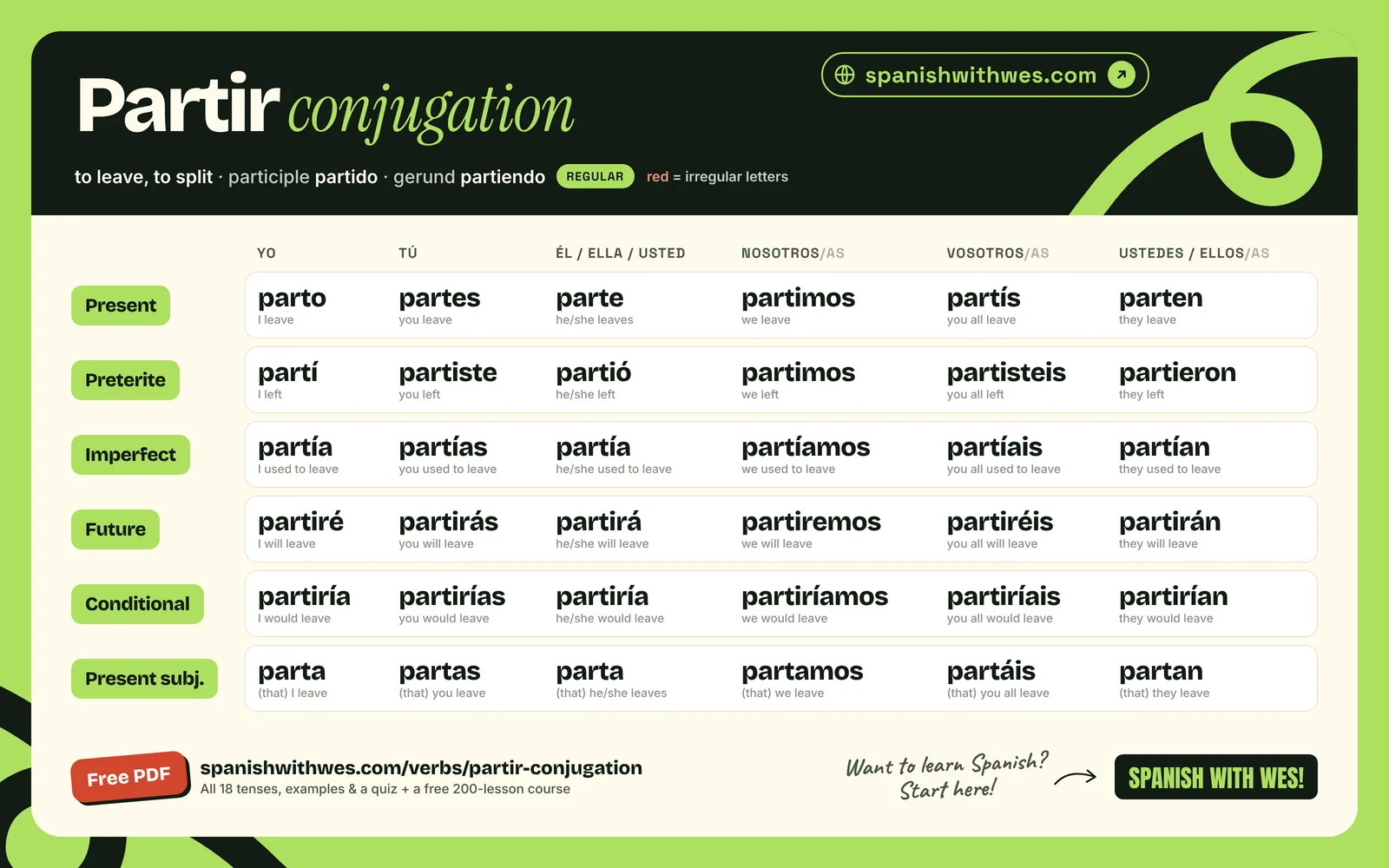
Present indicative
| yo | partoI leave |
|---|---|
| tú | partesyou leave |
| él/ella/usted | partehe/she leaves |
| nosotros/as | partimoswe leave |
| vosotros/as | partísyou all leave |
| ellos/ellas/ustedes | partenthey leave |
Fully regular -ir verb. Note partimos (we leave / we left) vs. parten (they leave).
Preterite indicative
| yo | partíI left |
|---|---|
| tú | partisteyou left |
| él/ella/usted | partióhe/she left |
| nosotros/as | partimoswe left |
| vosotros/as | partisteisyou all left |
| ellos/ellas/ustedes | partieronthey left |
Imperfect indicative
| yo | partíaI used to leave |
|---|---|
| tú | partíasyou used to leave |
| él/ella/usted | partíahe/she used to leave |
| nosotros/as | partíamoswe used to leave |
| vosotros/as | partíaisyou all used to leave |
| ellos/ellas/ustedes | partíanthey used to leave |
Present continuous indicative
| yo | estoy partiendoI am leaving |
|---|---|
| tú | estás partiendoyou are leaving |
| él/ella/usted | está partiendohe/she is leaving |
| nosotros/as | estamos partiendowe are leaving |
| vosotros/as | estáis partiendoyou all are leaving |
| ellos/ellas/ustedes | están partiendothey are leaving |
estar + gerund
Informal future indicative
| yo | voy a partirI am going to leave |
|---|---|
| tú | vas a partiryou are going to leave |
| él/ella/usted | va a partirhe/she is going to leave |
| nosotros/as | vamos a partirwe are going to leave |
| vosotros/as | vais a partiryou all are going to leave |
| ellos/ellas/ustedes | van a partirthey are going to leave |
ir a + infinitive
Future indicative
| yo | partiréI will leave |
|---|---|
| tú | partirásyou will leave |
| él/ella/usted | partiráhe/she will leave |
| nosotros/as | partiremoswe will leave |
| vosotros/as | partiréisyou all will leave |
| ellos/ellas/ustedes | partiránthey will leave |
Conditional indicative
| yo | partiríaI would leave |
|---|---|
| tú | partiríasyou would leave |
| él/ella/usted | partiríahe/she would leave |
| nosotros/as | partiríamoswe would leave |
| vosotros/as | partiríaisyou all would leave |
| ellos/ellas/ustedes | partiríanthey would leave |
Present perfect indicative
| yo | he partidoI have left |
|---|---|
| tú | has partidoyou have left |
| él/ella/usted | ha partidohe/she has left |
| nosotros/as | hemos partidowe have left |
| vosotros/as | habéis partidoyou all have left |
| ellos/ellas/ustedes | han partidothey have left |
haber (present) + past participle
Past perfect indicative
| yo | había partidoI had left |
|---|---|
| tú | habías partidoyou had left |
| él/ella/usted | había partidohe/she had left |
| nosotros/as | habíamos partidowe had left |
| vosotros/as | habíais partidoyou all had left |
| ellos/ellas/ustedes | habían partidothey had left |
haber (imperfect) + past participle
Future perfect indicative
| yo | habré partidoI will have left |
|---|---|
| tú | habrás partidoyou will have left |
| él/ella/usted | habrá partidohe/she will have left |
| nosotros/as | habremos partidowe will have left |
| vosotros/as | habréis partidoyou all will have left |
| ellos/ellas/ustedes | habrán partidothey will have left |
haber (future) + past participle
Conditional perfect indicative
| yo | habría partidoI would have left |
|---|---|
| tú | habrías partidoyou would have left |
| él/ella/usted | habría partidohe/she would have left |
| nosotros/as | habríamos partidowe would have left |
| vosotros/as | habríais partidoyou all would have left |
| ellos/ellas/ustedes | habrían partidothey would have left |
haber (conditional) + past participle
Subjunctive tenses of partir
Wishes, doubts, emotions and "if" sentences.
Present subjunctive
| yo | parta(that) I leave |
|---|---|
| tú | partas(that) you leave |
| él/ella/usted | parta(that) he/she leaves |
| nosotros/as | partamos(that) we leave |
| vosotros/as | partáis(that) you all leave |
| ellos/ellas/ustedes | partan(that) they leave |
Imperfect subjunctive
| yo | partiera(if) I left |
|---|---|
| tú | partieras(if) you left |
| él/ella/usted | partiera(if) he/she left |
| nosotros/as | partiéramos(if) we left |
| vosotros/as | partierais(if) you all left |
| ellos/ellas/ustedes | partieran(if) they left |
Future subjunctive
| yo | partiere(if) I leave |
|---|---|
| tú | partieres(if) you leave |
| él/ella/usted | partiere(if) he/she leaves |
| nosotros/as | partiéremos(if) we leave |
| vosotros/as | partiereis(if) you all leave |
| ellos/ellas/ustedes | partieren(if) they leave |
rarely used: legal & formal texts
Present perfect subjunctive
| yo | haya partido(that) I have left |
|---|---|
| tú | hayas partido(that) you have left |
| él/ella/usted | haya partido(that) he/she has left |
| nosotros/as | hayamos partido(that) we have left |
| vosotros/as | hayáis partido(that) you all have left |
| ellos/ellas/ustedes | hayan partido(that) they have left |
haber (present subj.) + past participle
Past perfect subjunctive
| yo | hubiera partido(if) I had left |
|---|---|
| tú | hubieras partido(if) you had left |
| él/ella/usted | hubiera partido(if) he/she had left |
| nosotros/as | hubiéramos partido(if) we had left |
| vosotros/as | hubierais partido(if) you all had left |
| ellos/ellas/ustedes | hubieran partido(if) they had left |
haber (imperfect subj.) + past participle
Future perfect subjunctive
| yo | hubiere partido(if) I will have left |
|---|---|
| tú | hubieres partido(if) you will have left |
| él/ella/usted | hubiere partido(if) he/she will have left |
| nosotros/as | hubiéremos partido(if) we will have left |
| vosotros/as | hubiereis partido(if) you all will have left |
| ellos/ellas/ustedes | hubieren partido(if) they will have left |
rarely used: legal & formal texts
Imperative tenses of partir
Commands and instructions.
Affirmative imperative
| tú | parteleave! |
|---|---|
| usted | partaleave! (formal) |
| nosotros/as | partamoslet's leave! |
| vosotros/as | partidleave! (you all) |
| ustedes | partanleave! (you all, formal) |
Negative imperative
| tú | no partasdon't leave! |
|---|---|
| usted | no partadon't leave! (formal) |
| nosotros/as | no partamoslet's not leave! |
| vosotros/as | no partáisdon't leave! (you all) |
| ustedes | no partandon't leave! (you all, formal) |
Practice partir
Two quick exercises. No sign-up, no app: just you and partir.
How to use partir
El tren parte a las ocho.
The train leaves at eight.
¿Partes la tarta en ocho trozos?
Will you cut the cake into eight pieces?
A partir de hoy, no fumo.
From today on, I don't smoke.
Se partió una pierna esquiando.
He broke a leg skiing.
Nos partimos de risa con él.
We cracked up laughing with him.
Example sentences with partir
- ¿A qué hora parte el autobús?What time does the bus leave?
- Partimos mañana temprano.We leave early tomorrow.
- Partió hacia América en 1920.He left for America in 1920.
- Mi abuela partía el pan con las manos.My grandmother used to break the bread with her hands.
- Partiremos al amanecer.We'll set off at dawn.
- Parte el limón por la mitad.Cut the lemon in half.
- Me partí de risa.I cracked up laughing.
- He partido la manzana en dos.I've cut the apple in two.
Verbs like partir
Partir follows the regular -ir pattern, like vivir. Compartir (to share) and repartir (to hand out) conjugate the same way.
Frequently asked questions about partir
Is partir regular or irregular?
Partir is completely regular in every tense.
How do you conjugate partir in the present tense?
parto, partes, parte, partimos, partís, parten.
How do you conjugate partir in the preterite?
partí, partiste, partió, partimos, partisteis, partieron.
What does "a partir de" mean?
"Starting from" or "from … on": a partir de mañana = from tomorrow on.
What is the difference between partir and salir?
Both mean "to leave". Salir is everyday; partir sounds more formal (timetables, stories).
What is the past participle of partir?
The past participle is partido — also the word for a match or a political party!
Free cheat sheet
All 18 tenses of partir, on one page.
Print it, stick it on your fridge, or keep it on your phone. Fill in your name and email and I'll send it straight to your inbox.
📩 Check your inbox! The partir cheat sheet is on its way.
Paid courses
Ready to actually speak?
Knowing the conjugations is step one. My paid courses take you from tables to real conversations: structured, step by step, with practice built in.
- Conversational courseStop freezing in real conversations
- Verb tenses courseEvery tense, finally clear

Hola, soy Wes!
Your Spanish teacher
A Dutchie who learned Spanish from scratch. I make the lessons I wish I'd had: clear, practical and free.
My story →Support Spanish with Wes!
Did this page help you?
All my lessons, verb charts and cheat sheets are free, and I want to keep it that way. If you'd like to help me make more, you can support me here. Think of it as buying me a café con leche ☕
More Spanish verbs
Verb search
Find any Spanish verb.
Type a verb, an English word or a conjugated form like fui or hubo.