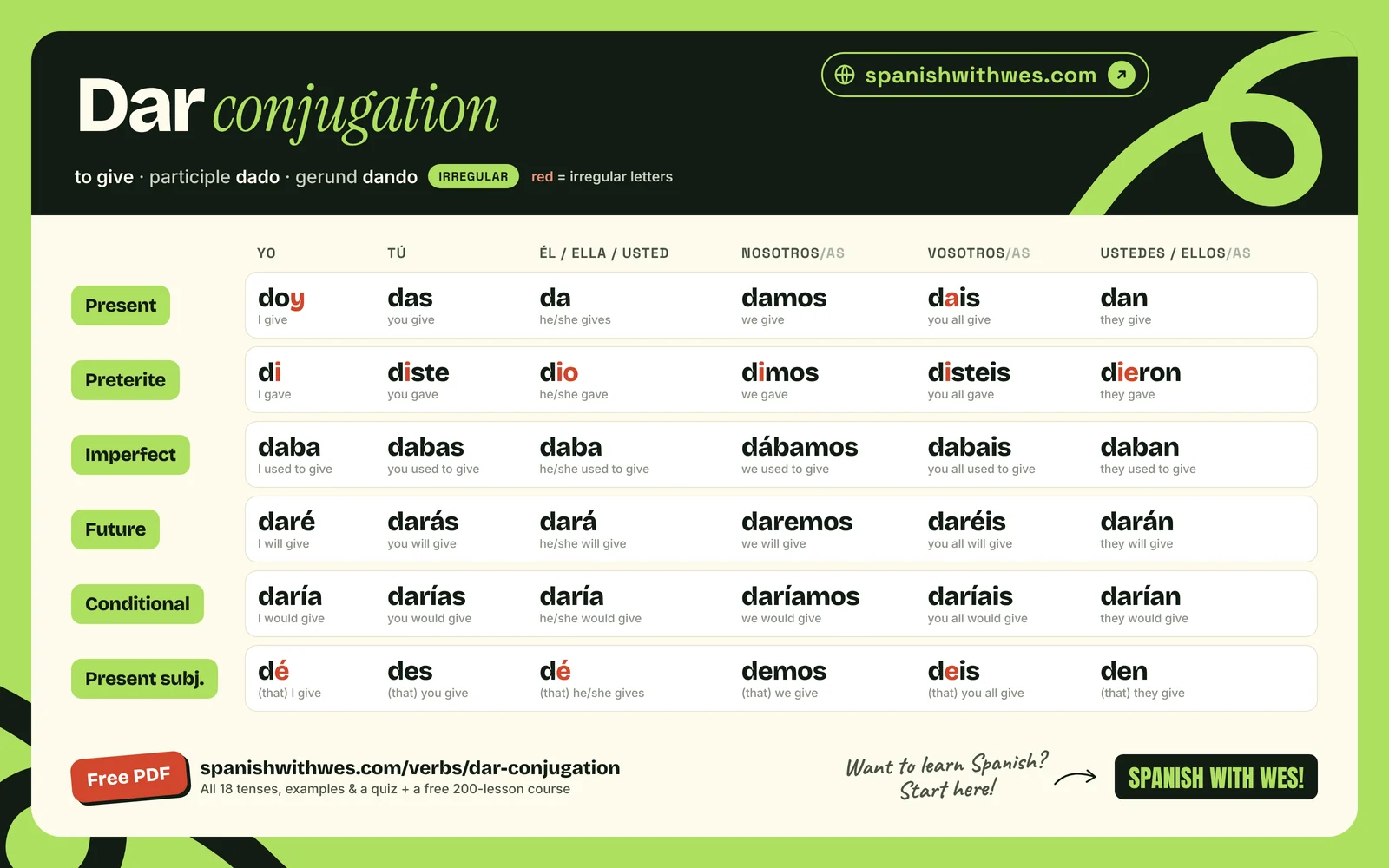
Expressions with dar
Dar is in tons of everyday expressions: me da igual (I don't mind), dar un paseo (go for a walk), dar las gracias (say thanks), darse cuenta (to realize), me da miedo (it scares me) and dar una vuelta (go for a stroll).
Indicative tenses of dar
Facts and things that happen: the tenses you'll use most.
Present indicative
| yo | doyI give |
|---|---|
| tú | dasyou give |
| él/ella/usted | dahe/she gives |
| nosotros/as | damoswe give |
| vosotros/as | daisyou all give |
| ellos/ellas/ustedes | danthey give |
Only the yo form is irregular: doy (like estoy, voy, soy).
Preterite indicative
| yo | diI gave |
|---|---|
| tú | disteyou gave |
| él/ella/usted | diohe/she gave |
| nosotros/as | dimoswe gave |
| vosotros/as | disteisyou all gave |
| ellos/ellas/ustedes | dieronthey gave |
Dar takes the -er/-ir endings in the preterite: di, diste, dio.
Imperfect indicative
| yo | dabaI used to give |
|---|---|
| tú | dabasyou used to give |
| él/ella/usted | dabahe/she used to give |
| nosotros/as | dábamoswe used to give |
| vosotros/as | dabaisyou all used to give |
| ellos/ellas/ustedes | dabanthey used to give |
Present continuous indicative
| yo | estoy dandoI am giving |
|---|---|
| tú | estás dandoyou are giving |
| él/ella/usted | está dandohe/she is giving |
| nosotros/as | estamos dandowe are giving |
| vosotros/as | estáis dandoyou all are giving |
| ellos/ellas/ustedes | están dandothey are giving |
estar + gerund
Informal future indicative
| yo | voy a darI am going to give |
|---|---|
| tú | vas a daryou are going to give |
| él/ella/usted | va a darhe/she is going to give |
| nosotros/as | vamos a darwe are going to give |
| vosotros/as | vais a daryou all are going to give |
| ellos/ellas/ustedes | van a darthey are going to give |
ir a + infinitive
Future indicative
| yo | daréI will give |
|---|---|
| tú | darásyou will give |
| él/ella/usted | daráhe/she will give |
| nosotros/as | daremoswe will give |
| vosotros/as | daréisyou all will give |
| ellos/ellas/ustedes | daránthey will give |
Conditional indicative
| yo | daríaI would give |
|---|---|
| tú | daríasyou would give |
| él/ella/usted | daríahe/she would give |
| nosotros/as | daríamoswe would give |
| vosotros/as | daríaisyou all would give |
| ellos/ellas/ustedes | daríanthey would give |
Present perfect indicative
| yo | he dadoI have given |
|---|---|
| tú | has dadoyou have given |
| él/ella/usted | ha dadohe/she has given |
| nosotros/as | hemos dadowe have given |
| vosotros/as | habéis dadoyou all have given |
| ellos/ellas/ustedes | han dadothey have given |
haber (present) + past participle
Past perfect indicative
| yo | había dadoI had given |
|---|---|
| tú | habías dadoyou had given |
| él/ella/usted | había dadohe/she had given |
| nosotros/as | habíamos dadowe had given |
| vosotros/as | habíais dadoyou all had given |
| ellos/ellas/ustedes | habían dadothey had given |
haber (imperfect) + past participle
Future perfect indicative
| yo | habré dadoI will have given |
|---|---|
| tú | habrás dadoyou will have given |
| él/ella/usted | habrá dadohe/she will have given |
| nosotros/as | habremos dadowe will have given |
| vosotros/as | habréis dadoyou all will have given |
| ellos/ellas/ustedes | habrán dadothey will have given |
haber (future) + past participle
Conditional perfect indicative
| yo | habría dadoI would have given |
|---|---|
| tú | habrías dadoyou would have given |
| él/ella/usted | habría dadohe/she would have given |
| nosotros/as | habríamos dadowe would have given |
| vosotros/as | habríais dadoyou all would have given |
| ellos/ellas/ustedes | habrían dadothey would have given |
haber (conditional) + past participle
Subjunctive tenses of dar
Wishes, doubts, emotions and "if" sentences.
Present subjunctive
| yo | dé(that) I give |
|---|---|
| tú | des(that) you give |
| él/ella/usted | dé(that) he/she gives |
| nosotros/as | demos(that) we give |
| vosotros/as | deis(that) you all give |
| ellos/ellas/ustedes | den(that) they give |
Dé has an accent to tell it apart from de (of, from).
Imperfect subjunctive
| yo | diera / diese(if) I gave |
|---|---|
| tú | dieras / dieses(if) you gave |
| él/ella/usted | diera / diese(if) he/she gave |
| nosotros/as | diéramos / diésemos(if) we gave |
| vosotros/as | dierais / dieseis(if) you all gave |
| ellos/ellas/ustedes | dieran / diesen(if) they gave |
Future subjunctive
| yo | diere(if) I give |
|---|---|
| tú | dieres(if) you give |
| él/ella/usted | diere(if) he/she gives |
| nosotros/as | diéremos(if) we give |
| vosotros/as | diereis(if) you all give |
| ellos/ellas/ustedes | dieren(if) they give |
rarely used: legal & formal texts
Present perfect subjunctive
| yo | haya dado(that) I have given |
|---|---|
| tú | hayas dado(that) you have given |
| él/ella/usted | haya dado(that) he/she has given |
| nosotros/as | hayamos dado(that) we have given |
| vosotros/as | hayáis dado(that) you all have given |
| ellos/ellas/ustedes | hayan dado(that) they have given |
haber (present subj.) + past participle
Past perfect subjunctive
| yo | hubiera dado(if) I had given |
|---|---|
| tú | hubieras dado(if) you had given |
| él/ella/usted | hubiera dado(if) he/she had given |
| nosotros/as | hubiéramos dado(if) we had given |
| vosotros/as | hubierais dado(if) you all had given |
| ellos/ellas/ustedes | hubieran dado(if) they had given |
haber (imperfect subj.) + past participle
Future perfect subjunctive
| yo | hubiere dado(if) I will have given |
|---|---|
| tú | hubieres dado(if) you will have given |
| él/ella/usted | hubiere dado(if) he/she will have given |
| nosotros/as | hubiéremos dado(if) we will have given |
| vosotros/as | hubiereis dado(if) you all will have given |
| ellos/ellas/ustedes | hubieren dado(if) they will have given |
rarely used: legal & formal texts
Imperative tenses of dar
Commands and instructions.
Affirmative imperative
| tú | dagive! |
|---|---|
| usted | dégive! (formal) |
| nosotros/as | demoslet's give! |
| vosotros/as | dadgive! (you all) |
| ustedes | dengive! (you all, formal) |
Negative imperative
| tú | no desdon't give! |
|---|---|
| usted | no dédon't give! (formal) |
| nosotros/as | no demoslet's not give! |
| vosotros/as | no deisdon't give! (you all) |
| ustedes | no dendon't give! (you all, formal) |
Practice dar
Two quick exercises. No sign-up, no app: just you and dar.
How to use dar
Te doy mi número.
I'll give you my number.
Me da igual.
I don't mind.
No me di cuenta.
I didn't realize.
Me da miedo volar.
Flying scares me.
Vamos a dar un paseo.
Let's go for a walk.
Example sentences with dar
- ¿Me das un vaso de agua?Can you give me a glass of water?
- Te doy las gracias.I thank you.
- Me dio un regalo precioso.She gave me a beautiful present.
- Mi abuelo siempre nos daba caramelos.My grandpa always used to give us candy.
- Te daré una respuesta mañana.I'll give you an answer tomorrow.
- ¿Me darías tu opinión?Would you give me your opinion?
- No me des más trabajo.Don't give me more work.
- Dame un minuto.Give me a minute.
Verbs like dar
Like doy, estar, ir and ser end in -oy in the yo form. Ver has the same kind of short preterite: vi, vio like di, dio.
Frequently asked questions about dar
Is dar regular or irregular?
Dar is irregular in the present yo form (doy), the preterite (di, dio) and the subjunctive (dé). The imperfect (daba), future (daré), conditional (daría) and participle (dado) are regular.
How do you conjugate dar in the present tense?
doy, das, da, damos, dais, dan.
How do you conjugate dar in the preterite?
di, diste, dio, dimos, disteis, dieron.
Why does "dé" have an accent?
To tell it apart from de (of, from): quiero que me dé el libro de Juan.
What does "me da igual" mean?
"I don't mind" or "it's all the same to me". Very common in everyday Spanish.
What is the past participle of dar?
The past participle is dado (he dado, I have given) and the gerund is dando.
Free cheat sheet
All 18 tenses of dar, on one page.
Print it, stick it on your fridge, or keep it on your phone. Fill in your name and email and I'll send it straight to your inbox.
📩 Check your inbox! The dar cheat sheet is on its way.
Paid courses
Ready to actually speak?
Knowing the conjugations is step one. My paid courses take you from tables to real conversations: structured, step by step, with practice built in.
- Conversational courseStop freezing in real conversations
- Verb tenses courseEvery tense, finally clear

Hola, soy Wes!
Your Spanish teacher
A Dutchie who learned Spanish from scratch. I make the lessons I wish I'd had: clear, practical and free.
My story →Support Spanish with Wes!
Did this page help you?
All my lessons, verb charts and cheat sheets are free, and I want to keep it that way. If you'd like to help me make more, you can support me here. Think of it as buying me a café con leche ☕
More Spanish verbs
Verb search
Find any Spanish verb.
Type a verb, an English word or a conjugated form like fui or hubo.