Me gusta vs. me gustan
Look at what you like, not who likes it: Me gusta + singular noun or verb (me gusta bailar), me gustan + plural (me gustan las películas de miedo). Add a mí / a ti / a Ana for emphasis or clarity: A Ana le gusta el té. The other forms are for people: me gustas = I like you (romantically!).
Indicative tenses of gustar
Facts and things that happen: the tenses you'll use most.
Present indicative
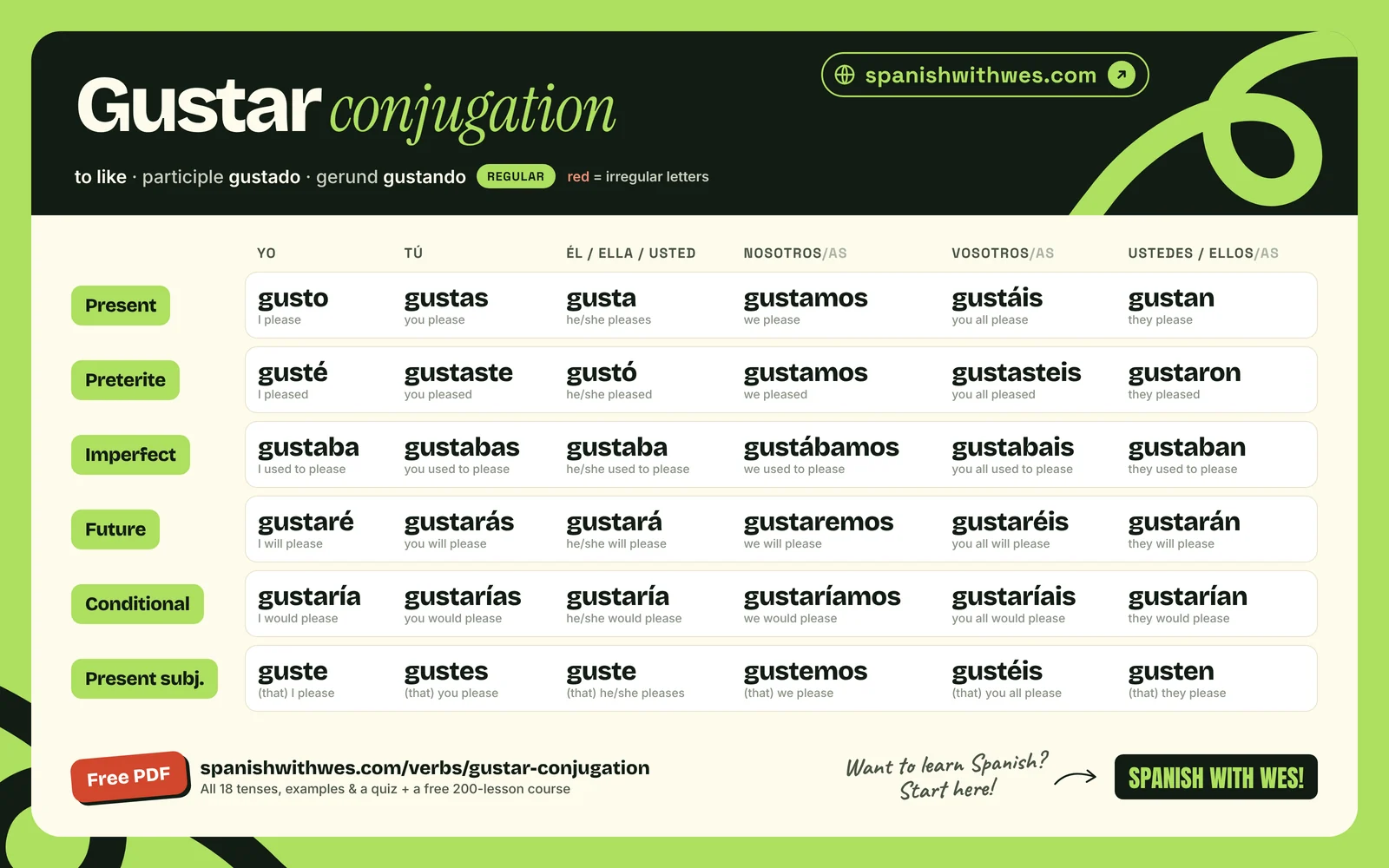
| yo | gustoI please |
|---|---|
| tú | gustasyou please |
| él/ella/usted | gustahe/she pleases |
| nosotros/as | gustamoswe please |
| vosotros/as | gustáisyou all please |
| ellos/ellas/ustedes | gustanthey please |
In practice you mostly use gusta (one thing) and gustan (several things): me gusta el café, me gustan los perros.
Preterite indicative
| yo | gustéI pleased |
|---|---|
| tú | gustasteyou pleased |
| él/ella/usted | gustóhe/she pleased |
| nosotros/as | gustamoswe pleased |
| vosotros/as | gustasteisyou all pleased |
| ellos/ellas/ustedes | gustaronthey pleased |
Imperfect indicative
| yo | gustabaI used to please |
|---|---|
| tú | gustabasyou used to please |
| él/ella/usted | gustabahe/she used to please |
| nosotros/as | gustábamoswe used to please |
| vosotros/as | gustabaisyou all used to please |
| ellos/ellas/ustedes | gustabanthey used to please |
Present continuous indicative
| yo | estoy gustandoI am pleasing |
|---|---|
| tú | estás gustandoyou are pleasing |
| él/ella/usted | está gustandohe/she is pleasing |
| nosotros/as | estamos gustandowe are pleasing |
| vosotros/as | estáis gustandoyou all are pleasing |
| ellos/ellas/ustedes | están gustandothey are pleasing |
estar + gerund
Informal future indicative
| yo | voy a gustarI am going to please |
|---|---|
| tú | vas a gustaryou are going to please |
| él/ella/usted | va a gustarhe/she is going to please |
| nosotros/as | vamos a gustarwe are going to please |
| vosotros/as | vais a gustaryou all are going to please |
| ellos/ellas/ustedes | van a gustarthey are going to please |
ir a + infinitive
Future indicative
| yo | gustaréI will please |
|---|---|
| tú | gustarásyou will please |
| él/ella/usted | gustaráhe/she will please |
| nosotros/as | gustaremoswe will please |
| vosotros/as | gustaréisyou all will please |
| ellos/ellas/ustedes | gustaránthey will please |
Conditional indicative
| yo | gustaríaI would please |
|---|---|
| tú | gustaríasyou would please |
| él/ella/usted | gustaríahe/she would please |
| nosotros/as | gustaríamoswe would please |
| vosotros/as | gustaríaisyou all would please |
| ellos/ellas/ustedes | gustaríanthey would please |
Present perfect indicative
| yo | he gustadoI have pleased |
|---|---|
| tú | has gustadoyou have pleased |
| él/ella/usted | ha gustadohe/she has pleased |
| nosotros/as | hemos gustadowe have pleased |
| vosotros/as | habéis gustadoyou all have pleased |
| ellos/ellas/ustedes | han gustadothey have pleased |
haber (present) + past participle
Past perfect indicative
| yo | había gustadoI had pleased |
|---|---|
| tú | habías gustadoyou had pleased |
| él/ella/usted | había gustadohe/she had pleased |
| nosotros/as | habíamos gustadowe had pleased |
| vosotros/as | habíais gustadoyou all had pleased |
| ellos/ellas/ustedes | habían gustadothey had pleased |
haber (imperfect) + past participle
Future perfect indicative
| yo | habré gustadoI will have pleased |
|---|---|
| tú | habrás gustadoyou will have pleased |
| él/ella/usted | habrá gustadohe/she will have pleased |
| nosotros/as | habremos gustadowe will have pleased |
| vosotros/as | habréis gustadoyou all will have pleased |
| ellos/ellas/ustedes | habrán gustadothey will have pleased |
haber (future) + past participle
Conditional perfect indicative
| yo | habría gustadoI would have pleased |
|---|---|
| tú | habrías gustadoyou would have pleased |
| él/ella/usted | habría gustadohe/she would have pleased |
| nosotros/as | habríamos gustadowe would have pleased |
| vosotros/as | habríais gustadoyou all would have pleased |
| ellos/ellas/ustedes | habrían gustadothey would have pleased |
haber (conditional) + past participle
Subjunctive tenses of gustar
Wishes, doubts, emotions and "if" sentences.
Present subjunctive
| yo | guste(that) I please |
|---|---|
| tú | gustes(that) you please |
| él/ella/usted | guste(that) he/she pleases |
| nosotros/as | gustemos(that) we please |
| vosotros/as | gustéis(that) you all please |
| ellos/ellas/ustedes | gusten(that) they please |
Imperfect subjunctive
| yo | gustara(if) I pleased |
|---|---|
| tú | gustaras(if) you pleased |
| él/ella/usted | gustara(if) he/she pleased |
| nosotros/as | gustáramos(if) we pleased |
| vosotros/as | gustarais(if) you all pleased |
| ellos/ellas/ustedes | gustaran(if) they pleased |
Future subjunctive
| yo | gustare(if) I please |
|---|---|
| tú | gustares(if) you please |
| él/ella/usted | gustare(if) he/she pleases |
| nosotros/as | gustáremos(if) we please |
| vosotros/as | gustareis(if) you all please |
| ellos/ellas/ustedes | gustaren(if) they please |
rarely used: legal & formal texts
Present perfect subjunctive
| yo | haya gustado(that) I have pleased |
|---|---|
| tú | hayas gustado(that) you have pleased |
| él/ella/usted | haya gustado(that) he/she has pleased |
| nosotros/as | hayamos gustado(that) we have pleased |
| vosotros/as | hayáis gustado(that) you all have pleased |
| ellos/ellas/ustedes | hayan gustado(that) they have pleased |
haber (present subj.) + past participle
Past perfect subjunctive
| yo | hubiera gustado(if) I had pleased |
|---|---|
| tú | hubieras gustado(if) you had pleased |
| él/ella/usted | hubiera gustado(if) he/she had pleased |
| nosotros/as | hubiéramos gustado(if) we had pleased |
| vosotros/as | hubierais gustado(if) you all had pleased |
| ellos/ellas/ustedes | hubieran gustado(if) they had pleased |
haber (imperfect subj.) + past participle
Future perfect subjunctive
| yo | hubiere gustado(if) I will have pleased |
|---|---|
| tú | hubieres gustado(if) you will have pleased |
| él/ella/usted | hubiere gustado(if) he/she will have pleased |
| nosotros/as | hubiéremos gustado(if) we will have pleased |
| vosotros/as | hubiereis gustado(if) you all will have pleased |
| ellos/ellas/ustedes | hubieren gustado(if) they will have pleased |
rarely used: legal & formal texts
Imperative tenses of gustar
Commands and instructions.
Affirmative imperative
| tú | gustaplease! |
|---|---|
| usted | gusteplease! (formal) |
| nosotros/as | gustemoslet's please! |
| vosotros/as | gustadplease! (you all) |
| ustedes | gustenplease! (you all, formal) |
Negative imperative
| tú | no gustesdon't please! |
|---|---|
| usted | no gustedon't please! (formal) |
| nosotros/as | no gustemoslet's not please! |
| vosotros/as | no gustéisdon't please! (you all) |
| ustedes | no gustendon't please! (you all, formal) |
Practice gustar
Two quick exercises. No sign-up, no app: just you and gustar.
How to use gustar
Me gusta mucho el café.
I really like coffee.
Me gustan los perros.
I like dogs.
¿Te gusta bailar?
Do you like dancing?
A mi madre le gusta leer.
My mother likes reading.
Me gustas mucho.
I really like you.
Example sentences with gustar
- ¿Te gustó la película?Did you like the film?
- No nos gustaron los postres.We didn't like the desserts.
- De niño me gustaban los dinosaurios.As a kid I liked dinosaurs.
- Te va a gustar este sitio.You're going to like this place.
- Me gustaría un café, por favor.I'd like a coffee, please.
- Espero que te guste el regalo.I hope you like the present.
- ¿Os ha gustado Madrid?Did you all like Madrid?
- Les gusta mucho viajar.They really like travelling.
Verbs like gustar
Gustar works "backwards", and so do encantar (to love), interesar, molestar (to bother) and doler (to hurt): me encanta, me duele la cabeza.
Frequently asked questions about gustar
Is gustar regular or irregular?
Gustar is completely regular — it just works "backwards": the thing you like is the subject.
When do I use gusta and when gustan?
Gusta with one thing or a verb, gustan with plural things: me gusta el té, me gustan los gatos.
How do you say "I like you"?
Me gustas. Careful: it's romantic! For friends, me caes bien.
How do you say "I would like"?
Me gustaría — the polite way to ask for something.
Why do people say "a mí me gusta"?
A mí adds emphasis or contrast: "I like it (even if you don't)".
What is the past participle of gustar?
The past participle is gustado: ¿te ha gustado? (did you like it?).
Free cheat sheet
All 18 tenses of gustar, on one page.
Print it, stick it on your fridge, or keep it on your phone. Fill in your name and email and I'll send it straight to your inbox.
📩 Check your inbox! The gustar cheat sheet is on its way.
Paid courses
Ready to actually speak?
Knowing the conjugations is step one. My paid courses take you from tables to real conversations: structured, step by step, with practice built in.
- Conversational courseStop freezing in real conversations
- Verb tenses courseEvery tense, finally clear

Hola, soy Wes!
Your Spanish teacher
A Dutchie who learned Spanish from scratch. I make the lessons I wish I'd had: clear, practical and free.
My story →Support Spanish with Wes!
Did this page help you?
All my lessons, verb charts and cheat sheets are free, and I want to keep it that way. If you'd like to help me make more, you can support me here. Think of it as buying me a café con leche ☕
More Spanish verbs
Verb search
Find any Spanish verb.
Type a verb, an English word or a conjugated form like fui or hubo.