Talking about your job
¿En qué trabajas? or ¿a qué te dedicas? = what do you do? Answer with trabajo de + job (no article!): trabajo de profesor, or trabajo en + place: trabajo en un hospital. Trabajar desde casa = to work from home.
Indicative tenses of trabajar
Facts and things that happen: the tenses you'll use most.
Present indicative
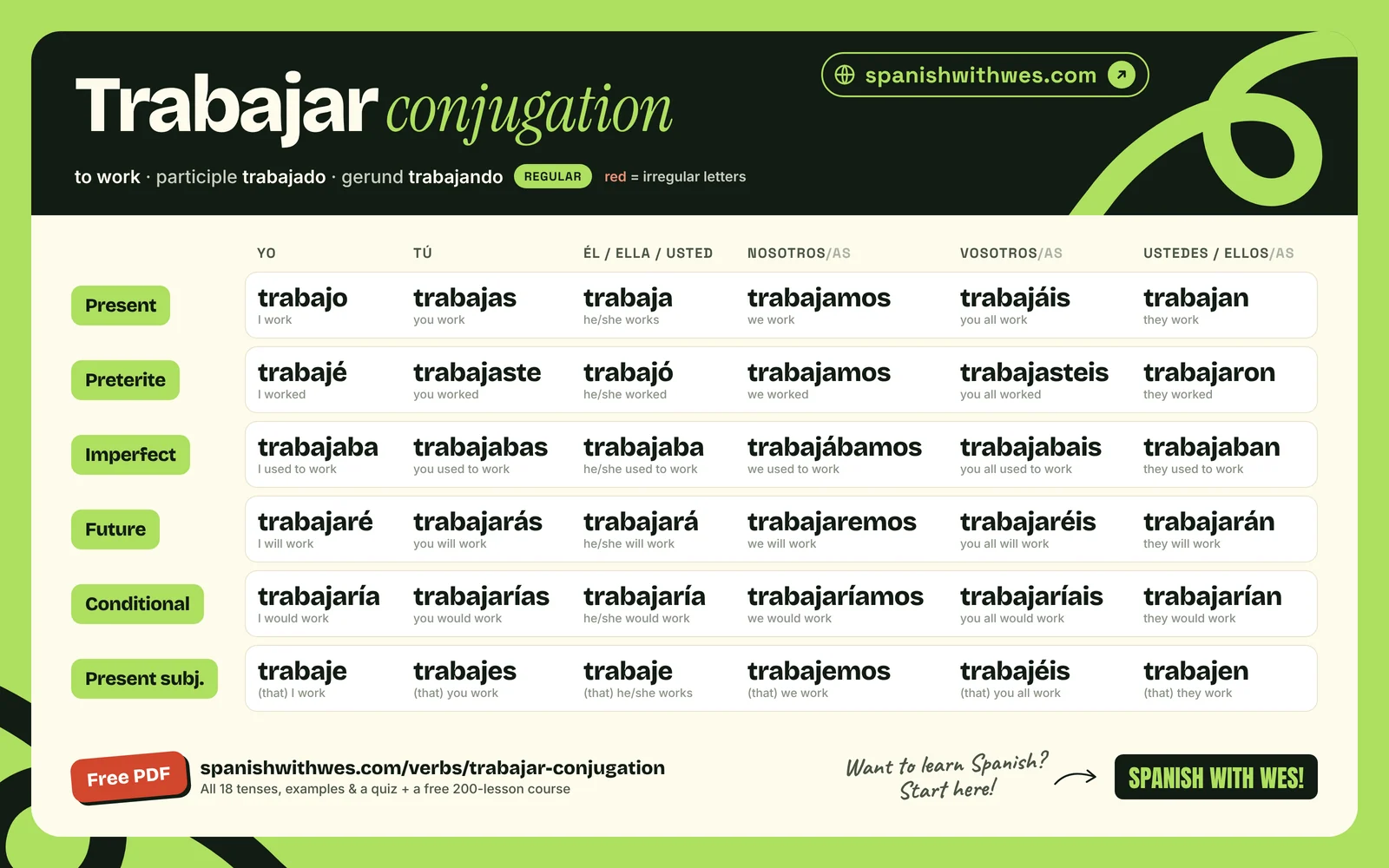
| yo | trabajoI work |
|---|---|
| tú | trabajasyou work |
| él/ella/usted | trabajahe/she works |
| nosotros/as | trabajamoswe work |
| vosotros/as | trabajáisyou all work |
| ellos/ellas/ustedes | trabajanthey work |
¿En qué trabajas? (what do you do for work?) is a classic question when you meet someone.
Preterite indicative
| yo | trabajéI worked |
|---|---|
| tú | trabajasteyou worked |
| él/ella/usted | trabajóhe/she worked |
| nosotros/as | trabajamoswe worked |
| vosotros/as | trabajasteisyou all worked |
| ellos/ellas/ustedes | trabajaronthey worked |
Imperfect indicative
| yo | trabajabaI used to work |
|---|---|
| tú | trabajabasyou used to work |
| él/ella/usted | trabajabahe/she used to work |
| nosotros/as | trabajábamoswe used to work |
| vosotros/as | trabajabaisyou all used to work |
| ellos/ellas/ustedes | trabajabanthey used to work |
Present continuous indicative
| yo | estoy trabajandoI am working |
|---|---|
| tú | estás trabajandoyou are working |
| él/ella/usted | está trabajandohe/she is working |
| nosotros/as | estamos trabajandowe are working |
| vosotros/as | estáis trabajandoyou all are working |
| ellos/ellas/ustedes | están trabajandothey are working |
estar + gerund
Informal future indicative
| yo | voy a trabajarI am going to work |
|---|---|
| tú | vas a trabajaryou are going to work |
| él/ella/usted | va a trabajarhe/she is going to work |
| nosotros/as | vamos a trabajarwe are going to work |
| vosotros/as | vais a trabajaryou all are going to work |
| ellos/ellas/ustedes | van a trabajarthey are going to work |
ir a + infinitive
Future indicative
| yo | trabajaréI will work |
|---|---|
| tú | trabajarásyou will work |
| él/ella/usted | trabajaráhe/she will work |
| nosotros/as | trabajaremoswe will work |
| vosotros/as | trabajaréisyou all will work |
| ellos/ellas/ustedes | trabajaránthey will work |
Conditional indicative
| yo | trabajaríaI would work |
|---|---|
| tú | trabajaríasyou would work |
| él/ella/usted | trabajaríahe/she would work |
| nosotros/as | trabajaríamoswe would work |
| vosotros/as | trabajaríaisyou all would work |
| ellos/ellas/ustedes | trabajaríanthey would work |
Present perfect indicative
| yo | he trabajadoI have worked |
|---|---|
| tú | has trabajadoyou have worked |
| él/ella/usted | ha trabajadohe/she has worked |
| nosotros/as | hemos trabajadowe have worked |
| vosotros/as | habéis trabajadoyou all have worked |
| ellos/ellas/ustedes | han trabajadothey have worked |
haber (present) + past participle
Past perfect indicative
| yo | había trabajadoI had worked |
|---|---|
| tú | habías trabajadoyou had worked |
| él/ella/usted | había trabajadohe/she had worked |
| nosotros/as | habíamos trabajadowe had worked |
| vosotros/as | habíais trabajadoyou all had worked |
| ellos/ellas/ustedes | habían trabajadothey had worked |
haber (imperfect) + past participle
Future perfect indicative
| yo | habré trabajadoI will have worked |
|---|---|
| tú | habrás trabajadoyou will have worked |
| él/ella/usted | habrá trabajadohe/she will have worked |
| nosotros/as | habremos trabajadowe will have worked |
| vosotros/as | habréis trabajadoyou all will have worked |
| ellos/ellas/ustedes | habrán trabajadothey will have worked |
haber (future) + past participle
Conditional perfect indicative
| yo | habría trabajadoI would have worked |
|---|---|
| tú | habrías trabajadoyou would have worked |
| él/ella/usted | habría trabajadohe/she would have worked |
| nosotros/as | habríamos trabajadowe would have worked |
| vosotros/as | habríais trabajadoyou all would have worked |
| ellos/ellas/ustedes | habrían trabajadothey would have worked |
haber (conditional) + past participle
Subjunctive tenses of trabajar
Wishes, doubts, emotions and "if" sentences.
Present subjunctive
| yo | trabaje(that) I work |
|---|---|
| tú | trabajes(that) you work |
| él/ella/usted | trabaje(that) he/she works |
| nosotros/as | trabajemos(that) we work |
| vosotros/as | trabajéis(that) you all work |
| ellos/ellas/ustedes | trabajen(that) they work |
Imperfect subjunctive
| yo | trabajara(if) I worked |
|---|---|
| tú | trabajaras(if) you worked |
| él/ella/usted | trabajara(if) he/she worked |
| nosotros/as | trabajáramos(if) we worked |
| vosotros/as | trabajarais(if) you all worked |
| ellos/ellas/ustedes | trabajaran(if) they worked |
Future subjunctive
| yo | trabajare(if) I work |
|---|---|
| tú | trabajares(if) you work |
| él/ella/usted | trabajare(if) he/she works |
| nosotros/as | trabajáremos(if) we work |
| vosotros/as | trabajareis(if) you all work |
| ellos/ellas/ustedes | trabajaren(if) they work |
rarely used: legal & formal texts
Present perfect subjunctive
| yo | haya trabajado(that) I have worked |
|---|---|
| tú | hayas trabajado(that) you have worked |
| él/ella/usted | haya trabajado(that) he/she has worked |
| nosotros/as | hayamos trabajado(that) we have worked |
| vosotros/as | hayáis trabajado(that) you all have worked |
| ellos/ellas/ustedes | hayan trabajado(that) they have worked |
haber (present subj.) + past participle
Past perfect subjunctive
| yo | hubiera trabajado(if) I had worked |
|---|---|
| tú | hubieras trabajado(if) you had worked |
| él/ella/usted | hubiera trabajado(if) he/she had worked |
| nosotros/as | hubiéramos trabajado(if) we had worked |
| vosotros/as | hubierais trabajado(if) you all had worked |
| ellos/ellas/ustedes | hubieran trabajado(if) they had worked |
haber (imperfect subj.) + past participle
Future perfect subjunctive
| yo | hubiere trabajado(if) I will have worked |
|---|---|
| tú | hubieres trabajado(if) you will have worked |
| él/ella/usted | hubiere trabajado(if) he/she will have worked |
| nosotros/as | hubiéremos trabajado(if) we will have worked |
| vosotros/as | hubiereis trabajado(if) you all will have worked |
| ellos/ellas/ustedes | hubieren trabajado(if) they will have worked |
rarely used: legal & formal texts
Imperative tenses of trabajar
Commands and instructions.
Affirmative imperative
| tú | trabajawork! |
|---|---|
| usted | trabajework! (formal) |
| nosotros/as | trabajemoslet's work! |
| vosotros/as | trabajadwork! (you all) |
| ustedes | trabajenwork! (you all, formal) |
Negative imperative
| tú | no trabajesdon't work! |
|---|---|
| usted | no trabajedon't work! (formal) |
| nosotros/as | no trabajemoslet's not work! |
| vosotros/as | no trabajéisdon't work! (you all) |
| ustedes | no trabajendon't work! (you all, formal) |
Practice trabajar
Two quick exercises. No sign-up, no app: just you and trabajar.
How to use trabajar
Trabajo de editor de vídeo.
I work as a video editor.
Trabaja en un banco.
She works at a bank.
Trabajo de nueve a cinco.
I work from nine to five.
Hoy trabajo desde casa.
I'm working from home today.
Estoy trabajando en un proyecto.
I'm working on a project.
Example sentences with trabajar
- ¿En qué trabajas?What do you do for work?
- Trabajamos juntos.We work together.
- Ayer trabajé diez horas.Yesterday I worked ten hours.
- Antes trabajaba en Barcelona.I used to work in Barcelona.
- Mañana no trabajaré.Tomorrow I won't work.
- ¿Trabajarías los domingos?Would you work on Sundays?
- No trabajes tanto.Don't work so much.
- He trabajado mucho este año.I've worked a lot this year.
Verbs like trabajar
All regular -ar verbs: they follow exactly the same pattern as trabajar.
Frequently asked questions about trabajar
Is trabajar regular or irregular?
Trabajar is completely regular. It follows the normal -ar pattern in every tense.
How do you conjugate trabajar in the present tense?
trabajo, trabajas, trabaja, trabajamos, trabajáis, trabajan.
How do you say "I work as a…" in Spanish?
Trabajo de + job, without an article: trabajo de camarero. Or soy + job: soy camarero.
How do you ask "what do you do?" in Spanish?
¿En qué trabajas? or ¿a qué te dedicas?
Trabajar or funcionar?
For people, use trabajar. For machines that "work", use funcionar: el móvil no funciona.
What is the past participle of trabajar?
The past participle is trabajado and the gerund is trabajando.
Free cheat sheet
All 18 tenses of trabajar, on one page.
Print it, stick it on your fridge, or keep it on your phone. Fill in your name and email and I'll send it straight to your inbox.
📩 Check your inbox! The trabajar cheat sheet is on its way.
Paid courses
Ready to actually speak?
Knowing the conjugations is step one. My paid courses take you from tables to real conversations: structured, step by step, with practice built in.
- Conversational courseStop freezing in real conversations
- Verb tenses courseEvery tense, finally clear

Hola, soy Wes!
Your Spanish teacher
A Dutchie who learned Spanish from scratch. I make the lessons I wish I'd had: clear, practical and free.
My story →Support Spanish with Wes!
Did this page help you?
All my lessons, verb charts and cheat sheets are free, and I want to keep it that way. If you'd like to help me make more, you can support me here. Think of it as buying me a café con leche ☕
More Spanish verbs
Verb search
Find any Spanish verb.
Type a verb, an English word or a conjugated form like fui or hubo.