Venir or ir?
Spanish uses venir only for movement towards where the speaker is: ¡ven aquí! (come here!). Moving away, or towards the listener, is ir: ¡ya voy! (I'm coming!, literally "I'm going"). So when someone calls you, answer ¡voy!, not "vengo".
Indicative tenses of venir
Facts and things that happen: the tenses you'll use most.
Present indicative
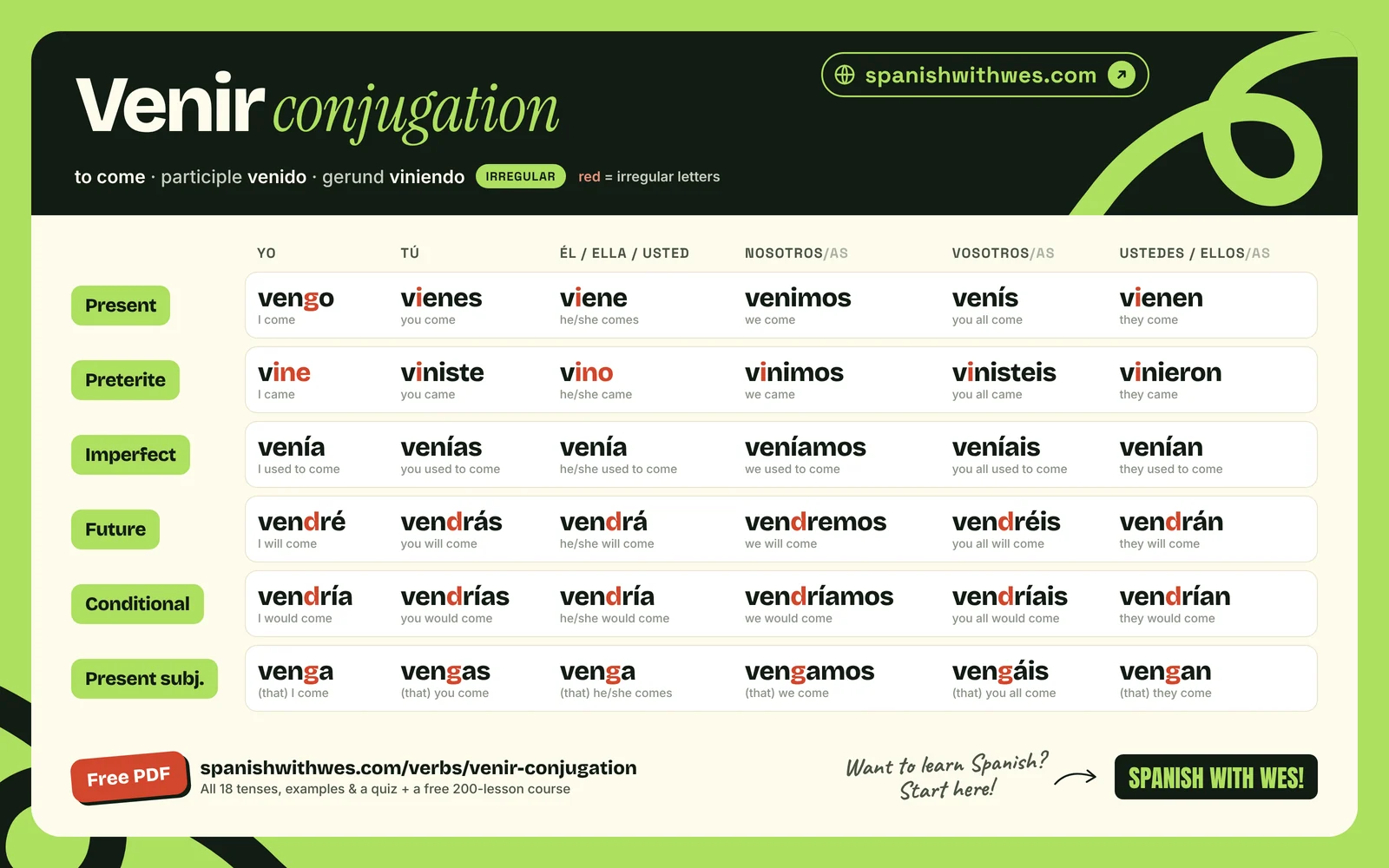
| yo | vengoI come |
|---|---|
| tú | vienesyou come |
| él/ella/usted | vienehe/she comes |
| nosotros/as | venimoswe come |
| vosotros/as | venísyou all come |
| ellos/ellas/ustedes | vienenthey come |
Extra g in the yo form (vengo) and e → ie in the others (vienes), just like tener.
Preterite indicative
| yo | vineI came |
|---|---|
| tú | vinisteyou came |
| él/ella/usted | vinohe/she came |
| nosotros/as | vinimoswe came |
| vosotros/as | vinisteisyou all came |
| ellos/ellas/ustedes | vinieronthey came |
Imperfect indicative
| yo | veníaI used to come |
|---|---|
| tú | veníasyou used to come |
| él/ella/usted | veníahe/she used to come |
| nosotros/as | veníamoswe used to come |
| vosotros/as | veníaisyou all used to come |
| ellos/ellas/ustedes | veníanthey used to come |
Present continuous indicative
| yo | estoy viniendoI am coming |
|---|---|
| tú | estás viniendoyou are coming |
| él/ella/usted | está viniendohe/she is coming |
| nosotros/as | estamos viniendowe are coming |
| vosotros/as | estáis viniendoyou all are coming |
| ellos/ellas/ustedes | están viniendothey are coming |
estar + gerund
Informal future indicative
| yo | voy a venirI am going to come |
|---|---|
| tú | vas a veniryou are going to come |
| él/ella/usted | va a venirhe/she is going to come |
| nosotros/as | vamos a venirwe are going to come |
| vosotros/as | vais a veniryou all are going to come |
| ellos/ellas/ustedes | van a venirthey are going to come |
ir a + infinitive
Future indicative
| yo | vendréI will come |
|---|---|
| tú | vendrásyou will come |
| él/ella/usted | vendráhe/she will come |
| nosotros/as | vendremoswe will come |
| vosotros/as | vendréisyou all will come |
| ellos/ellas/ustedes | vendránthey will come |
Irregular stem vendr-: vendré.
Conditional indicative
| yo | vendríaI would come |
|---|---|
| tú | vendríasyou would come |
| él/ella/usted | vendríahe/she would come |
| nosotros/as | vendríamoswe would come |
| vosotros/as | vendríaisyou all would come |
| ellos/ellas/ustedes | vendríanthey would come |
Present perfect indicative
| yo | he venidoI have come |
|---|---|
| tú | has venidoyou have come |
| él/ella/usted | ha venidohe/she has come |
| nosotros/as | hemos venidowe have come |
| vosotros/as | habéis venidoyou all have come |
| ellos/ellas/ustedes | han venidothey have come |
haber (present) + past participle
Past perfect indicative
| yo | había venidoI had come |
|---|---|
| tú | habías venidoyou had come |
| él/ella/usted | había venidohe/she had come |
| nosotros/as | habíamos venidowe had come |
| vosotros/as | habíais venidoyou all had come |
| ellos/ellas/ustedes | habían venidothey had come |
haber (imperfect) + past participle
Future perfect indicative
| yo | habré venidoI will have come |
|---|---|
| tú | habrás venidoyou will have come |
| él/ella/usted | habrá venidohe/she will have come |
| nosotros/as | habremos venidowe will have come |
| vosotros/as | habréis venidoyou all will have come |
| ellos/ellas/ustedes | habrán venidothey will have come |
haber (future) + past participle
Conditional perfect indicative
| yo | habría venidoI would have come |
|---|---|
| tú | habrías venidoyou would have come |
| él/ella/usted | habría venidohe/she would have come |
| nosotros/as | habríamos venidowe would have come |
| vosotros/as | habríais venidoyou all would have come |
| ellos/ellas/ustedes | habrían venidothey would have come |
haber (conditional) + past participle
Subjunctive tenses of venir
Wishes, doubts, emotions and "if" sentences.
Present subjunctive
| yo | venga(that) I come |
|---|---|
| tú | vengas(that) you come |
| él/ella/usted | venga(that) he/she comes |
| nosotros/as | vengamos(that) we come |
| vosotros/as | vengáis(that) you all come |
| ellos/ellas/ustedes | vengan(that) they come |
Imperfect subjunctive
| yo | viniera / viniese(if) I came |
|---|---|
| tú | vinieras / vinieses(if) you came |
| él/ella/usted | viniera / viniese(if) he/she came |
| nosotros/as | viniéramos / viniésemos(if) we came |
| vosotros/as | vinierais / vinieseis(if) you all came |
| ellos/ellas/ustedes | vinieran / viniesen(if) they came |
Future subjunctive
| yo | viniere(if) I come |
|---|---|
| tú | vinieres(if) you come |
| él/ella/usted | viniere(if) he/she comes |
| nosotros/as | viniéremos(if) we come |
| vosotros/as | viniereis(if) you all come |
| ellos/ellas/ustedes | vinieren(if) they come |
rarely used: legal & formal texts
Present perfect subjunctive
| yo | haya venido(that) I have come |
|---|---|
| tú | hayas venido(that) you have come |
| él/ella/usted | haya venido(that) he/she has come |
| nosotros/as | hayamos venido(that) we have come |
| vosotros/as | hayáis venido(that) you all have come |
| ellos/ellas/ustedes | hayan venido(that) they have come |
haber (present subj.) + past participle
Past perfect subjunctive
| yo | hubiera venido(if) I had come |
|---|---|
| tú | hubieras venido(if) you had come |
| él/ella/usted | hubiera venido(if) he/she had come |
| nosotros/as | hubiéramos venido(if) we had come |
| vosotros/as | hubierais venido(if) you all had come |
| ellos/ellas/ustedes | hubieran venido(if) they had come |
haber (imperfect subj.) + past participle
Future perfect subjunctive
| yo | hubiere venido(if) I will have come |
|---|---|
| tú | hubieres venido(if) you will have come |
| él/ella/usted | hubiere venido(if) he/she will have come |
| nosotros/as | hubiéremos venido(if) we will have come |
| vosotros/as | hubiereis venido(if) you all will have come |
| ellos/ellas/ustedes | hubieren venido(if) they will have come |
rarely used: legal & formal texts
Imperative tenses of venir
Commands and instructions.
Affirmative imperative
| tú | vencome! |
|---|---|
| usted | vengacome! (formal) |
| nosotros/as | vengamoslet's come! |
| vosotros/as | venidcome! (you all) |
| ustedes | vengancome! (you all, formal) |
¡Venga! is also a super common "come on!" / "OK!" in Spain.
Negative imperative
| tú | no vengasdon't come! |
|---|---|
| usted | no vengadon't come! (formal) |
| nosotros/as | no vengamoslet's not come! |
| vosotros/as | no vengáisdon't come! (you all) |
| ustedes | no vengandon't come! (you all, formal) |
Practice venir
Two quick exercises. No sign-up, no app: just you and venir.
How to use venir
¿Vienes a la fiesta?
Are you coming to the party?
Vengo de Holanda.
I come from the Netherlands.
La semana que viene.
Next week.
¿Te viene bien el lunes?
Does Monday work for you?
¡Venga, vamos!
Come on, let's go!
Example sentences with venir
- ¡Ven aquí!Come here!
- ¿De dónde vienes?Where are you coming from?
- Vino a verme ayer.He came to see me yesterday.
- Mis primos venían cada verano.My cousins used to come every summer.
- ¿Vendrás a mi cumpleaños?Will you come to my birthday?
- Me vendría bien un café.A coffee would be good right now.
- Espero que vengas.I hope you come.
- He venido a trabajar.I've come to work.
Verbs like venir
Venir is conjugated almost exactly like tener (vengo/tengo, vendré/tendré). Verbs ending in -venir follow venir.
Frequently asked questions about venir
Is venir regular or irregular?
Venir is very irregular: vengo, vienes (present), vine (preterite), vendré (future), venga (subjunctive), ven (command) and the gerund viniendo. Only the imperfect (venía) and participle (venido) are regular.
How do you conjugate venir in the present tense?
vengo, vienes, viene, venimos, venís, vienen.
How do you conjugate venir in the preterite?
vine, viniste, vino, vinimos, vinisteis, vinieron.
What is the difference between venir and ir?
Venir = to come towards where the speaker is. Ir = to go anywhere else. When someone calls you, you say ¡voy! (I'm coming!).
What does "¡venga!" mean?
In Spain it means "come on!", "OK!" or "alright, bye!", depending on the tone. It's the command form of venir.
What is the past participle of venir?
The past participle is venido and the gerund is viniendo.
Free cheat sheet
All 18 tenses of venir, on one page.
Print it, stick it on your fridge, or keep it on your phone. Fill in your name and email and I'll send it straight to your inbox.
📩 Check your inbox! The venir cheat sheet is on its way.
Paid courses
Ready to actually speak?
Knowing the conjugations is step one. My paid courses take you from tables to real conversations: structured, step by step, with practice built in.
- Conversational courseStop freezing in real conversations
- Verb tenses courseEvery tense, finally clear

Hola, soy Wes!
Your Spanish teacher
A Dutchie who learned Spanish from scratch. I make the lessons I wish I'd had: clear, practical and free.
My story →Support Spanish with Wes!
Did this page help you?
All my lessons, verb charts and cheat sheets are free, and I want to keep it that way. If you'd like to help me make more, you can support me here. Think of it as buying me a café con leche ☕
More Spanish verbs
Verb search
Find any Spanish verb.
Type a verb, an English word or a conjugated form like fui or hubo.