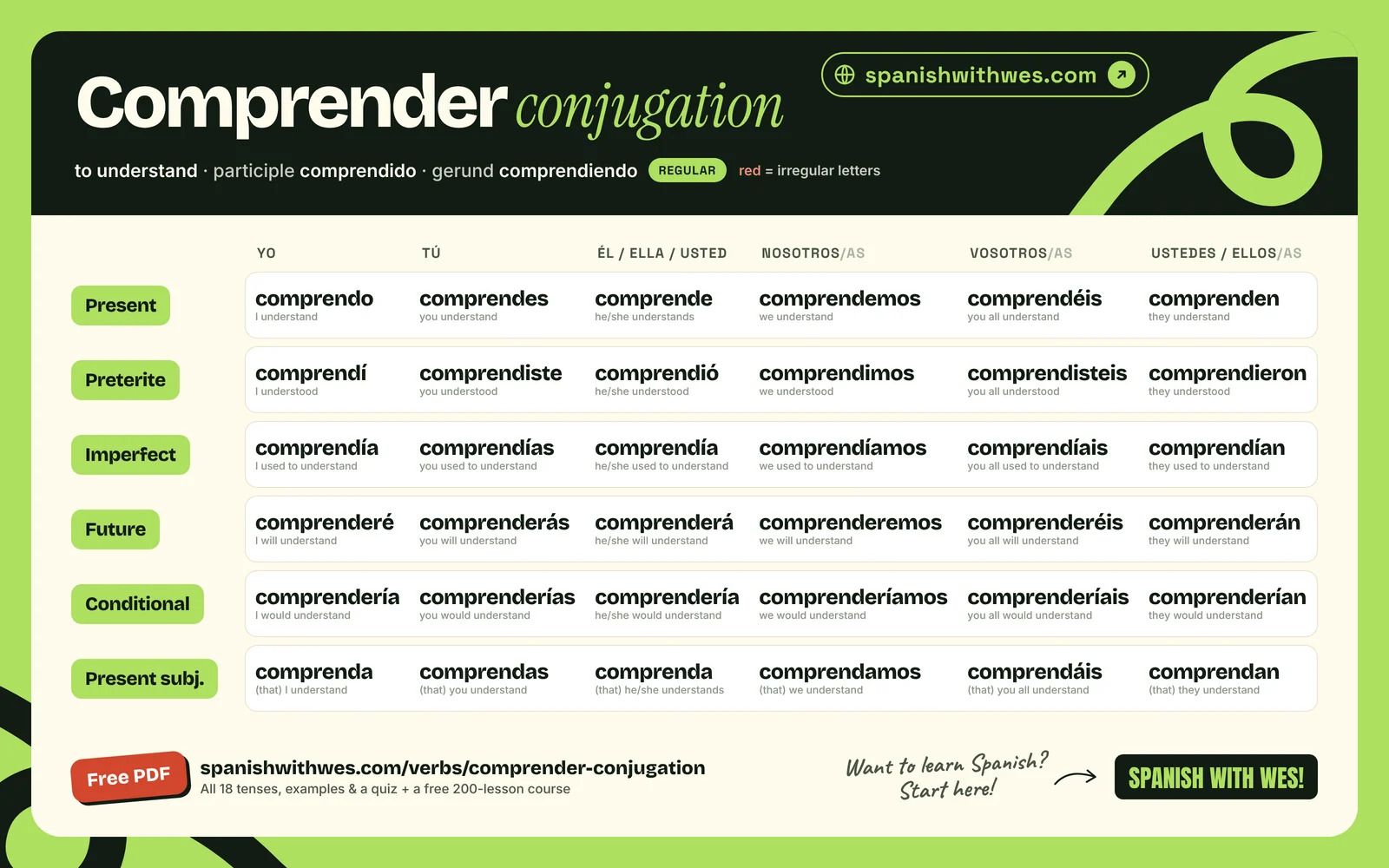
Comprender or entender?
In most situations they are interchangeable: No comprendo = No entiendo (I don't understand). Comprender can feel a bit deeper — understanding someone's feelings: Te comprendo (I understand how you feel). Bonus: comprender is fully regular, so it's easier to conjugate!
Indicative tenses of comprender
Facts and things that happen: the tenses you'll use most.
Present indicative
| yo | comprendoI understand |
|---|---|
| tú | comprendesyou understand |
| él/ella/usted | comprendehe/she understands |
| nosotros/as | comprendemoswe understand |
| vosotros/as | comprendéisyou all understand |
| ellos/ellas/ustedes | comprendenthey understand |
Fully regular — unlike entender, there is no stem change: comprendo, not compriendo.
Preterite indicative
| yo | comprendíI understood |
|---|---|
| tú | comprendisteyou understood |
| él/ella/usted | comprendióhe/she understood |
| nosotros/as | comprendimoswe understood |
| vosotros/as | comprendisteisyou all understood |
| ellos/ellas/ustedes | comprendieronthey understood |
Imperfect indicative
| yo | comprendíaI used to understand |
|---|---|
| tú | comprendíasyou used to understand |
| él/ella/usted | comprendíahe/she used to understand |
| nosotros/as | comprendíamoswe used to understand |
| vosotros/as | comprendíaisyou all used to understand |
| ellos/ellas/ustedes | comprendíanthey used to understand |
Present continuous indicative
| yo | estoy comprendiendoI am understanding |
|---|---|
| tú | estás comprendiendoyou are understanding |
| él/ella/usted | está comprendiendohe/she is understanding |
| nosotros/as | estamos comprendiendowe are understanding |
| vosotros/as | estáis comprendiendoyou all are understanding |
| ellos/ellas/ustedes | están comprendiendothey are understanding |
estar + gerund
Informal future indicative
| yo | voy a comprenderI am going to understand |
|---|---|
| tú | vas a comprenderyou are going to understand |
| él/ella/usted | va a comprenderhe/she is going to understand |
| nosotros/as | vamos a comprenderwe are going to understand |
| vosotros/as | vais a comprenderyou all are going to understand |
| ellos/ellas/ustedes | van a comprenderthey are going to understand |
ir a + infinitive
Future indicative
| yo | comprenderéI will understand |
|---|---|
| tú | comprenderásyou will understand |
| él/ella/usted | comprenderáhe/she will understand |
| nosotros/as | comprenderemoswe will understand |
| vosotros/as | comprenderéisyou all will understand |
| ellos/ellas/ustedes | comprenderánthey will understand |
Conditional indicative
| yo | comprenderíaI would understand |
|---|---|
| tú | comprenderíasyou would understand |
| él/ella/usted | comprenderíahe/she would understand |
| nosotros/as | comprenderíamoswe would understand |
| vosotros/as | comprenderíaisyou all would understand |
| ellos/ellas/ustedes | comprenderíanthey would understand |
Present perfect indicative
| yo | he comprendidoI have understood |
|---|---|
| tú | has comprendidoyou have understood |
| él/ella/usted | ha comprendidohe/she has understood |
| nosotros/as | hemos comprendidowe have understood |
| vosotros/as | habéis comprendidoyou all have understood |
| ellos/ellas/ustedes | han comprendidothey have understood |
haber (present) + past participle
Past perfect indicative
| yo | había comprendidoI had understood |
|---|---|
| tú | habías comprendidoyou had understood |
| él/ella/usted | había comprendidohe/she had understood |
| nosotros/as | habíamos comprendidowe had understood |
| vosotros/as | habíais comprendidoyou all had understood |
| ellos/ellas/ustedes | habían comprendidothey had understood |
haber (imperfect) + past participle
Future perfect indicative
| yo | habré comprendidoI will have understood |
|---|---|
| tú | habrás comprendidoyou will have understood |
| él/ella/usted | habrá comprendidohe/she will have understood |
| nosotros/as | habremos comprendidowe will have understood |
| vosotros/as | habréis comprendidoyou all will have understood |
| ellos/ellas/ustedes | habrán comprendidothey will have understood |
haber (future) + past participle
Conditional perfect indicative
| yo | habría comprendidoI would have understood |
|---|---|
| tú | habrías comprendidoyou would have understood |
| él/ella/usted | habría comprendidohe/she would have understood |
| nosotros/as | habríamos comprendidowe would have understood |
| vosotros/as | habríais comprendidoyou all would have understood |
| ellos/ellas/ustedes | habrían comprendidothey would have understood |
haber (conditional) + past participle
Subjunctive tenses of comprender
Wishes, doubts, emotions and "if" sentences.
Present subjunctive
| yo | comprenda(that) I understand |
|---|---|
| tú | comprendas(that) you understand |
| él/ella/usted | comprenda(that) he/she understands |
| nosotros/as | comprendamos(that) we understand |
| vosotros/as | comprendáis(that) you all understand |
| ellos/ellas/ustedes | comprendan(that) they understand |
Imperfect subjunctive
| yo | comprendiera(if) I understood |
|---|---|
| tú | comprendieras(if) you understood |
| él/ella/usted | comprendiera(if) he/she understood |
| nosotros/as | comprendiéramos(if) we understood |
| vosotros/as | comprendierais(if) you all understood |
| ellos/ellas/ustedes | comprendieran(if) they understood |
Future subjunctive
| yo | comprendiere(if) I understand |
|---|---|
| tú | comprendieres(if) you understand |
| él/ella/usted | comprendiere(if) he/she understands |
| nosotros/as | comprendiéremos(if) we understand |
| vosotros/as | comprendiereis(if) you all understand |
| ellos/ellas/ustedes | comprendieren(if) they understand |
rarely used: legal & formal texts
Present perfect subjunctive
| yo | haya comprendido(that) I have understood |
|---|---|
| tú | hayas comprendido(that) you have understood |
| él/ella/usted | haya comprendido(that) he/she has understood |
| nosotros/as | hayamos comprendido(that) we have understood |
| vosotros/as | hayáis comprendido(that) you all have understood |
| ellos/ellas/ustedes | hayan comprendido(that) they have understood |
haber (present subj.) + past participle
Past perfect subjunctive
| yo | hubiera comprendido(if) I had understood |
|---|---|
| tú | hubieras comprendido(if) you had understood |
| él/ella/usted | hubiera comprendido(if) he/she had understood |
| nosotros/as | hubiéramos comprendido(if) we had understood |
| vosotros/as | hubierais comprendido(if) you all had understood |
| ellos/ellas/ustedes | hubieran comprendido(if) they had understood |
haber (imperfect subj.) + past participle
Future perfect subjunctive
| yo | hubiere comprendido(if) I will have understood |
|---|---|
| tú | hubieres comprendido(if) you will have understood |
| él/ella/usted | hubiere comprendido(if) he/she will have understood |
| nosotros/as | hubiéremos comprendido(if) we will have understood |
| vosotros/as | hubiereis comprendido(if) you all will have understood |
| ellos/ellas/ustedes | hubieren comprendido(if) they will have understood |
rarely used: legal & formal texts
Imperative tenses of comprender
Commands and instructions.
Affirmative imperative
| tú | comprendeunderstand! |
|---|---|
| usted | comprendaunderstand! (formal) |
| nosotros/as | comprendamoslet's understand! |
| vosotros/as | comprendedunderstand! (you all) |
| ustedes | comprendanunderstand! (you all, formal) |
Negative imperative
| tú | no comprendasdon't understand! |
|---|---|
| usted | no comprendadon't understand! (formal) |
| nosotros/as | no comprendamoslet's not understand! |
| vosotros/as | no comprendáisdon't understand! (you all) |
| ustedes | no comprendandon't understand! (you all, formal) |
Practice comprender
Two quick exercises. No sign-up, no app: just you and comprender.
How to use comprender
No comprendo la pregunta.
I don't understand the question.
Te comprendo perfectamente.
I completely understand you.
Entonces comprendí el problema.
Then I understood the problem.
El precio comprende el desayuno.
The price includes breakfast.
Comprendo mejor el español escrito.
I understand written Spanish better.
Example sentences with comprender
- ¿Comprendes lo que digo?Do you understand what I'm saying?
- Mis padres no me comprenden.My parents don't understand me.
- Por fin comprendió la situación.She finally understood the situation.
- Al principio no comprendía nada.At first I didn't understand anything.
- Algún día lo comprenderás.One day you'll understand.
- Necesito que me comprendas.I need you to understand me.
- Comprende esto antes de seguir.Understand this before you go on.
- ¿Has comprendido la lección?Have you understood the lesson?
Verbs like comprender
Comprender follows the regular -er pattern, like comer and aprender. Its synonym entender has an e → ie stem change.
Frequently asked questions about comprender
Is comprender regular or irregular?
Comprender is completely regular in every tense.
How do you conjugate comprender in the present tense?
comprendo, comprendes, comprende, comprendemos, comprendéis, comprenden.
How do you conjugate comprender in the preterite?
comprendí, comprendiste, comprendió, comprendimos, comprendisteis, comprendieron.
What is the difference between comprender and entender?
They mostly mean the same. Comprender can sound a bit deeper (empathy) and has no stem change.
How do you say "I don't understand"?
No comprendo or no entiendo.
What is the past participle of comprender?
The past participle is comprendido and the gerund is comprendiendo.
Free cheat sheet
All 18 tenses of comprender, on one page.
Print it, stick it on your fridge, or keep it on your phone. Fill in your name and email and I'll send it straight to your inbox.
📩 Check your inbox! The comprender cheat sheet is on its way.
Paid courses
Ready to actually speak?
Knowing the conjugations is step one. My paid courses take you from tables to real conversations: structured, step by step, with practice built in.
- Conversational courseStop freezing in real conversations
- Verb tenses courseEvery tense, finally clear

Hola, soy Wes!
Your Spanish teacher
A Dutchie who learned Spanish from scratch. I make the lessons I wish I'd had: clear, practical and free.
My story →Support Spanish with Wes!
Did this page help you?
All my lessons, verb charts and cheat sheets are free, and I want to keep it that way. If you'd like to help me make more, you can support me here. Think of it as buying me a café con leche ☕
More Spanish verbs
Verb search
Find any Spanish verb.
Type a verb, an English word or a conjugated form like fui or hubo.