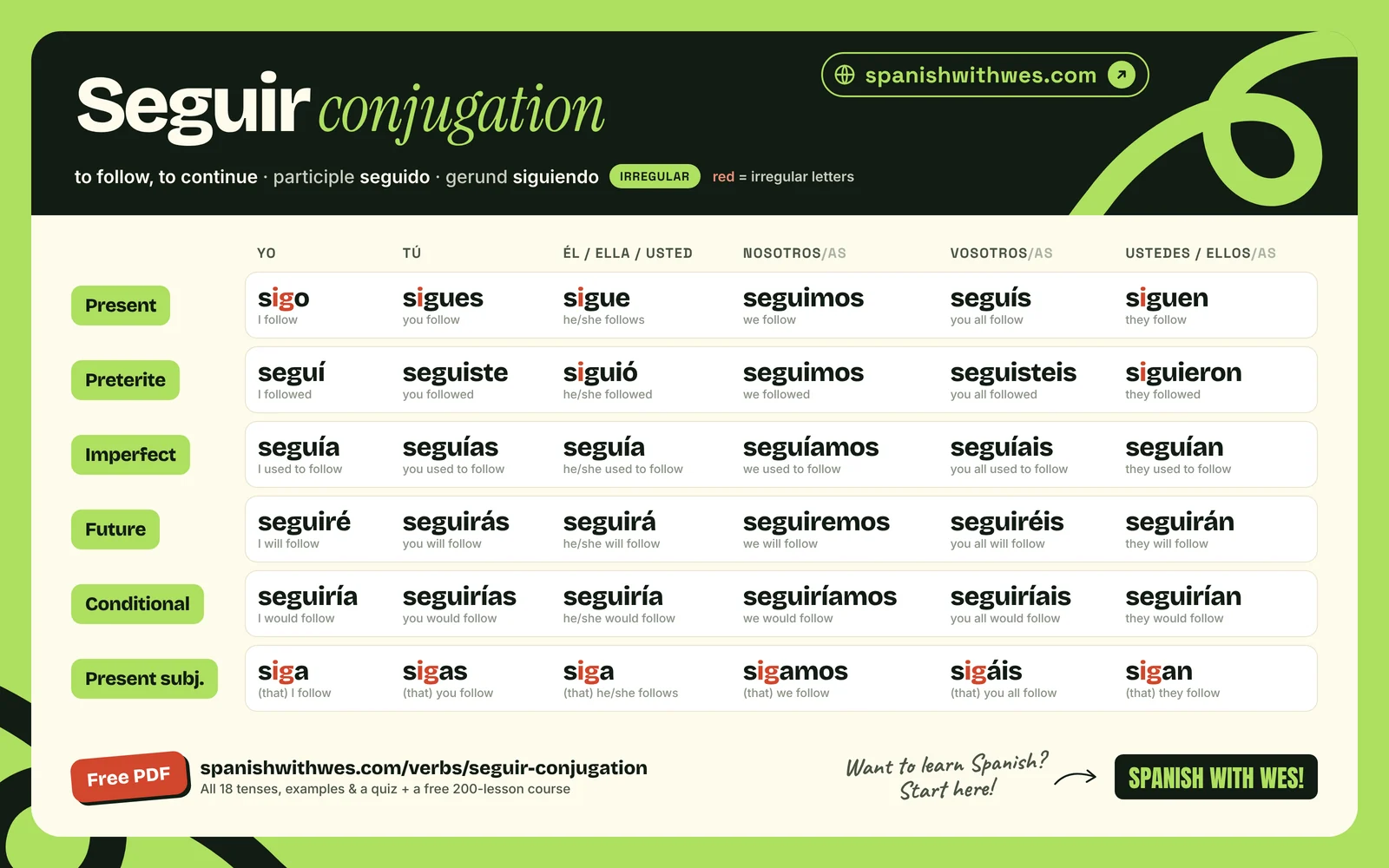
Seguir + gerund = still / keep
Seguir + gerund means "to still be" or "to keep doing": sigo viviendo en Madrid (I still live in Madrid), sigue lloviendo (it's still raining). And for social media: ¿me sigues en Instagram? (do you follow me on Instagram?).
Indicative tenses of seguir
Facts and things that happen: the tenses you'll use most.
Present indicative
| yo | sigoI follow |
|---|---|
| tú | siguesyou follow |
| él/ella/usted | siguehe/she follows |
| nosotros/as | seguimoswe follow |
| vosotros/as | seguísyou all follow |
| ellos/ellas/ustedes | siguenthey follow |
Stem change e → i (sigues), and in the yo form the u drops: sigo.
Preterite indicative
| yo | seguíI followed |
|---|---|
| tú | seguisteyou followed |
| él/ella/usted | siguióhe/she followed |
| nosotros/as | seguimoswe followed |
| vosotros/as | seguisteisyou all followed |
| ellos/ellas/ustedes | siguieronthey followed |
Only él/ella and ellos change: siguió, siguieron.
Imperfect indicative
| yo | seguíaI used to follow |
|---|---|
| tú | seguíasyou used to follow |
| él/ella/usted | seguíahe/she used to follow |
| nosotros/as | seguíamoswe used to follow |
| vosotros/as | seguíaisyou all used to follow |
| ellos/ellas/ustedes | seguíanthey used to follow |
Present continuous indicative
| yo | estoy siguiendoI am following |
|---|---|
| tú | estás siguiendoyou are following |
| él/ella/usted | está siguiendohe/she is following |
| nosotros/as | estamos siguiendowe are following |
| vosotros/as | estáis siguiendoyou all are following |
| ellos/ellas/ustedes | están siguiendothey are following |
estar + gerund
Informal future indicative
| yo | voy a seguirI am going to follow |
|---|---|
| tú | vas a seguiryou are going to follow |
| él/ella/usted | va a seguirhe/she is going to follow |
| nosotros/as | vamos a seguirwe are going to follow |
| vosotros/as | vais a seguiryou all are going to follow |
| ellos/ellas/ustedes | van a seguirthey are going to follow |
ir a + infinitive
Future indicative
| yo | seguiréI will follow |
|---|---|
| tú | seguirásyou will follow |
| él/ella/usted | seguiráhe/she will follow |
| nosotros/as | seguiremoswe will follow |
| vosotros/as | seguiréisyou all will follow |
| ellos/ellas/ustedes | seguiránthey will follow |
Conditional indicative
| yo | seguiríaI would follow |
|---|---|
| tú | seguiríasyou would follow |
| él/ella/usted | seguiríahe/she would follow |
| nosotros/as | seguiríamoswe would follow |
| vosotros/as | seguiríaisyou all would follow |
| ellos/ellas/ustedes | seguiríanthey would follow |
Present perfect indicative
| yo | he seguidoI have followed |
|---|---|
| tú | has seguidoyou have followed |
| él/ella/usted | ha seguidohe/she has followed |
| nosotros/as | hemos seguidowe have followed |
| vosotros/as | habéis seguidoyou all have followed |
| ellos/ellas/ustedes | han seguidothey have followed |
haber (present) + past participle
Past perfect indicative
| yo | había seguidoI had followed |
|---|---|
| tú | habías seguidoyou had followed |
| él/ella/usted | había seguidohe/she had followed |
| nosotros/as | habíamos seguidowe had followed |
| vosotros/as | habíais seguidoyou all had followed |
| ellos/ellas/ustedes | habían seguidothey had followed |
haber (imperfect) + past participle
Future perfect indicative
| yo | habré seguidoI will have followed |
|---|---|
| tú | habrás seguidoyou will have followed |
| él/ella/usted | habrá seguidohe/she will have followed |
| nosotros/as | habremos seguidowe will have followed |
| vosotros/as | habréis seguidoyou all will have followed |
| ellos/ellas/ustedes | habrán seguidothey will have followed |
haber (future) + past participle
Conditional perfect indicative
| yo | habría seguidoI would have followed |
|---|---|
| tú | habrías seguidoyou would have followed |
| él/ella/usted | habría seguidohe/she would have followed |
| nosotros/as | habríamos seguidowe would have followed |
| vosotros/as | habríais seguidoyou all would have followed |
| ellos/ellas/ustedes | habrían seguidothey would have followed |
haber (conditional) + past participle
Subjunctive tenses of seguir
Wishes, doubts, emotions and "if" sentences.
Present subjunctive
| yo | siga(that) I follow |
|---|---|
| tú | sigas(that) you follow |
| él/ella/usted | siga(that) he/she follows |
| nosotros/as | sigamos(that) we follow |
| vosotros/as | sigáis(that) you all follow |
| ellos/ellas/ustedes | sigan(that) they follow |
Imperfect subjunctive
| yo | siguiera / siguiese(if) I followed |
|---|---|
| tú | siguieras / siguieses(if) you followed |
| él/ella/usted | siguiera / siguiese(if) he/she followed |
| nosotros/as | siguiéramos / siguiésemos(if) we followed |
| vosotros/as | siguierais / siguieseis(if) you all followed |
| ellos/ellas/ustedes | siguieran / siguiesen(if) they followed |
Future subjunctive
| yo | siguiere(if) I follow |
|---|---|
| tú | siguieres(if) you follow |
| él/ella/usted | siguiere(if) he/she follows |
| nosotros/as | siguiéremos(if) we follow |
| vosotros/as | siguiereis(if) you all follow |
| ellos/ellas/ustedes | siguieren(if) they follow |
rarely used: legal & formal texts
Present perfect subjunctive
| yo | haya seguido(that) I have followed |
|---|---|
| tú | hayas seguido(that) you have followed |
| él/ella/usted | haya seguido(that) he/she has followed |
| nosotros/as | hayamos seguido(that) we have followed |
| vosotros/as | hayáis seguido(that) you all have followed |
| ellos/ellas/ustedes | hayan seguido(that) they have followed |
haber (present subj.) + past participle
Past perfect subjunctive
| yo | hubiera seguido(if) I had followed |
|---|---|
| tú | hubieras seguido(if) you had followed |
| él/ella/usted | hubiera seguido(if) he/she had followed |
| nosotros/as | hubiéramos seguido(if) we had followed |
| vosotros/as | hubierais seguido(if) you all had followed |
| ellos/ellas/ustedes | hubieran seguido(if) they had followed |
haber (imperfect subj.) + past participle
Future perfect subjunctive
| yo | hubiere seguido(if) I will have followed |
|---|---|
| tú | hubieres seguido(if) you will have followed |
| él/ella/usted | hubiere seguido(if) he/she will have followed |
| nosotros/as | hubiéremos seguido(if) we will have followed |
| vosotros/as | hubiereis seguido(if) you all will have followed |
| ellos/ellas/ustedes | hubieren seguido(if) they will have followed |
rarely used: legal & formal texts
Imperative tenses of seguir
Commands and instructions.
Affirmative imperative
| tú | siguefollow! |
|---|---|
| usted | sigafollow! (formal) |
| nosotros/as | sigamoslet's follow! |
| vosotros/as | seguidfollow! (you all) |
| ustedes | siganfollow! (you all, formal) |
Negative imperative
| tú | no sigasdon't follow! |
|---|---|
| usted | no sigadon't follow! (formal) |
| nosotros/as | no sigamoslet's not follow! |
| vosotros/as | no sigáisdon't follow! (you all) |
| ustedes | no sigandon't follow! (you all, formal) |
Practice seguir
Two quick exercises. No sign-up, no app: just you and seguir.
How to use seguir
Sígueme.
Follow me.
Seguimos mañana.
We'll continue tomorrow.
Sigo trabajando.
I'm still working.
Siga todo recto.
Keep going straight.
Te sigo en Instagram.
I follow you on Instagram.
Example sentences with seguir
- ¿Sigues ahí?Are you still there?
- Sigue lloviendo.It's still raining.
- El perro me siguió hasta casa.The dog followed me home.
- Seguíamos hablando a las tres.We were still talking at three.
- Seguiré estudiando español.I'll keep learning Spanish.
- ¿Seguirías mi consejo?Would you follow my advice?
- Siga todo recto.Keep going straight.
- No sigas por ese camino.Don't go down that road.
Verbs like seguir
Verbs ending in -seguir (conseguir, perseguir) follow seguir exactly. Pedir, repetir and servir have the same e → i change.
Frequently asked questions about seguir
Is seguir regular or irregular?
Seguir is irregular: a stem change e → i (sigues, siguió, siga), plus a spelling change in sigo and siga. The imperfect (seguía), future (seguiré) and participle (seguido) are regular.
How do you conjugate seguir in the present tense?
sigo, sigues, sigue, seguimos, seguís, siguen.
How do you conjugate seguir in the preterite?
seguí, seguiste, siguió, seguimos, seguisteis, siguieron.
Why is it "sigo" and not "siguo"?
Spelling only: before o and a, the u isn't needed to keep the hard g sound: sigo, siga.
How do you say "still" with seguir?
Seguir + gerund: sigo esperando (I'm still waiting), ¿sigues viviendo allí? (do you still live there?).
What is the past participle of seguir?
The past participle is seguido and the gerund is siguiendo.
Free cheat sheet
All 18 tenses of seguir, on one page.
Print it, stick it on your fridge, or keep it on your phone. Fill in your name and email and I'll send it straight to your inbox.
📩 Check your inbox! The seguir cheat sheet is on its way.
Paid courses
Ready to actually speak?
Knowing the conjugations is step one. My paid courses take you from tables to real conversations: structured, step by step, with practice built in.
- Conversational courseStop freezing in real conversations
- Verb tenses courseEvery tense, finally clear

Hola, soy Wes!
Your Spanish teacher
A Dutchie who learned Spanish from scratch. I make the lessons I wish I'd had: clear, practical and free.
My story →Support Spanish with Wes!
Did this page help you?
All my lessons, verb charts and cheat sheets are free, and I want to keep it that way. If you'd like to help me make more, you can support me here. Think of it as buying me a café con leche ☕
More Spanish verbs
Verb search
Find any Spanish verb.
Type a verb, an English word or a conjugated form like fui or hubo.