Dejar de = to stop
Dejar de + infinitive means to stop or quit doing something: he dejado de beber café (I've stopped drinking coffee). No dejar de = to keep doing: no deja de llover (it won't stop raining). And ¡déjame en paz! = leave me alone!
Indicative tenses of dejar
Facts and things that happen: the tenses you'll use most.
Present indicative
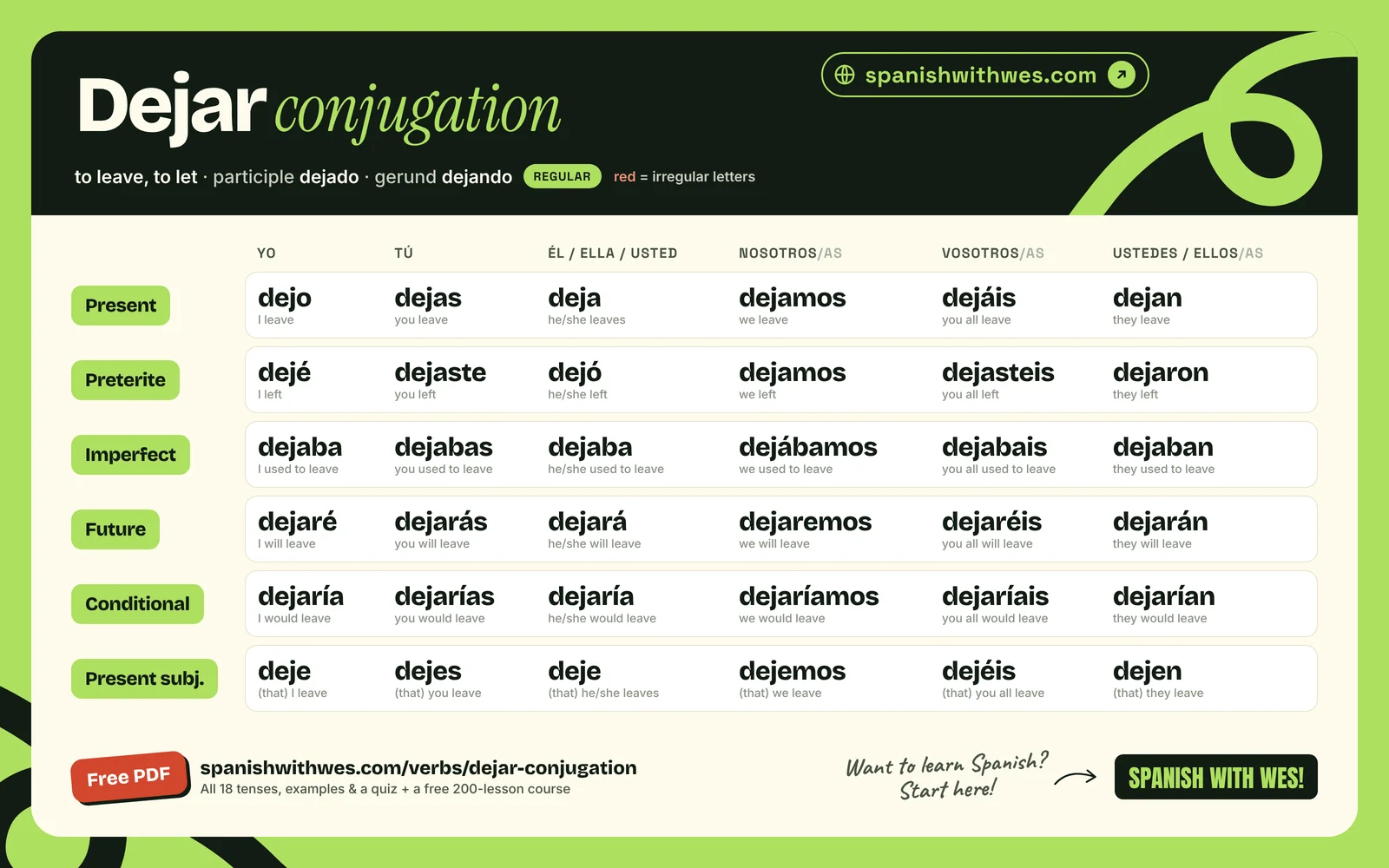
| yo | dejoI leave |
|---|---|
| tú | dejasyou leave |
| él/ella/usted | dejahe/she leaves |
| nosotros/as | dejamoswe leave |
| vosotros/as | dejáisyou all leave |
| ellos/ellas/ustedes | dejanthey leave |
Dejar de + infinitive = to stop doing something: dejo de fumar.
Preterite indicative
| yo | dejéI left |
|---|---|
| tú | dejasteyou left |
| él/ella/usted | dejóhe/she left |
| nosotros/as | dejamoswe left |
| vosotros/as | dejasteisyou all left |
| ellos/ellas/ustedes | dejaronthey left |
Imperfect indicative
| yo | dejabaI used to leave |
|---|---|
| tú | dejabasyou used to leave |
| él/ella/usted | dejabahe/she used to leave |
| nosotros/as | dejábamoswe used to leave |
| vosotros/as | dejabaisyou all used to leave |
| ellos/ellas/ustedes | dejabanthey used to leave |
Present continuous indicative
| yo | estoy dejandoI am leaving |
|---|---|
| tú | estás dejandoyou are leaving |
| él/ella/usted | está dejandohe/she is leaving |
| nosotros/as | estamos dejandowe are leaving |
| vosotros/as | estáis dejandoyou all are leaving |
| ellos/ellas/ustedes | están dejandothey are leaving |
estar + gerund
Informal future indicative
| yo | voy a dejarI am going to leave |
|---|---|
| tú | vas a dejaryou are going to leave |
| él/ella/usted | va a dejarhe/she is going to leave |
| nosotros/as | vamos a dejarwe are going to leave |
| vosotros/as | vais a dejaryou all are going to leave |
| ellos/ellas/ustedes | van a dejarthey are going to leave |
ir a + infinitive
Future indicative
| yo | dejaréI will leave |
|---|---|
| tú | dejarásyou will leave |
| él/ella/usted | dejaráhe/she will leave |
| nosotros/as | dejaremoswe will leave |
| vosotros/as | dejaréisyou all will leave |
| ellos/ellas/ustedes | dejaránthey will leave |
Conditional indicative
| yo | dejaríaI would leave |
|---|---|
| tú | dejaríasyou would leave |
| él/ella/usted | dejaríahe/she would leave |
| nosotros/as | dejaríamoswe would leave |
| vosotros/as | dejaríaisyou all would leave |
| ellos/ellas/ustedes | dejaríanthey would leave |
Present perfect indicative
| yo | he dejadoI have left |
|---|---|
| tú | has dejadoyou have left |
| él/ella/usted | ha dejadohe/she has left |
| nosotros/as | hemos dejadowe have left |
| vosotros/as | habéis dejadoyou all have left |
| ellos/ellas/ustedes | han dejadothey have left |
haber (present) + past participle
Past perfect indicative
| yo | había dejadoI had left |
|---|---|
| tú | habías dejadoyou had left |
| él/ella/usted | había dejadohe/she had left |
| nosotros/as | habíamos dejadowe had left |
| vosotros/as | habíais dejadoyou all had left |
| ellos/ellas/ustedes | habían dejadothey had left |
haber (imperfect) + past participle
Future perfect indicative
| yo | habré dejadoI will have left |
|---|---|
| tú | habrás dejadoyou will have left |
| él/ella/usted | habrá dejadohe/she will have left |
| nosotros/as | habremos dejadowe will have left |
| vosotros/as | habréis dejadoyou all will have left |
| ellos/ellas/ustedes | habrán dejadothey will have left |
haber (future) + past participle
Conditional perfect indicative
| yo | habría dejadoI would have left |
|---|---|
| tú | habrías dejadoyou would have left |
| él/ella/usted | habría dejadohe/she would have left |
| nosotros/as | habríamos dejadowe would have left |
| vosotros/as | habríais dejadoyou all would have left |
| ellos/ellas/ustedes | habrían dejadothey would have left |
haber (conditional) + past participle
Subjunctive tenses of dejar
Wishes, doubts, emotions and "if" sentences.
Present subjunctive
| yo | deje(that) I leave |
|---|---|
| tú | dejes(that) you leave |
| él/ella/usted | deje(that) he/she leaves |
| nosotros/as | dejemos(that) we leave |
| vosotros/as | dejéis(that) you all leave |
| ellos/ellas/ustedes | dejen(that) they leave |
Imperfect subjunctive
| yo | dejara(if) I left |
|---|---|
| tú | dejaras(if) you left |
| él/ella/usted | dejara(if) he/she left |
| nosotros/as | dejáramos(if) we left |
| vosotros/as | dejarais(if) you all left |
| ellos/ellas/ustedes | dejaran(if) they left |
Future subjunctive
| yo | dejare(if) I leave |
|---|---|
| tú | dejares(if) you leave |
| él/ella/usted | dejare(if) he/she leaves |
| nosotros/as | dejáremos(if) we leave |
| vosotros/as | dejareis(if) you all leave |
| ellos/ellas/ustedes | dejaren(if) they leave |
rarely used: legal & formal texts
Present perfect subjunctive
| yo | haya dejado(that) I have left |
|---|---|
| tú | hayas dejado(that) you have left |
| él/ella/usted | haya dejado(that) he/she has left |
| nosotros/as | hayamos dejado(that) we have left |
| vosotros/as | hayáis dejado(that) you all have left |
| ellos/ellas/ustedes | hayan dejado(that) they have left |
haber (present subj.) + past participle
Past perfect subjunctive
| yo | hubiera dejado(if) I had left |
|---|---|
| tú | hubieras dejado(if) you had left |
| él/ella/usted | hubiera dejado(if) he/she had left |
| nosotros/as | hubiéramos dejado(if) we had left |
| vosotros/as | hubierais dejado(if) you all had left |
| ellos/ellas/ustedes | hubieran dejado(if) they had left |
haber (imperfect subj.) + past participle
Future perfect subjunctive
| yo | hubiere dejado(if) I will have left |
|---|---|
| tú | hubieres dejado(if) you will have left |
| él/ella/usted | hubiere dejado(if) he/she will have left |
| nosotros/as | hubiéremos dejado(if) we will have left |
| vosotros/as | hubiereis dejado(if) you all will have left |
| ellos/ellas/ustedes | hubieren dejado(if) they will have left |
rarely used: legal & formal texts
Imperative tenses of dejar
Commands and instructions.
Affirmative imperative
| tú | dejaleave! |
|---|---|
| usted | dejeleave! (formal) |
| nosotros/as | dejemoslet's leave! |
| vosotros/as | dejadleave! (you all) |
| ustedes | dejenleave! (you all, formal) |
Negative imperative
| tú | no dejesdon't leave! |
|---|---|
| usted | no dejedon't leave! (formal) |
| nosotros/as | no dejemoslet's not leave! |
| vosotros/as | no dejéisdon't leave! (you all) |
| ustedes | no dejendon't leave! (you all, formal) |
Practice dejar
Two quick exercises. No sign-up, no app: just you and dejar.
How to use dejar
Dejé las llaves en casa.
I left the keys at home.
Mis padres no me dejan salir.
My parents don't let me go out.
Dejé de fumar hace un año.
I quit smoking a year ago.
¿Me dejas tu boli?
Can I borrow your pen?
Mi novia me dejó.
My girlfriend left me.
Example sentences with dejar
- Déjame pensar.Let me think.
- ¿Dónde dejaste el coche?Where did you leave the car?
- No deja de llover.It won't stop raining.
- Antes me dejaban salir hasta tarde.They used to let me stay out late.
- Te dejaré un mensaje.I'll leave you a message.
- ¿Me dejarías tu coche?Would you lend me your car?
- ¡Déjame en paz!Leave me alone!
- He dejado el trabajo.I've quit my job.
Verbs like dejar
Dejar follows the regular -ar pattern. Careful: salir is "to leave" a place (salgo de casa), dejar is to leave something or someone behind.
Frequently asked questions about dejar
Is dejar regular or irregular?
Dejar is completely regular. It follows the normal -ar pattern in every tense.
How do you conjugate dejar in the present tense?
dejo, dejas, deja, dejamos, dejáis, dejan.
What does "dejar de" mean?
"To stop" or "to quit" doing something: dejé de fumar (I quit smoking).
What is the difference between dejar and salir?
Salir = to leave a place (salgo de casa a las ocho). Dejar = to leave something or someone behind (dejé el móvil en casa).
How do you say "let me…" in Spanish?
Déjame + infinitive: déjame ver (let me see), déjame pensar (let me think).
What is the past participle of dejar?
The past participle is dejado and the gerund is dejando.
Free cheat sheet
All 18 tenses of dejar, on one page.
Print it, stick it on your fridge, or keep it on your phone. Fill in your name and email and I'll send it straight to your inbox.
📩 Check your inbox! The dejar cheat sheet is on its way.
Paid courses
Ready to actually speak?
Knowing the conjugations is step one. My paid courses take you from tables to real conversations: structured, step by step, with practice built in.
- Conversational courseStop freezing in real conversations
- Verb tenses courseEvery tense, finally clear

Hola, soy Wes!
Your Spanish teacher
A Dutchie who learned Spanish from scratch. I make the lessons I wish I'd had: clear, practical and free.
My story →Support Spanish with Wes!
Did this page help you?
All my lessons, verb charts and cheat sheets are free, and I want to keep it that way. If you'd like to help me make more, you can support me here. Think of it as buying me a café con leche ☕
More Spanish verbs
Verb search
Find any Spanish verb.
Type a verb, an English word or a conjugated form like fui or hubo.