Conocer or saber?
Conocer = to know people, places and things you're familiar with: conozco a María, conozco Madrid. Saber = to know facts, information and how to do things: sé su nombre, sé nadar. Remember the personal a with people: conozco a tu padre.
Indicative tenses of conocer
Facts and things that happen: the tenses you'll use most.
Present indicative
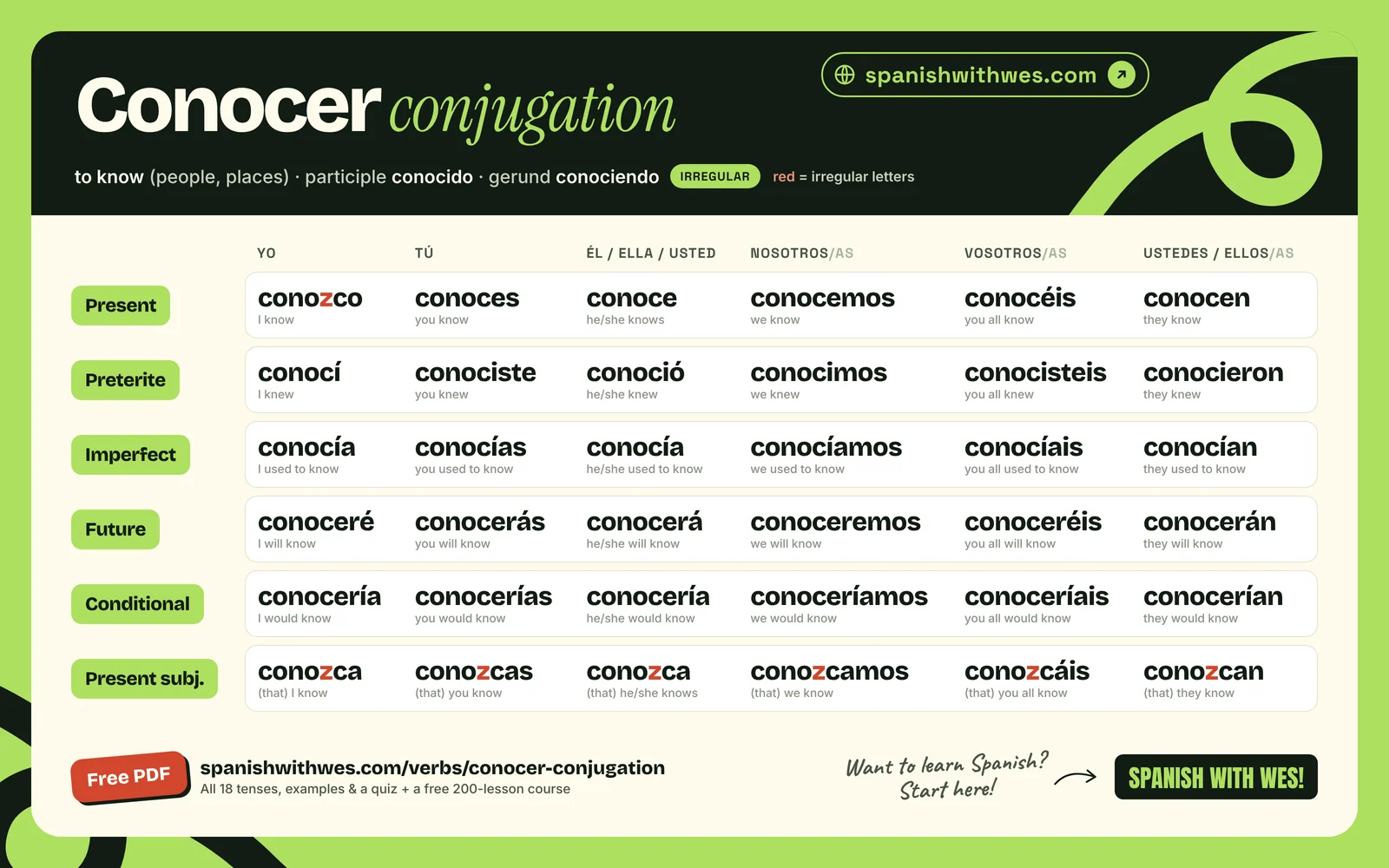
| yo | conozcoI know |
|---|---|
| tú | conocesyou know |
| él/ella/usted | conocehe/she knows |
| nosotros/as | conocemoswe know |
| vosotros/as | conocéisyou all know |
| ellos/ellas/ustedes | conocenthey know |
Only the yo form is irregular: c → zc (conozco).
Preterite indicative
| yo | conocíI knew |
|---|---|
| tú | conocisteyou knew |
| él/ella/usted | conocióhe/she knew |
| nosotros/as | conocimoswe knew |
| vosotros/as | conocisteisyou all knew |
| ellos/ellas/ustedes | conocieronthey knew |
In the preterite, conocer means "met" (for the first time): la conocí en Madrid.
Imperfect indicative
| yo | conocíaI used to know |
|---|---|
| tú | conocíasyou used to know |
| él/ella/usted | conocíahe/she used to know |
| nosotros/as | conocíamoswe used to know |
| vosotros/as | conocíaisyou all used to know |
| ellos/ellas/ustedes | conocíanthey used to know |
Present continuous indicative
| yo | estoy conociendoI am knowing |
|---|---|
| tú | estás conociendoyou are knowing |
| él/ella/usted | está conociendohe/she is knowing |
| nosotros/as | estamos conociendowe are knowing |
| vosotros/as | estáis conociendoyou all are knowing |
| ellos/ellas/ustedes | están conociendothey are knowing |
estar + gerund
Informal future indicative
| yo | voy a conocerI am going to know |
|---|---|
| tú | vas a conoceryou are going to know |
| él/ella/usted | va a conocerhe/she is going to know |
| nosotros/as | vamos a conocerwe are going to know |
| vosotros/as | vais a conoceryou all are going to know |
| ellos/ellas/ustedes | van a conocerthey are going to know |
ir a + infinitive
Future indicative
| yo | conoceréI will know |
|---|---|
| tú | conocerásyou will know |
| él/ella/usted | conoceráhe/she will know |
| nosotros/as | conoceremoswe will know |
| vosotros/as | conoceréisyou all will know |
| ellos/ellas/ustedes | conoceránthey will know |
Conditional indicative
| yo | conoceríaI would know |
|---|---|
| tú | conoceríasyou would know |
| él/ella/usted | conoceríahe/she would know |
| nosotros/as | conoceríamoswe would know |
| vosotros/as | conoceríaisyou all would know |
| ellos/ellas/ustedes | conoceríanthey would know |
Present perfect indicative
| yo | he conocidoI have known |
|---|---|
| tú | has conocidoyou have known |
| él/ella/usted | ha conocidohe/she has known |
| nosotros/as | hemos conocidowe have known |
| vosotros/as | habéis conocidoyou all have known |
| ellos/ellas/ustedes | han conocidothey have known |
haber (present) + past participle
Past perfect indicative
| yo | había conocidoI had known |
|---|---|
| tú | habías conocidoyou had known |
| él/ella/usted | había conocidohe/she had known |
| nosotros/as | habíamos conocidowe had known |
| vosotros/as | habíais conocidoyou all had known |
| ellos/ellas/ustedes | habían conocidothey had known |
haber (imperfect) + past participle
Future perfect indicative
| yo | habré conocidoI will have known |
|---|---|
| tú | habrás conocidoyou will have known |
| él/ella/usted | habrá conocidohe/she will have known |
| nosotros/as | habremos conocidowe will have known |
| vosotros/as | habréis conocidoyou all will have known |
| ellos/ellas/ustedes | habrán conocidothey will have known |
haber (future) + past participle
Conditional perfect indicative
| yo | habría conocidoI would have known |
|---|---|
| tú | habrías conocidoyou would have known |
| él/ella/usted | habría conocidohe/she would have known |
| nosotros/as | habríamos conocidowe would have known |
| vosotros/as | habríais conocidoyou all would have known |
| ellos/ellas/ustedes | habrían conocidothey would have known |
haber (conditional) + past participle
Subjunctive tenses of conocer
Wishes, doubts, emotions and "if" sentences.
Present subjunctive
| yo | conozca(that) I know |
|---|---|
| tú | conozcas(that) you know |
| él/ella/usted | conozca(that) he/she knows |
| nosotros/as | conozcamos(that) we know |
| vosotros/as | conozcáis(that) you all know |
| ellos/ellas/ustedes | conozcan(that) they know |
Imperfect subjunctive
| yo | conociera(if) I knew |
|---|---|
| tú | conocieras(if) you knew |
| él/ella/usted | conociera(if) he/she knew |
| nosotros/as | conociéramos(if) we knew |
| vosotros/as | conocierais(if) you all knew |
| ellos/ellas/ustedes | conocieran(if) they knew |
Future subjunctive
| yo | conociere(if) I know |
|---|---|
| tú | conocieres(if) you know |
| él/ella/usted | conociere(if) he/she knows |
| nosotros/as | conociéremos(if) we know |
| vosotros/as | conociereis(if) you all know |
| ellos/ellas/ustedes | conocieren(if) they know |
rarely used: legal & formal texts
Present perfect subjunctive
| yo | haya conocido(that) I have known |
|---|---|
| tú | hayas conocido(that) you have known |
| él/ella/usted | haya conocido(that) he/she has known |
| nosotros/as | hayamos conocido(that) we have known |
| vosotros/as | hayáis conocido(that) you all have known |
| ellos/ellas/ustedes | hayan conocido(that) they have known |
haber (present subj.) + past participle
Past perfect subjunctive
| yo | hubiera conocido(if) I had known |
|---|---|
| tú | hubieras conocido(if) you had known |
| él/ella/usted | hubiera conocido(if) he/she had known |
| nosotros/as | hubiéramos conocido(if) we had known |
| vosotros/as | hubierais conocido(if) you all had known |
| ellos/ellas/ustedes | hubieran conocido(if) they had known |
haber (imperfect subj.) + past participle
Future perfect subjunctive
| yo | hubiere conocido(if) I will have known |
|---|---|
| tú | hubieres conocido(if) you will have known |
| él/ella/usted | hubiere conocido(if) he/she will have known |
| nosotros/as | hubiéremos conocido(if) we will have known |
| vosotros/as | hubiereis conocido(if) you all will have known |
| ellos/ellas/ustedes | hubieren conocido(if) they will have known |
rarely used: legal & formal texts
Imperative tenses of conocer
Commands and instructions.
Affirmative imperative
| tú | conoceknow! |
|---|---|
| usted | conozcaknow! (formal) |
| nosotros/as | conozcamoslet's know! |
| vosotros/as | conocedknow! (you all) |
| ustedes | conozcanknow! (you all, formal) |
Negative imperative
| tú | no conozcasdon't know! |
|---|---|
| usted | no conozcadon't know! (formal) |
| nosotros/as | no conozcamoslet's not know! |
| vosotros/as | no conozcáisdon't know! (you all) |
| ustedes | no conozcandon't know! (you all, formal) |
Practice conocer
Two quick exercises. No sign-up, no app: just you and conocer.
How to use conocer
Conozco a tu hermana.
I know your sister.
¿Conoces Sevilla?
Have you been to Seville?
Nos conocimos en la universidad.
We met at university.
Quiero conocer México.
I want to get to know Mexico.
Encantado de conocerte.
Nice to meet you.
Example sentences with conocer
- ¿Conoces a mi amigo Pablo?Do you know my friend Pablo?
- No conozco esta ciudad.I don't know this city.
- ¿Dónde os conocisteis?Where did you two meet?
- Antes conocía a todos los vecinos.I used to know all the neighbors.
- Conocerás a gente maravillosa.You'll meet wonderful people.
- ¿Conocerías a alguien que pueda ayudarme?Would you know someone who can help me?
- Quiero que conozcas a mis padres.I want you to meet my parents.
- Nunca he conocido a nadie como tú.I've never met anyone like you.
Verbs like conocer
Verbs ending in -cer or -cir after a vowel get the same zc in the yo form: parezco, ofrezco, conduzco. Saber is conocer's "to know" partner.
Frequently asked questions about conocer
Is conocer regular or irregular?
Conocer is irregular only in the yo form of the present (conozco) and the present subjunctive (conozca). All other tenses are regular.
How do you conjugate conocer in the present tense?
conozco, conoces, conoce, conocemos, conocéis, conocen.
What is the difference between conocer and saber?
Conocer = to know people, places and things you're familiar with. Saber = to know facts and how to do things. Conozco a Ana, pero no sé dónde vive.
What does "conocí" mean?
In the preterite, conocer means "met" (for the first time): conocí a mi novia en un bar (I met my girlfriend in a bar).
Why "conozco a" with people?
Spanish uses the personal a before people as objects: conozco a tu madre. With places, there's no a: conozco Madrid.
What is the past participle of conocer?
The past participle is conocido and the gerund is conociendo. Conocido also means "well-known".
Free cheat sheet
All 18 tenses of conocer, on one page.
Print it, stick it on your fridge, or keep it on your phone. Fill in your name and email and I'll send it straight to your inbox.
📩 Check your inbox! The conocer cheat sheet is on its way.
Paid courses
Ready to actually speak?
Knowing the conjugations is step one. My paid courses take you from tables to real conversations: structured, step by step, with practice built in.
- Conversational courseStop freezing in real conversations
- Verb tenses courseEvery tense, finally clear

Hola, soy Wes!
Your Spanish teacher
A Dutchie who learned Spanish from scratch. I make the lessons I wish I'd had: clear, practical and free.
My story →Support Spanish with Wes!
Did this page help you?
All my lessons, verb charts and cheat sheets are free, and I want to keep it that way. If you'd like to help me make more, you can support me here. Think of it as buying me a café con leche ☕
More Spanish verbs
Verb search
Find any Spanish verb.
Type a verb, an English word or a conjugated form like fui or hubo.