Ponerse: put on and become
With se, poner gets new meanings: ponerse + clothes = to put on (me pongo la chaqueta). Ponerse + adjective = to become, for sudden changes (se puso rojo, he went red). And ponerse a + infinitive = to start doing something (me puse a llorar, I started crying).
Indicative tenses of poner
Facts and things that happen: the tenses you'll use most.
Present indicative
| yo | pongoI put |
|---|---|
| tú | ponesyou put |
| él/ella/usted | ponehe/she puts |
| nosotros/as | ponemoswe put |
| vosotros/as | ponéisyou all put |
| ellos/ellas/ustedes | ponenthey put |
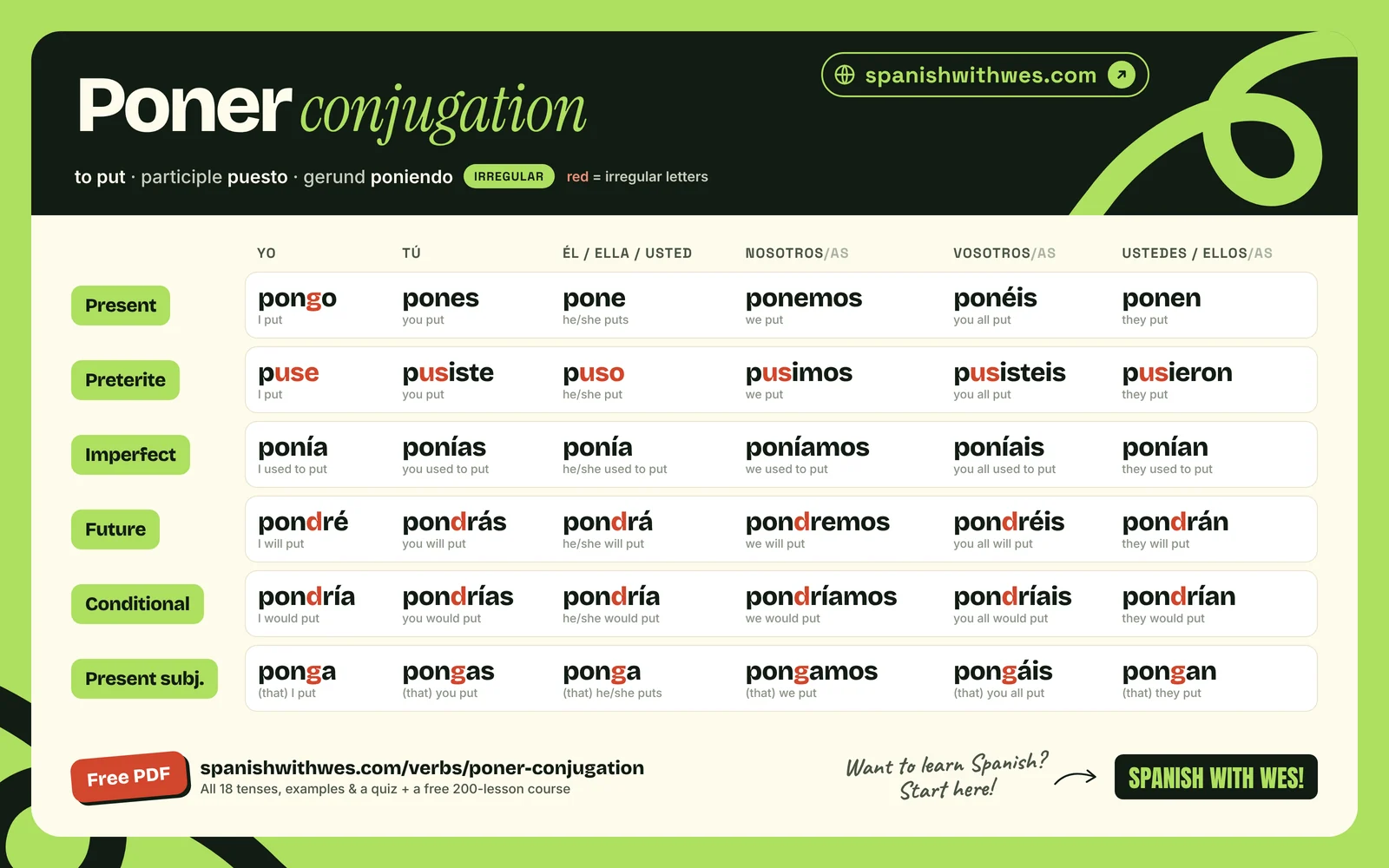
Only the yo form is irregular: an extra g (pongo).
Preterite indicative
| yo | puseI put |
|---|---|
| tú | pusisteyou put |
| él/ella/usted | pusohe/she put |
| nosotros/as | pusimoswe put |
| vosotros/as | pusisteisyou all put |
| ellos/ellas/ustedes | pusieronthey put |
Imperfect indicative
| yo | poníaI used to put |
|---|---|
| tú | poníasyou used to put |
| él/ella/usted | poníahe/she used to put |
| nosotros/as | poníamoswe used to put |
| vosotros/as | poníaisyou all used to put |
| ellos/ellas/ustedes | poníanthey used to put |
Present continuous indicative
| yo | estoy poniendoI am putting |
|---|---|
| tú | estás poniendoyou are putting |
| él/ella/usted | está poniendohe/she is putting |
| nosotros/as | estamos poniendowe are putting |
| vosotros/as | estáis poniendoyou all are putting |
| ellos/ellas/ustedes | están poniendothey are putting |
estar + gerund
Informal future indicative
| yo | voy a ponerI am going to put |
|---|---|
| tú | vas a poneryou are going to put |
| él/ella/usted | va a ponerhe/she is going to put |
| nosotros/as | vamos a ponerwe are going to put |
| vosotros/as | vais a poneryou all are going to put |
| ellos/ellas/ustedes | van a ponerthey are going to put |
ir a + infinitive
Future indicative
| yo | pondréI will put |
|---|---|
| tú | pondrásyou will put |
| él/ella/usted | pondráhe/she will put |
| nosotros/as | pondremoswe will put |
| vosotros/as | pondréisyou all will put |
| ellos/ellas/ustedes | pondránthey will put |
Irregular stem pondr-: pondré, not "poneré".
Conditional indicative
| yo | pondríaI would put |
|---|---|
| tú | pondríasyou would put |
| él/ella/usted | pondríahe/she would put |
| nosotros/as | pondríamoswe would put |
| vosotros/as | pondríaisyou all would put |
| ellos/ellas/ustedes | pondríanthey would put |
Present perfect indicative
| yo | he puestoI have put |
|---|---|
| tú | has puestoyou have put |
| él/ella/usted | ha puestohe/she has put |
| nosotros/as | hemos puestowe have put |
| vosotros/as | habéis puestoyou all have put |
| ellos/ellas/ustedes | han puestothey have put |
haber (present) + past participle
The past participle is irregular: puesto.
Past perfect indicative
| yo | había puestoI had put |
|---|---|
| tú | habías puestoyou had put |
| él/ella/usted | había puestohe/she had put |
| nosotros/as | habíamos puestowe had put |
| vosotros/as | habíais puestoyou all had put |
| ellos/ellas/ustedes | habían puestothey had put |
haber (imperfect) + past participle
Future perfect indicative
| yo | habré puestoI will have put |
|---|---|
| tú | habrás puestoyou will have put |
| él/ella/usted | habrá puestohe/she will have put |
| nosotros/as | habremos puestowe will have put |
| vosotros/as | habréis puestoyou all will have put |
| ellos/ellas/ustedes | habrán puestothey will have put |
haber (future) + past participle
Conditional perfect indicative
| yo | habría puestoI would have put |
|---|---|
| tú | habrías puestoyou would have put |
| él/ella/usted | habría puestohe/she would have put |
| nosotros/as | habríamos puestowe would have put |
| vosotros/as | habríais puestoyou all would have put |
| ellos/ellas/ustedes | habrían puestothey would have put |
haber (conditional) + past participle
Subjunctive tenses of poner
Wishes, doubts, emotions and "if" sentences.
Present subjunctive
| yo | ponga(that) I put |
|---|---|
| tú | pongas(that) you put |
| él/ella/usted | ponga(that) he/she puts |
| nosotros/as | pongamos(that) we put |
| vosotros/as | pongáis(that) you all put |
| ellos/ellas/ustedes | pongan(that) they put |
Imperfect subjunctive
| yo | pusiera / pusiese(if) I put |
|---|---|
| tú | pusieras / pusieses(if) you put |
| él/ella/usted | pusiera / pusiese(if) he/she put |
| nosotros/as | pusiéramos / pusiésemos(if) we put |
| vosotros/as | pusierais / pusieseis(if) you all put |
| ellos/ellas/ustedes | pusieran / pusiesen(if) they put |
Future subjunctive
| yo | pusiere(if) I put |
|---|---|
| tú | pusieres(if) you put |
| él/ella/usted | pusiere(if) he/she puts |
| nosotros/as | pusiéremos(if) we put |
| vosotros/as | pusiereis(if) you all put |
| ellos/ellas/ustedes | pusieren(if) they put |
rarely used: legal & formal texts
Present perfect subjunctive
| yo | haya puesto(that) I have put |
|---|---|
| tú | hayas puesto(that) you have put |
| él/ella/usted | haya puesto(that) he/she has put |
| nosotros/as | hayamos puesto(that) we have put |
| vosotros/as | hayáis puesto(that) you all have put |
| ellos/ellas/ustedes | hayan puesto(that) they have put |
haber (present subj.) + past participle
Past perfect subjunctive
| yo | hubiera puesto(if) I had put |
|---|---|
| tú | hubieras puesto(if) you had put |
| él/ella/usted | hubiera puesto(if) he/she had put |
| nosotros/as | hubiéramos puesto(if) we had put |
| vosotros/as | hubierais puesto(if) you all had put |
| ellos/ellas/ustedes | hubieran puesto(if) they had put |
haber (imperfect subj.) + past participle
Future perfect subjunctive
| yo | hubiere puesto(if) I will have put |
|---|---|
| tú | hubieres puesto(if) you will have put |
| él/ella/usted | hubiere puesto(if) he/she will have put |
| nosotros/as | hubiéremos puesto(if) we will have put |
| vosotros/as | hubiereis puesto(if) you all will have put |
| ellos/ellas/ustedes | hubieren puesto(if) they will have put |
rarely used: legal & formal texts
Imperative tenses of poner
Commands and instructions.
Affirmative imperative
| tú | ponput! |
|---|---|
| usted | pongaput! (formal) |
| nosotros/as | pongamoslet's put! |
| vosotros/as | ponedput! (you all) |
| ustedes | ponganput! (you all, formal) |
Negative imperative
| tú | no pongasdon't put! |
|---|---|
| usted | no pongadon't put! (formal) |
| nosotros/as | no pongamoslet's not put! |
| vosotros/as | no pongáisdon't put! (you all) |
| ustedes | no pongandon't put! (you all, formal) |
Practice poner
Two quick exercises. No sign-up, no app: just you and poner.
How to use poner
Pon las llaves en la mesa.
Put the keys on the table.
Me pongo el abrigo.
I'm putting on my coat.
Se puso muy contento.
He got very happy.
¿Pongo música?
Shall I put some music on?
Se puso a llover.
It started to rain.
Example sentences with poner
- ¿Dónde pongo esto?Where do I put this?
- Pon la tele, por favor.Turn on the TV, please.
- Me puse nervioso en el examen.I got nervous in the exam.
- Mi madre siempre ponía la mesa.My mom always used to set the table.
- Te pondré un ejemplo.I'll give you an example.
- ¿Qué te pondrías para la boda?What would you wear to the wedding?
- No te pongas triste.Don't be sad.
- ¿Dónde has puesto mis gafas?Where have you put my glasses?
Verbs like poner
Verbs ending in -poner (suponer, proponer, componer) are conjugated exactly like poner. Tener and salir also have the extra g and a -dr- future (tendré, saldré).
Frequently asked questions about poner
Is poner regular or irregular?
Poner is irregular: pongo (present yo), puse (preterite), pondré (future), ponga (subjunctive), pon (command) and the participle puesto. The imperfect (ponía) and the gerund (poniendo) are regular.
How do you conjugate poner in the present tense?
pongo, pones, pone, ponemos, ponéis, ponen.
How do you conjugate poner in the preterite?
puse, pusiste, puso, pusimos, pusisteis, pusieron.
What is the difference between poner and ponerse?
Poner = to put something somewhere. Ponerse = to put on clothes (me pongo los zapatos) or to become (se puso triste).
How do you say "to turn on" the TV in Spanish?
With poner: pon la tele, ¿pongo música? You can also say encender.
What is the past participle of poner?
The past participle is irregular: puesto (he puesto, I have put). The gerund is poniendo.
Free cheat sheet
All 18 tenses of poner, on one page.
Print it, stick it on your fridge, or keep it on your phone. Fill in your name and email and I'll send it straight to your inbox.
📩 Check your inbox! The poner cheat sheet is on its way.
Paid courses
Ready to actually speak?
Knowing the conjugations is step one. My paid courses take you from tables to real conversations: structured, step by step, with practice built in.
- Conversational courseStop freezing in real conversations
- Verb tenses courseEvery tense, finally clear

Hola, soy Wes!
Your Spanish teacher
A Dutchie who learned Spanish from scratch. I make the lessons I wish I'd had: clear, practical and free.
My story →Support Spanish with Wes!
Did this page help you?
All my lessons, verb charts and cheat sheets are free, and I want to keep it that way. If you'd like to help me make more, you can support me here. Think of it as buying me a café con leche ☕
More Spanish verbs
Verb search
Find any Spanish verb.
Type a verb, an English word or a conjugated form like fui or hubo.