Ser or estar?
Both mean "to be". Use ser for what something is: who you are, where you're from, what you do, what something is like (soy holandés, es alta). Use estar for how or where something is right now: feelings, states and location (estoy cansado, está en casa). Quick test: if it answers "where?" or "how are you right now?", you need estar.
Indicative tenses of ser
Facts and things that happen: the tenses you'll use most.
Present indicative
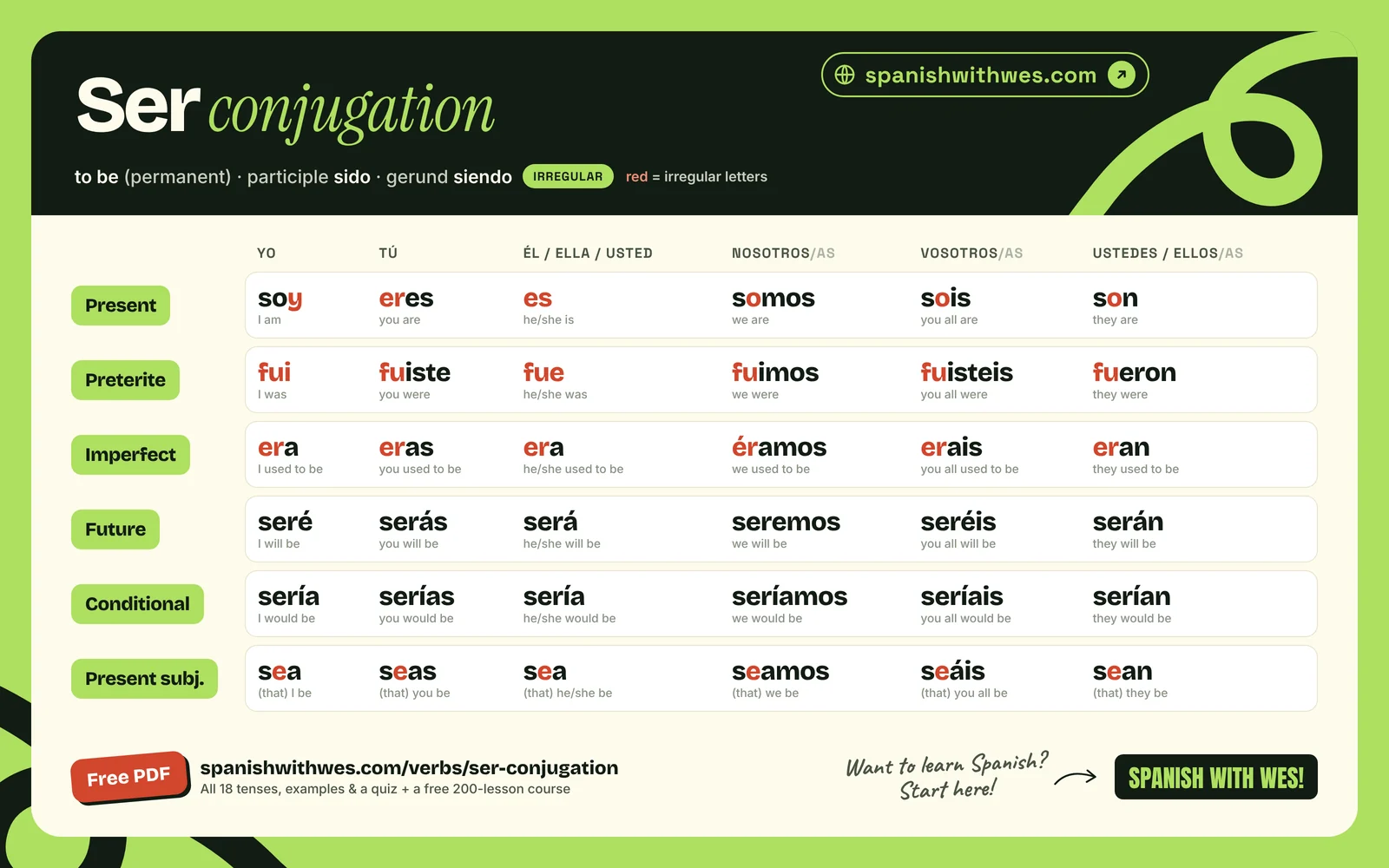
| yo | soyI am |
|---|---|
| tú | eresyou are |
| él/ella/usted | eshe/she is |
| nosotros/as | somoswe are |
| vosotros/as | soisyou all are |
| ellos/ellas/ustedes | sonthey are |
Preterite indicative
| yo | fuiI was |
|---|---|
| tú | fuisteyou were |
| él/ella/usted | fuehe/she was |
| nosotros/as | fuimoswe were |
| vosotros/as | fuisteisyou all were |
| ellos/ellas/ustedes | fueronthey were |
Ser and ir share the same preterite: fui can mean "I was" or "I went".
Imperfect indicative
| yo | eraI used to be |
|---|---|
| tú | erasyou used to be |
| él/ella/usted | erahe/she used to be |
| nosotros/as | éramoswe used to be |
| vosotros/as | eraisyou all used to be |
| ellos/ellas/ustedes | eranthey used to be |
Present continuous indicative
| yo | estoy siendoI am being |
|---|---|
| tú | estás siendoyou are being |
| él/ella/usted | está siendohe/she is being |
| nosotros/as | estamos siendowe are being |
| vosotros/as | estáis siendoyou all are being |
| ellos/ellas/ustedes | están siendothey are being |
estar + gerund
Rare, but used for behaviour right now: estás siendo muy amable (you're being very kind).
Informal future indicative
| yo | voy a serI am going to be |
|---|---|
| tú | vas a seryou are going to be |
| él/ella/usted | va a serhe/she is going to be |
| nosotros/as | vamos a serwe are going to be |
| vosotros/as | vais a seryou all are going to be |
| ellos/ellas/ustedes | van a serthey are going to be |
ir a + infinitive
Future indicative
| yo | seréI will be |
|---|---|
| tú | serásyou will be |
| él/ella/usted | seráhe/she will be |
| nosotros/as | seremoswe will be |
| vosotros/as | seréisyou all will be |
| ellos/ellas/ustedes | seránthey will be |
Conditional indicative
| yo | seríaI would be |
|---|---|
| tú | seríasyou would be |
| él/ella/usted | seríahe/she would be |
| nosotros/as | seríamoswe would be |
| vosotros/as | seríaisyou all would be |
| ellos/ellas/ustedes | seríanthey would be |
Present perfect indicative
| yo | he sidoI have been |
|---|---|
| tú | has sidoyou have been |
| él/ella/usted | ha sidohe/she has been |
| nosotros/as | hemos sidowe have been |
| vosotros/as | habéis sidoyou all have been |
| ellos/ellas/ustedes | han sidothey have been |
haber (present) + past participle
Past perfect indicative
| yo | había sidoI had been |
|---|---|
| tú | habías sidoyou had been |
| él/ella/usted | había sidohe/she had been |
| nosotros/as | habíamos sidowe had been |
| vosotros/as | habíais sidoyou all had been |
| ellos/ellas/ustedes | habían sidothey had been |
haber (imperfect) + past participle
Future perfect indicative
| yo | habré sidoI will have been |
|---|---|
| tú | habrás sidoyou will have been |
| él/ella/usted | habrá sidohe/she will have been |
| nosotros/as | habremos sidowe will have been |
| vosotros/as | habréis sidoyou all will have been |
| ellos/ellas/ustedes | habrán sidothey will have been |
haber (future) + past participle
Conditional perfect indicative
| yo | habría sidoI would have been |
|---|---|
| tú | habrías sidoyou would have been |
| él/ella/usted | habría sidohe/she would have been |
| nosotros/as | habríamos sidowe would have been |
| vosotros/as | habríais sidoyou all would have been |
| ellos/ellas/ustedes | habrían sidothey would have been |
haber (conditional) + past participle
Subjunctive tenses of ser
Wishes, doubts, emotions and "if" sentences.
Present subjunctive
| yo | sea(that) I be |
|---|---|
| tú | seas(that) you be |
| él/ella/usted | sea(that) he/she be |
| nosotros/as | seamos(that) we be |
| vosotros/as | seáis(that) you all be |
| ellos/ellas/ustedes | sean(that) they be |
Imperfect subjunctive
| yo | fuera / fuese(if) I were |
|---|---|
| tú | fueras / fueses(if) you were |
| él/ella/usted | fuera / fuese(if) he/she were |
| nosotros/as | fuéramos / fuésemos(if) we were |
| vosotros/as | fuerais / fueseis(if) you all were |
| ellos/ellas/ustedes | fueran / fuesen(if) they were |
Future subjunctive
| yo | fuere(if) I am |
|---|---|
| tú | fueres(if) you are |
| él/ella/usted | fuere(if) he/she is |
| nosotros/as | fuéremos(if) we are |
| vosotros/as | fuereis(if) you all are |
| ellos/ellas/ustedes | fueren(if) they are |
rarely used: legal & formal texts
Present perfect subjunctive
| yo | haya sido(that) I have been |
|---|---|
| tú | hayas sido(that) you have been |
| él/ella/usted | haya sido(that) he/she has been |
| nosotros/as | hayamos sido(that) we have been |
| vosotros/as | hayáis sido(that) you all have been |
| ellos/ellas/ustedes | hayan sido(that) they have been |
haber (present subj.) + past participle
Past perfect subjunctive
| yo | hubiera sido(if) I had been |
|---|---|
| tú | hubieras sido(if) you had been |
| él/ella/usted | hubiera sido(if) he/she had been |
| nosotros/as | hubiéramos sido(if) we had been |
| vosotros/as | hubierais sido(if) you all had been |
| ellos/ellas/ustedes | hubieran sido(if) they had been |
haber (imperfect subj.) + past participle
Future perfect subjunctive
| yo | hubiere sido(if) I will have been |
|---|---|
| tú | hubieres sido(if) you will have been |
| él/ella/usted | hubiere sido(if) he/she will have been |
| nosotros/as | hubiéremos sido(if) we will have been |
| vosotros/as | hubiereis sido(if) you all will have been |
| ellos/ellas/ustedes | hubieren sido(if) they will have been |
rarely used: legal & formal texts
Imperative tenses of ser
Commands and instructions.
Affirmative imperative
| tú | sébe! |
|---|---|
| usted | seabe! (formal) |
| nosotros/as | seamoslet's be! |
| vosotros/as | sedbe! (you all) |
| ustedes | seanbe! (you all, formal) |
Negative imperative
| tú | no seasdon't be! |
|---|---|
| usted | no seadon't be! (formal) |
| nosotros/as | no seamoslet's not be! |
| vosotros/as | no seáisdon't be! (you all) |
| ustedes | no seandon't be! (you all, formal) |
Practice ser
Two quick exercises. No sign-up, no app: just you and ser.
How to use ser
Soy Wes y soy profesor.
I'm Wes and I'm a teacher.
Mi amiga es de Colombia.
My friend is from Colombia.
La casa es muy grande.
The house is very big.
Son las tres. Hoy es lunes.
It's three o'clock. Today is Monday.
La fiesta es en mi casa.
The party is at my place.
Example sentences with ser
- ¿De dónde eres?Where are you from?
- Somos amigos desde hace años.We've been friends for years.
- Fue un día increíble.It was an amazing day.
- Cuando era pequeño, era muy tímido.When I was little, I was very shy.
- Será difícil, pero vale la pena.It'll be hard, but it's worth it.
- Sería genial verte pronto.It would be great to see you soon.
- Espero que sea verdad.I hope it is true.
- Si fuera tú, no lo haría.If I were you, I wouldn't do it.
Verbs like ser
Short, everyday verbs that are irregular too. Ir even shares its preterite with ser: fui, fuiste, fue.
Frequently asked questions about ser
Is ser regular or irregular?
Ser is completely irregular. The present (soy, eres, es), preterite (fui), imperfect (era) and subjunctive (sea) all have their own forms. Only the future, conditional, gerund (siendo) and participle (sido) are regular.
What is the difference between ser and estar?
Ser is for what something is (identity, origin, profession, character, time). Estar is for how or where something is right now (feelings, states, location). Es aburrido = he's boring. Está aburrido = he's bored.
How do you conjugate ser in the present tense?
soy, eres, es, somos, sois, son.
How do you conjugate ser in the preterite?
fui, fuiste, fue, fuimos, fuisteis, fueron. These are the same forms as the preterite of ir, so the context tells you if it means "was" or "went".
Is it "fue" or "era"?
Fue (preterite) is for something finished at one moment: fue un día increíble. Era (imperfect) is for descriptions and how things used to be: era un niño muy tímido.
What is the past participle of ser?
The past participle is sido (he sido, I have been) and the gerund is siendo.
Free cheat sheet
All 18 tenses of ser, on one page.
Print it, stick it on your fridge, or keep it on your phone. Fill in your name and email and I'll send it straight to your inbox.
📩 Check your inbox! The ser cheat sheet is on its way.
Paid courses
Ready to actually speak?
Knowing the conjugations is step one. My paid courses take you from tables to real conversations: structured, step by step, with practice built in.
- Conversational courseStop freezing in real conversations
- Verb tenses courseEvery tense, finally clear

Hola, soy Wes!
Your Spanish teacher
A Dutchie who learned Spanish from scratch. I make the lessons I wish I'd had: clear, practical and free.
My story →Support Spanish with Wes!
Did this page help you?
All my lessons, verb charts and cheat sheets are free, and I want to keep it that way. If you'd like to help me make more, you can support me here. Think of it as buying me a café con leche ☕
More Spanish verbs
Verb search
Find any Spanish verb.
Type a verb, an English word or a conjugated form like fui or hubo.