Abierto as an adjective
Use abierto/abierta with estar to say something is open: ¿Está abierto el museo? (Is the museum open?). The opposite is cerrado. And to say what time a place opens: ¿A qué hora abre? (What time does it open?).
Indicative tenses of abrir
Facts and things that happen: the tenses you'll use most.
Present indicative
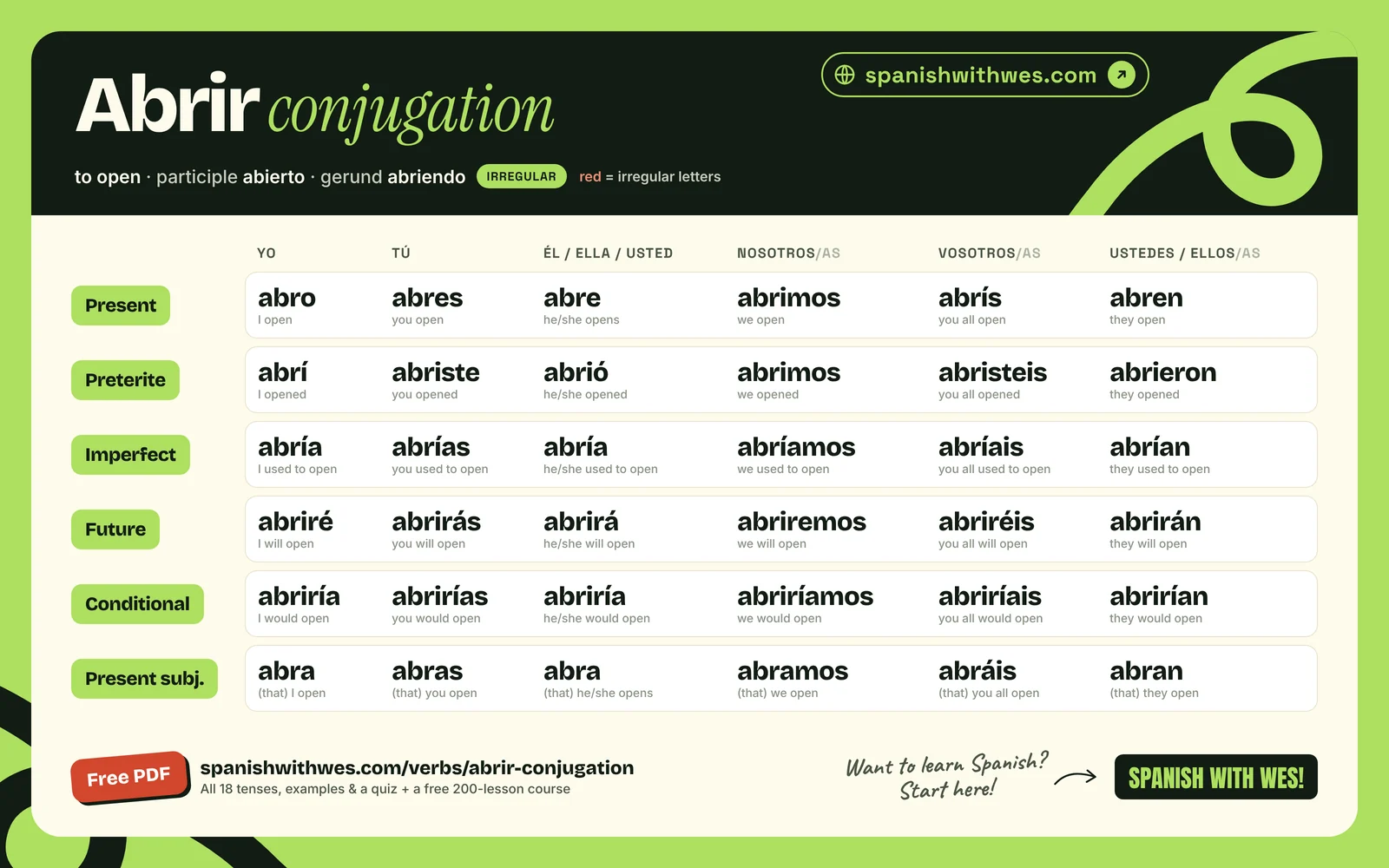
| yo | abroI open |
|---|---|
| tú | abresyou open |
| él/ella/usted | abrehe/she opens |
| nosotros/as | abrimoswe open |
| vosotros/as | abrísyou all open |
| ellos/ellas/ustedes | abrenthey open |
Preterite indicative
| yo | abríI opened |
|---|---|
| tú | abristeyou opened |
| él/ella/usted | abrióhe/she opened |
| nosotros/as | abrimoswe opened |
| vosotros/as | abristeisyou all opened |
| ellos/ellas/ustedes | abrieronthey opened |
Imperfect indicative
| yo | abríaI used to open |
|---|---|
| tú | abríasyou used to open |
| él/ella/usted | abríahe/she used to open |
| nosotros/as | abríamoswe used to open |
| vosotros/as | abríaisyou all used to open |
| ellos/ellas/ustedes | abríanthey used to open |
Present continuous indicative
| yo | estoy abriendoI am opening |
|---|---|
| tú | estás abriendoyou are opening |
| él/ella/usted | está abriendohe/she is opening |
| nosotros/as | estamos abriendowe are opening |
| vosotros/as | estáis abriendoyou all are opening |
| ellos/ellas/ustedes | están abriendothey are opening |
estar + gerund
Informal future indicative
| yo | voy a abrirI am going to open |
|---|---|
| tú | vas a abriryou are going to open |
| él/ella/usted | va a abrirhe/she is going to open |
| nosotros/as | vamos a abrirwe are going to open |
| vosotros/as | vais a abriryou all are going to open |
| ellos/ellas/ustedes | van a abrirthey are going to open |
ir a + infinitive
Future indicative
| yo | abriréI will open |
|---|---|
| tú | abrirásyou will open |
| él/ella/usted | abriráhe/she will open |
| nosotros/as | abriremoswe will open |
| vosotros/as | abriréisyou all will open |
| ellos/ellas/ustedes | abriránthey will open |
Conditional indicative
| yo | abriríaI would open |
|---|---|
| tú | abriríasyou would open |
| él/ella/usted | abriríahe/she would open |
| nosotros/as | abriríamoswe would open |
| vosotros/as | abriríaisyou all would open |
| ellos/ellas/ustedes | abriríanthey would open |
Present perfect indicative
| yo | he abiertoI have opened |
|---|---|
| tú | has abiertoyou have opened |
| él/ella/usted | ha abiertohe/she has opened |
| nosotros/as | hemos abiertowe have opened |
| vosotros/as | habéis abiertoyou all have opened |
| ellos/ellas/ustedes | han abiertothey have opened |
haber (present) + past participle
The past participle is irregular: abierto, not abrido.
Past perfect indicative
| yo | había abiertoI had opened |
|---|---|
| tú | habías abiertoyou had opened |
| él/ella/usted | había abiertohe/she had opened |
| nosotros/as | habíamos abiertowe had opened |
| vosotros/as | habíais abiertoyou all had opened |
| ellos/ellas/ustedes | habían abiertothey had opened |
haber (imperfect) + past participle
Future perfect indicative
| yo | habré abiertoI will have opened |
|---|---|
| tú | habrás abiertoyou will have opened |
| él/ella/usted | habrá abiertohe/she will have opened |
| nosotros/as | habremos abiertowe will have opened |
| vosotros/as | habréis abiertoyou all will have opened |
| ellos/ellas/ustedes | habrán abiertothey will have opened |
haber (future) + past participle
Conditional perfect indicative
| yo | habría abiertoI would have opened |
|---|---|
| tú | habrías abiertoyou would have opened |
| él/ella/usted | habría abiertohe/she would have opened |
| nosotros/as | habríamos abiertowe would have opened |
| vosotros/as | habríais abiertoyou all would have opened |
| ellos/ellas/ustedes | habrían abiertothey would have opened |
haber (conditional) + past participle
Subjunctive tenses of abrir
Wishes, doubts, emotions and "if" sentences.
Present subjunctive
| yo | abra(that) I open |
|---|---|
| tú | abras(that) you open |
| él/ella/usted | abra(that) he/she opens |
| nosotros/as | abramos(that) we open |
| vosotros/as | abráis(that) you all open |
| ellos/ellas/ustedes | abran(that) they open |
Imperfect subjunctive
| yo | abriera(if) I opened |
|---|---|
| tú | abrieras(if) you opened |
| él/ella/usted | abriera(if) he/she opened |
| nosotros/as | abriéramos(if) we opened |
| vosotros/as | abrierais(if) you all opened |
| ellos/ellas/ustedes | abrieran(if) they opened |
Future subjunctive
| yo | abriere(if) I open |
|---|---|
| tú | abrieres(if) you open |
| él/ella/usted | abriere(if) he/she opens |
| nosotros/as | abriéremos(if) we open |
| vosotros/as | abriereis(if) you all open |
| ellos/ellas/ustedes | abrieren(if) they open |
rarely used: legal & formal texts
Present perfect subjunctive
| yo | haya abierto(that) I have opened |
|---|---|
| tú | hayas abierto(that) you have opened |
| él/ella/usted | haya abierto(that) he/she has opened |
| nosotros/as | hayamos abierto(that) we have opened |
| vosotros/as | hayáis abierto(that) you all have opened |
| ellos/ellas/ustedes | hayan abierto(that) they have opened |
haber (present subj.) + past participle
Past perfect subjunctive
| yo | hubiera abierto(if) I had opened |
|---|---|
| tú | hubieras abierto(if) you had opened |
| él/ella/usted | hubiera abierto(if) he/she had opened |
| nosotros/as | hubiéramos abierto(if) we had opened |
| vosotros/as | hubierais abierto(if) you all had opened |
| ellos/ellas/ustedes | hubieran abierto(if) they had opened |
haber (imperfect subj.) + past participle
Future perfect subjunctive
| yo | hubiere abierto(if) I will have opened |
|---|---|
| tú | hubieres abierto(if) you will have opened |
| él/ella/usted | hubiere abierto(if) he/she will have opened |
| nosotros/as | hubiéremos abierto(if) we will have opened |
| vosotros/as | hubiereis abierto(if) you all will have opened |
| ellos/ellas/ustedes | hubieren abierto(if) they will have opened |
rarely used: legal & formal texts
Imperative tenses of abrir
Commands and instructions.
Affirmative imperative
| tú | abreopen! |
|---|---|
| usted | abraopen! (formal) |
| nosotros/as | abramoslet's open! |
| vosotros/as | abridopen! (you all) |
| ustedes | abranopen! (you all, formal) |
Negative imperative
| tú | no abrasdon't open! |
|---|---|
| usted | no abradon't open! (formal) |
| nosotros/as | no abramoslet's not open! |
| vosotros/as | no abráisdon't open! (you all) |
| ustedes | no abrandon't open! (you all, formal) |
Practice abrir
Two quick exercises. No sign-up, no app: just you and abrir.
How to use abrir
Abre la ventana, por favor.
Open the window, please.
¿A qué hora abre la farmacia?
What time does the pharmacy open?
Quiero abrir una cuenta en el banco.
I want to open a bank account.
El restaurante está abierto hasta las once.
The restaurant is open until eleven.
Por fin se abrió conmigo.
He finally opened up to me.
Example sentences with abrir
- ¿Puedo abrir la puerta?Can I open the door?
- La tienda abre a las nueve.The shop opens at nine.
- Abrí el regalo esta mañana.I opened the present this morning.
- Ella abrió un restaurante en Madrid.She opened a restaurant in Madrid.
- Antes abríamos los domingos.We used to open on Sundays.
- No abras ese correo.Don't open that email.
- ¿Has abierto la carta?Have you opened the letter?
- Abriremos una tienda nueva.We'll open a new shop.
Verbs like abrir
Abrir is a regular -ir verb like vivir, but with an irregular past participle — just like escribir (escrito) and cubrir (cubierto).
Frequently asked questions about abrir
Is abrir regular or irregular?
Abrir is regular in all simple tenses. Only the past participle is irregular: abierto.
How do you conjugate abrir in the present tense?
abro, abres, abre, abrimos, abrís, abren.
How do you conjugate abrir in the preterite?
abrí, abriste, abrió, abrimos, abristeis, abrieron.
What is the past participle of abrir?
Abierto, not abrido: he abierto la puerta (I have opened the door).
How do you say "the shop is open"?
La tienda está abierta. Use estar + abierto/abierta.
What is the gerund of abrir?
The gerund is regular: abriendo (opening).
Free cheat sheet
All 18 tenses of abrir, on one page.
Print it, stick it on your fridge, or keep it on your phone. Fill in your name and email and I'll send it straight to your inbox.
📩 Check your inbox! The abrir cheat sheet is on its way.
Paid courses
Ready to actually speak?
Knowing the conjugations is step one. My paid courses take you from tables to real conversations: structured, step by step, with practice built in.
- Conversational courseStop freezing in real conversations
- Verb tenses courseEvery tense, finally clear

Hola, soy Wes!
Your Spanish teacher
A Dutchie who learned Spanish from scratch. I make the lessons I wish I'd had: clear, practical and free.
My story →Support Spanish with Wes!
Did this page help you?
All my lessons, verb charts and cheat sheets are free, and I want to keep it that way. If you'd like to help me make more, you can support me here. Think of it as buying me a café con leche ☕
More Spanish verbs
Verb search
Find any Spanish verb.
Type a verb, an English word or a conjugated form like fui or hubo.