Lo siento
Lo siento = I'm sorry (for something sad or a mistake). Lo siento mucho = I'm so sorry. Use sentirse + adjective for feelings: me siento cansado (I feel tired). And sentir + noun for sensations: siento frío (I feel cold).
Indicative tenses of sentir
Facts and things that happen: the tenses you'll use most.
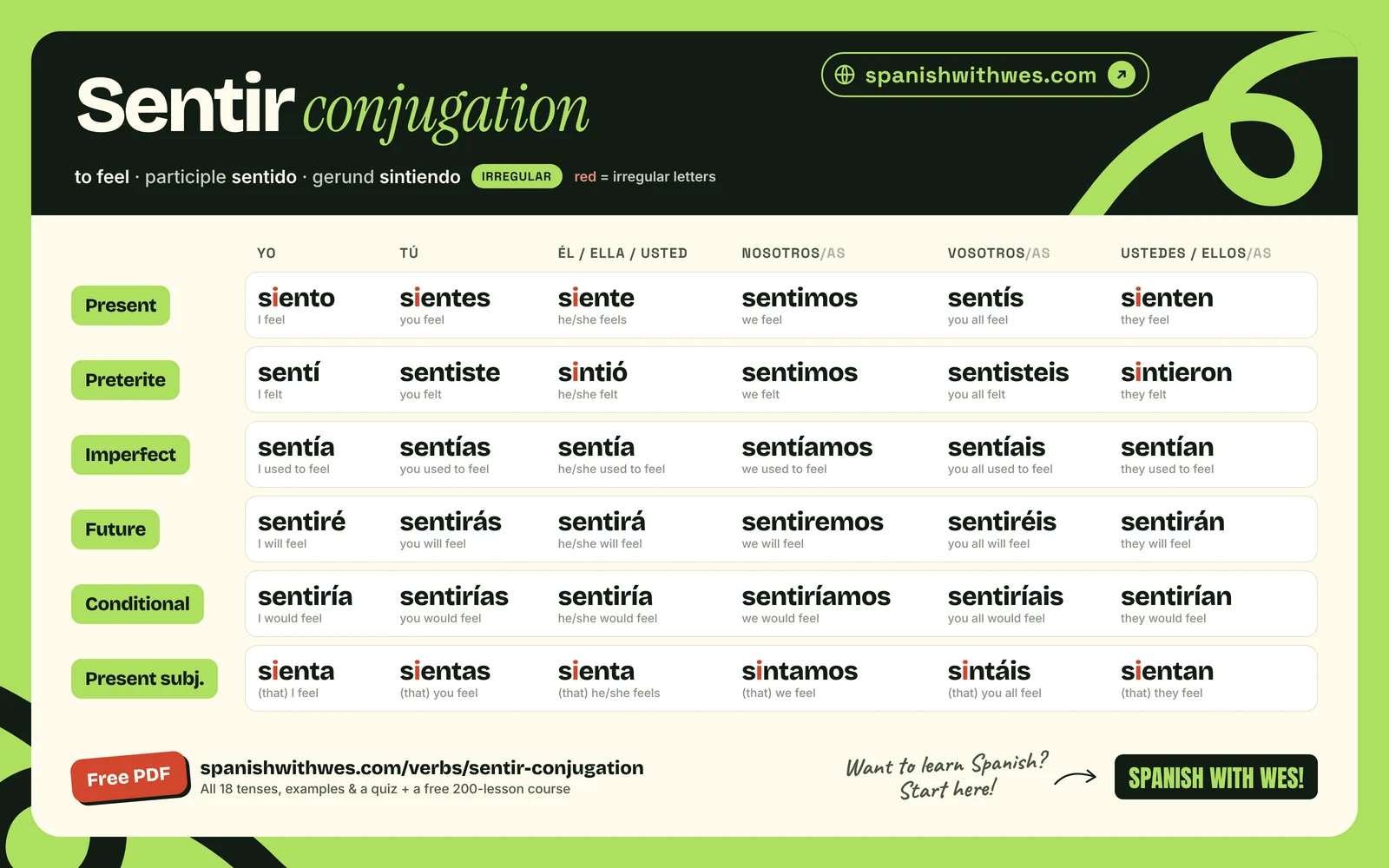
Present indicative
| yo | sientoI feel |
|---|---|
| tú | sientesyou feel |
| él/ella/usted | sientehe/she feels |
| nosotros/as | sentimoswe feel |
| vosotros/as | sentísyou all feel |
| ellos/ellas/ustedes | siententhey feel |
Stem change e → ie, except for nosotros and vosotros: sentimos.
Preterite indicative
| yo | sentíI felt |
|---|---|
| tú | sentisteyou felt |
| él/ella/usted | sintióhe/she felt |
| nosotros/as | sentimoswe felt |
| vosotros/as | sentisteisyou all felt |
| ellos/ellas/ustedes | sintieronthey felt |
Only él/ella and ellos change e → i: sintió, sintieron.
Imperfect indicative
| yo | sentíaI used to feel |
|---|---|
| tú | sentíasyou used to feel |
| él/ella/usted | sentíahe/she used to feel |
| nosotros/as | sentíamoswe used to feel |
| vosotros/as | sentíaisyou all used to feel |
| ellos/ellas/ustedes | sentíanthey used to feel |
Present continuous indicative
| yo | estoy sintiendoI am feeling |
|---|---|
| tú | estás sintiendoyou are feeling |
| él/ella/usted | está sintiendohe/she is feeling |
| nosotros/as | estamos sintiendowe are feeling |
| vosotros/as | estáis sintiendoyou all are feeling |
| ellos/ellas/ustedes | están sintiendothey are feeling |
estar + gerund
Informal future indicative
| yo | voy a sentirI am going to feel |
|---|---|
| tú | vas a sentiryou are going to feel |
| él/ella/usted | va a sentirhe/she is going to feel |
| nosotros/as | vamos a sentirwe are going to feel |
| vosotros/as | vais a sentiryou all are going to feel |
| ellos/ellas/ustedes | van a sentirthey are going to feel |
ir a + infinitive
Future indicative
| yo | sentiréI will feel |
|---|---|
| tú | sentirásyou will feel |
| él/ella/usted | sentiráhe/she will feel |
| nosotros/as | sentiremoswe will feel |
| vosotros/as | sentiréisyou all will feel |
| ellos/ellas/ustedes | sentiránthey will feel |
Conditional indicative
| yo | sentiríaI would feel |
|---|---|
| tú | sentiríasyou would feel |
| él/ella/usted | sentiríahe/she would feel |
| nosotros/as | sentiríamoswe would feel |
| vosotros/as | sentiríaisyou all would feel |
| ellos/ellas/ustedes | sentiríanthey would feel |
Present perfect indicative
| yo | he sentidoI have felt |
|---|---|
| tú | has sentidoyou have felt |
| él/ella/usted | ha sentidohe/she has felt |
| nosotros/as | hemos sentidowe have felt |
| vosotros/as | habéis sentidoyou all have felt |
| ellos/ellas/ustedes | han sentidothey have felt |
haber (present) + past participle
Past perfect indicative
| yo | había sentidoI had felt |
|---|---|
| tú | habías sentidoyou had felt |
| él/ella/usted | había sentidohe/she had felt |
| nosotros/as | habíamos sentidowe had felt |
| vosotros/as | habíais sentidoyou all had felt |
| ellos/ellas/ustedes | habían sentidothey had felt |
haber (imperfect) + past participle
Future perfect indicative
| yo | habré sentidoI will have felt |
|---|---|
| tú | habrás sentidoyou will have felt |
| él/ella/usted | habrá sentidohe/she will have felt |
| nosotros/as | habremos sentidowe will have felt |
| vosotros/as | habréis sentidoyou all will have felt |
| ellos/ellas/ustedes | habrán sentidothey will have felt |
haber (future) + past participle
Conditional perfect indicative
| yo | habría sentidoI would have felt |
|---|---|
| tú | habrías sentidoyou would have felt |
| él/ella/usted | habría sentidohe/she would have felt |
| nosotros/as | habríamos sentidowe would have felt |
| vosotros/as | habríais sentidoyou all would have felt |
| ellos/ellas/ustedes | habrían sentidothey would have felt |
haber (conditional) + past participle
Subjunctive tenses of sentir
Wishes, doubts, emotions and "if" sentences.
Present subjunctive
| yo | sienta(that) I feel |
|---|---|
| tú | sientas(that) you feel |
| él/ella/usted | sienta(that) he/she feels |
| nosotros/as | sintamos(that) we feel |
| vosotros/as | sintáis(that) you all feel |
| ellos/ellas/ustedes | sientan(that) they feel |
Note sintamos, sintáis with i.
Imperfect subjunctive
| yo | sintiera / sintiese(if) I felt |
|---|---|
| tú | sintieras / sintieses(if) you felt |
| él/ella/usted | sintiera / sintiese(if) he/she felt |
| nosotros/as | sintiéramos / sintiésemos(if) we felt |
| vosotros/as | sintierais / sintieseis(if) you all felt |
| ellos/ellas/ustedes | sintieran / sintiesen(if) they felt |
Future subjunctive
| yo | sintiere(if) I feel |
|---|---|
| tú | sintieres(if) you feel |
| él/ella/usted | sintiere(if) he/she feels |
| nosotros/as | sintiéremos(if) we feel |
| vosotros/as | sintiereis(if) you all feel |
| ellos/ellas/ustedes | sintieren(if) they feel |
rarely used: legal & formal texts
Present perfect subjunctive
| yo | haya sentido(that) I have felt |
|---|---|
| tú | hayas sentido(that) you have felt |
| él/ella/usted | haya sentido(that) he/she has felt |
| nosotros/as | hayamos sentido(that) we have felt |
| vosotros/as | hayáis sentido(that) you all have felt |
| ellos/ellas/ustedes | hayan sentido(that) they have felt |
haber (present subj.) + past participle
Past perfect subjunctive
| yo | hubiera sentido(if) I had felt |
|---|---|
| tú | hubieras sentido(if) you had felt |
| él/ella/usted | hubiera sentido(if) he/she had felt |
| nosotros/as | hubiéramos sentido(if) we had felt |
| vosotros/as | hubierais sentido(if) you all had felt |
| ellos/ellas/ustedes | hubieran sentido(if) they had felt |
haber (imperfect subj.) + past participle
Future perfect subjunctive
| yo | hubiere sentido(if) I will have felt |
|---|---|
| tú | hubieres sentido(if) you will have felt |
| él/ella/usted | hubiere sentido(if) he/she will have felt |
| nosotros/as | hubiéremos sentido(if) we will have felt |
| vosotros/as | hubiereis sentido(if) you all will have felt |
| ellos/ellas/ustedes | hubieren sentido(if) they will have felt |
rarely used: legal & formal texts
Imperative tenses of sentir
Commands and instructions.
Affirmative imperative
| tú | sientefeel! |
|---|---|
| usted | sientafeel! (formal) |
| nosotros/as | sintamoslet's feel! |
| vosotros/as | sentidfeel! (you all) |
| ustedes | sientanfeel! (you all, formal) |
Negative imperative
| tú | no sientasdon't feel! |
|---|---|
| usted | no sientadon't feel! (formal) |
| nosotros/as | no sintamoslet's not feel! |
| vosotros/as | no sintáisdon't feel! (you all) |
| ustedes | no sientandon't feel! (you all, formal) |
Practice sentir
Two quick exercises. No sign-up, no app: just you and sentir.
How to use sentir
Lo siento mucho.
I'm so sorry.
Hoy me siento mejor.
I feel better today.
Siento mucho frío.
I feel very cold.
Siento que algo no va bien.
I feel something is wrong.
Siento no poder ir.
I'm sorry I can't go.
Example sentences with sentir
- Lo siento, no te entiendo.I'm sorry, I don't understand you.
- ¿Cómo te sientes?How do you feel?
- Sentí mucha alegría.I felt very happy.
- Se sintió mal y se fue a casa.She felt ill and went home.
- Me sentía solo en la ciudad.I felt lonely in the city.
- Te sentirás mejor mañana.You'll feel better tomorrow.
- Siento llegar tarde.Sorry I'm late.
- Nunca había sentido algo así.I'd never felt anything like this.
Verbs like sentir
Preferir, mentir and divertirse follow sentir exactly (e → ie, e → i). Dormir has the same pattern with o → ue, o → u.
Frequently asked questions about sentir
Is sentir regular or irregular?
Sentir is a stem-changing verb: e → ie in the present (siento) and e → i in the preterite (sintió), subjunctive (sintamos) and gerund (sintiendo). The imperfect, future and conditional are regular.
How do you conjugate sentir in the present tense?
siento, sientes, siente, sentimos, sentís, sienten.
How do you conjugate sentir in the preterite?
sentí, sentiste, sintió, sentimos, sentisteis, sintieron.
What is the difference between sentir and sentirse?
Sentir + noun = to feel something (siento frío) or to be sorry (lo siento). Sentirse + adjective = to feel a certain way (me siento feliz).
How do you say "I'm sorry" in Spanish?
Lo siento. For small things, like bumping into someone, perdón or disculpa is more common.
What is the past participle of sentir?
The past participle is sentido and the gerund is sintiendo. Sentido also means "sense" or "meaning".
Free cheat sheet
All 18 tenses of sentir, on one page.
Print it, stick it on your fridge, or keep it on your phone. Fill in your name and email and I'll send it straight to your inbox.
📩 Check your inbox! The sentir cheat sheet is on its way.
Paid courses
Ready to actually speak?
Knowing the conjugations is step one. My paid courses take you from tables to real conversations: structured, step by step, with practice built in.
- Conversational courseStop freezing in real conversations
- Verb tenses courseEvery tense, finally clear

Hola, soy Wes!
Your Spanish teacher
A Dutchie who learned Spanish from scratch. I make the lessons I wish I'd had: clear, practical and free.
My story →Support Spanish with Wes!
Did this page help you?
All my lessons, verb charts and cheat sheets are free, and I want to keep it that way. If you'd like to help me make more, you can support me here. Think of it as buying me a café con leche ☕
More Spanish verbs
Verb search
Find any Spanish verb.
Type a verb, an English word or a conjugated form like fui or hubo.