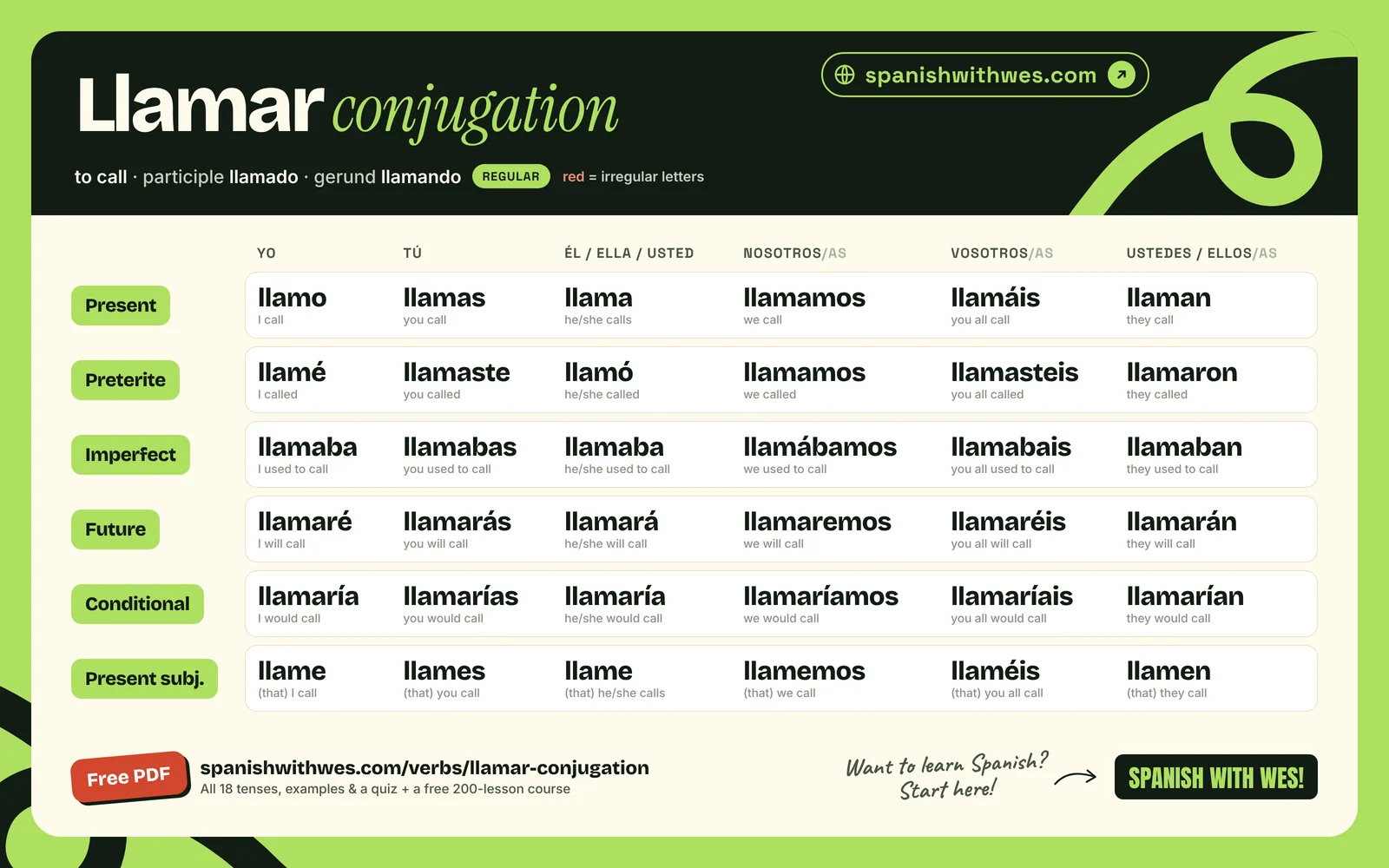
Me llamo…
The first sentence most people learn: ¿cómo te llamas? (what's your name?) – me llamo… (my name is…). Literally "how do you call yourself?". Without se, llamar is to call someone: te llamo luego (I'll call you later).
Indicative tenses of llamar
Facts and things that happen: the tenses you'll use most.
Present indicative
| yo | llamoI call |
|---|---|
| tú | llamasyou call |
| él/ella/usted | llamahe/she calls |
| nosotros/as | llamamoswe call |
| vosotros/as | llamáisyou all call |
| ellos/ellas/ustedes | llamanthey call |
Me llamo… (my name is…) literally means "I call myself".
Preterite indicative
| yo | llaméI called |
|---|---|
| tú | llamasteyou called |
| él/ella/usted | llamóhe/she called |
| nosotros/as | llamamoswe called |
| vosotros/as | llamasteisyou all called |
| ellos/ellas/ustedes | llamaronthey called |
Imperfect indicative
| yo | llamabaI used to call |
|---|---|
| tú | llamabasyou used to call |
| él/ella/usted | llamabahe/she used to call |
| nosotros/as | llamábamoswe used to call |
| vosotros/as | llamabaisyou all used to call |
| ellos/ellas/ustedes | llamabanthey used to call |
Present continuous indicative
| yo | estoy llamandoI am calling |
|---|---|
| tú | estás llamandoyou are calling |
| él/ella/usted | está llamandohe/she is calling |
| nosotros/as | estamos llamandowe are calling |
| vosotros/as | estáis llamandoyou all are calling |
| ellos/ellas/ustedes | están llamandothey are calling |
estar + gerund
Informal future indicative
| yo | voy a llamarI am going to call |
|---|---|
| tú | vas a llamaryou are going to call |
| él/ella/usted | va a llamarhe/she is going to call |
| nosotros/as | vamos a llamarwe are going to call |
| vosotros/as | vais a llamaryou all are going to call |
| ellos/ellas/ustedes | van a llamarthey are going to call |
ir a + infinitive
Future indicative
| yo | llamaréI will call |
|---|---|
| tú | llamarásyou will call |
| él/ella/usted | llamaráhe/she will call |
| nosotros/as | llamaremoswe will call |
| vosotros/as | llamaréisyou all will call |
| ellos/ellas/ustedes | llamaránthey will call |
Conditional indicative
| yo | llamaríaI would call |
|---|---|
| tú | llamaríasyou would call |
| él/ella/usted | llamaríahe/she would call |
| nosotros/as | llamaríamoswe would call |
| vosotros/as | llamaríaisyou all would call |
| ellos/ellas/ustedes | llamaríanthey would call |
Present perfect indicative
| yo | he llamadoI have called |
|---|---|
| tú | has llamadoyou have called |
| él/ella/usted | ha llamadohe/she has called |
| nosotros/as | hemos llamadowe have called |
| vosotros/as | habéis llamadoyou all have called |
| ellos/ellas/ustedes | han llamadothey have called |
haber (present) + past participle
Past perfect indicative
| yo | había llamadoI had called |
|---|---|
| tú | habías llamadoyou had called |
| él/ella/usted | había llamadohe/she had called |
| nosotros/as | habíamos llamadowe had called |
| vosotros/as | habíais llamadoyou all had called |
| ellos/ellas/ustedes | habían llamadothey had called |
haber (imperfect) + past participle
Future perfect indicative
| yo | habré llamadoI will have called |
|---|---|
| tú | habrás llamadoyou will have called |
| él/ella/usted | habrá llamadohe/she will have called |
| nosotros/as | habremos llamadowe will have called |
| vosotros/as | habréis llamadoyou all will have called |
| ellos/ellas/ustedes | habrán llamadothey will have called |
haber (future) + past participle
Conditional perfect indicative
| yo | habría llamadoI would have called |
|---|---|
| tú | habrías llamadoyou would have called |
| él/ella/usted | habría llamadohe/she would have called |
| nosotros/as | habríamos llamadowe would have called |
| vosotros/as | habríais llamadoyou all would have called |
| ellos/ellas/ustedes | habrían llamadothey would have called |
haber (conditional) + past participle
Subjunctive tenses of llamar
Wishes, doubts, emotions and "if" sentences.
Present subjunctive
| yo | llame(that) I call |
|---|---|
| tú | llames(that) you call |
| él/ella/usted | llame(that) he/she calls |
| nosotros/as | llamemos(that) we call |
| vosotros/as | llaméis(that) you all call |
| ellos/ellas/ustedes | llamen(that) they call |
Imperfect subjunctive
| yo | llamara(if) I called |
|---|---|
| tú | llamaras(if) you called |
| él/ella/usted | llamara(if) he/she called |
| nosotros/as | llamáramos(if) we called |
| vosotros/as | llamarais(if) you all called |
| ellos/ellas/ustedes | llamaran(if) they called |
Future subjunctive
| yo | llamare(if) I call |
|---|---|
| tú | llamares(if) you call |
| él/ella/usted | llamare(if) he/she calls |
| nosotros/as | llamáremos(if) we call |
| vosotros/as | llamareis(if) you all call |
| ellos/ellas/ustedes | llamaren(if) they call |
rarely used: legal & formal texts
Present perfect subjunctive
| yo | haya llamado(that) I have called |
|---|---|
| tú | hayas llamado(that) you have called |
| él/ella/usted | haya llamado(that) he/she has called |
| nosotros/as | hayamos llamado(that) we have called |
| vosotros/as | hayáis llamado(that) you all have called |
| ellos/ellas/ustedes | hayan llamado(that) they have called |
haber (present subj.) + past participle
Past perfect subjunctive
| yo | hubiera llamado(if) I had called |
|---|---|
| tú | hubieras llamado(if) you had called |
| él/ella/usted | hubiera llamado(if) he/she had called |
| nosotros/as | hubiéramos llamado(if) we had called |
| vosotros/as | hubierais llamado(if) you all had called |
| ellos/ellas/ustedes | hubieran llamado(if) they had called |
haber (imperfect subj.) + past participle
Future perfect subjunctive
| yo | hubiere llamado(if) I will have called |
|---|---|
| tú | hubieres llamado(if) you will have called |
| él/ella/usted | hubiere llamado(if) he/she will have called |
| nosotros/as | hubiéremos llamado(if) we will have called |
| vosotros/as | hubiereis llamado(if) you all will have called |
| ellos/ellas/ustedes | hubieren llamado(if) they will have called |
rarely used: legal & formal texts
Imperative tenses of llamar
Commands and instructions.
Affirmative imperative
| tú | llamacall! |
|---|---|
| usted | llamecall! (formal) |
| nosotros/as | llamemoslet's call! |
| vosotros/as | llamadcall! (you all) |
| ustedes | llamencall! (you all, formal) |
Negative imperative
| tú | no llamesdon't call! |
|---|---|
| usted | no llamedon't call! (formal) |
| nosotros/as | no llamemoslet's not call! |
| vosotros/as | no llaméisdon't call! (you all) |
| ustedes | no llamendon't call! (you all, formal) |
Practice llamar
Two quick exercises. No sign-up, no app: just you and llamar.
How to use llamar
Me llamo Wes.
My name is Wes.
Te llamo esta noche.
I'll call you tonight.
Todos le llaman Pepe.
Everyone calls him Pepe.
Alguien llama a la puerta.
Someone's knocking at the door.
Me llama la atención.
It catches my attention.
Example sentences with llamar
- ¿Cómo te llamas?What's your name?
- Te llamo luego.I'll call you later.
- ¿Me llamaste ayer?Did you call me yesterday?
- Mi abuela me llamaba cada domingo.My grandma used to call me every Sunday.
- Te llamaré cuando llegue.I'll call you when I arrive.
- ¿Cómo llamarías a tu hijo?What would you name your son?
- Llámame cuando puedas.Call me when you can.
- ¿Has llamado al médico?Have you called the doctor?
Verbs like llamar
All regular -ar verbs: they follow exactly the same pattern as llamar.
Frequently asked questions about llamar
Is llamar regular or irregular?
Llamar is completely regular. It follows the normal -ar pattern in every tense.
How do you conjugate llamar in the present tense?
llamo, llamas, llama, llamamos, llamáis, llaman.
How do you say "my name is" in Spanish?
Me llamo… (from llamarse). You can also say mi nombre es…, but me llamo is more natural.
What is the difference between llamar and llamarse?
Llamar = to call someone (te llamo mañana). Llamarse = to be called / named (me llamo Ana).
How do you pronounce "ll"?
In most of Spain and Latin America, ll sounds like the y in "yes". In Argentina and Uruguay it sounds more like "sh".
What is the past participle of llamar?
The past participle is llamado and the gerund is llamando.
Free cheat sheet
All 18 tenses of llamar, on one page.
Print it, stick it on your fridge, or keep it on your phone. Fill in your name and email and I'll send it straight to your inbox.
📩 Check your inbox! The llamar cheat sheet is on its way.
Paid courses
Ready to actually speak?
Knowing the conjugations is step one. My paid courses take you from tables to real conversations: structured, step by step, with practice built in.
- Conversational courseStop freezing in real conversations
- Verb tenses courseEvery tense, finally clear

Hola, soy Wes!
Your Spanish teacher
A Dutchie who learned Spanish from scratch. I make the lessons I wish I'd had: clear, practical and free.
My story →Support Spanish with Wes!
Did this page help you?
All my lessons, verb charts and cheat sheets are free, and I want to keep it that way. If you'd like to help me make more, you can support me here. Think of it as buying me a café con leche ☕
More Spanish verbs
Verb search
Find any Spanish verb.
Type a verb, an English word or a conjugated form like fui or hubo.