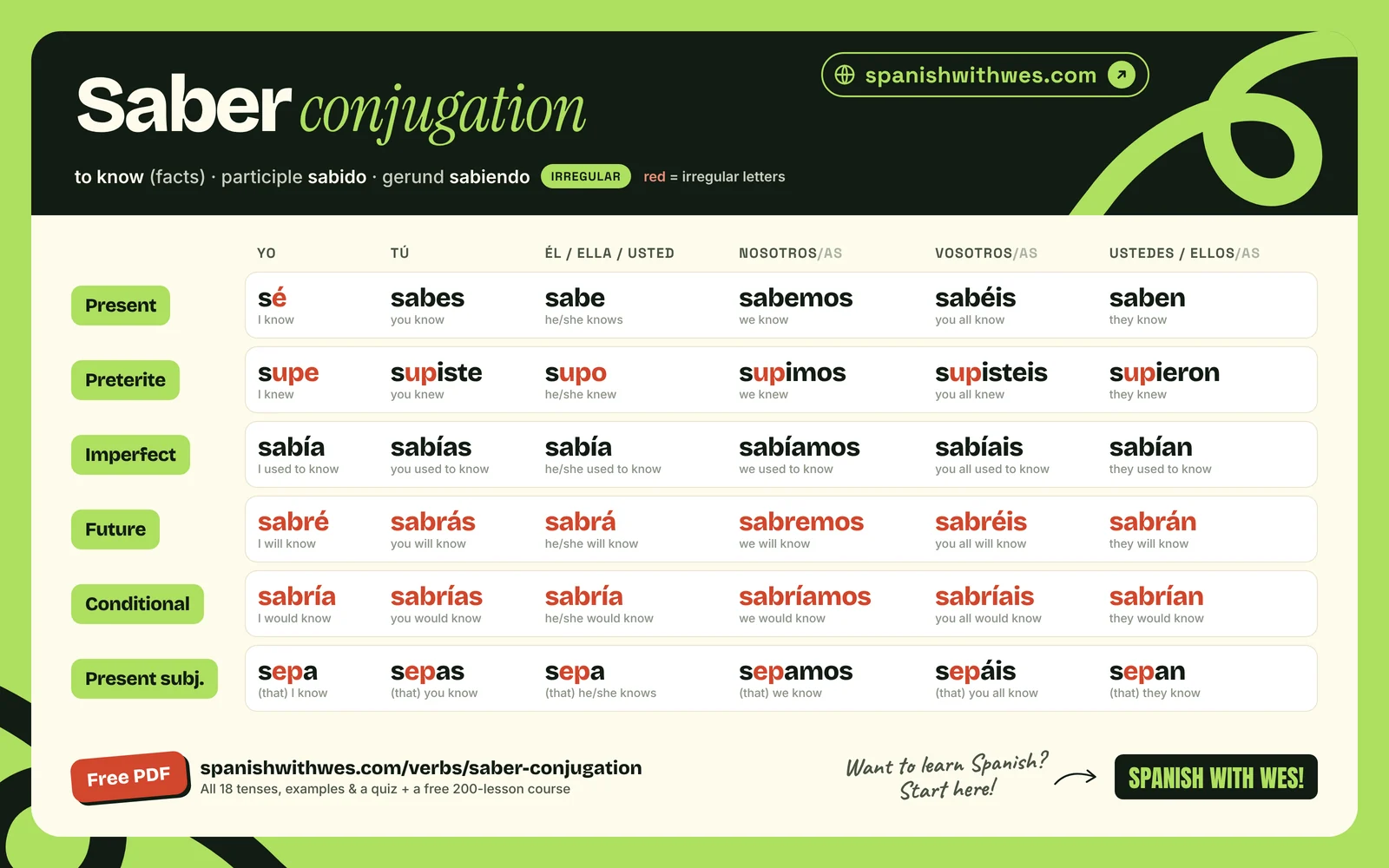
Saber or conocer?
Both mean "to know". Use saber for facts, information and skills: sé tu nombre, sé cocinar. Use conocer for people, places and things you're familiar with: conozco a María, conozco Madrid. Quick test: if you could say "know how" or "know that", it's saber.
Indicative tenses of saber
Facts and things that happen: the tenses you'll use most.
Present indicative
| yo | séI know |
|---|---|
| tú | sabesyou know |
| él/ella/usted | sabehe/she knows |
| nosotros/as | sabemoswe know |
| vosotros/as | sabéisyou all know |
| ellos/ellas/ustedes | sabenthey know |
Sé (I know) has an accent, to tell it apart from se.
Preterite indicative
| yo | supeI knew |
|---|---|
| tú | supisteyou knew |
| él/ella/usted | supohe/she knew |
| nosotros/as | supimoswe knew |
| vosotros/as | supisteisyou all knew |
| ellos/ellas/ustedes | supieronthey knew |
In the preterite, saber often means "found out": lo supe ayer (I found out yesterday).
Imperfect indicative
| yo | sabíaI used to know |
|---|---|
| tú | sabíasyou used to know |
| él/ella/usted | sabíahe/she used to know |
| nosotros/as | sabíamoswe used to know |
| vosotros/as | sabíaisyou all used to know |
| ellos/ellas/ustedes | sabíanthey used to know |
Present continuous indicative
| yo | estoy sabiendoI am knowing |
|---|---|
| tú | estás sabiendoyou are knowing |
| él/ella/usted | está sabiendohe/she is knowing |
| nosotros/as | estamos sabiendowe are knowing |
| vosotros/as | estáis sabiendoyou all are knowing |
| ellos/ellas/ustedes | están sabiendothey are knowing |
estar + gerund
Informal future indicative
| yo | voy a saberI am going to know |
|---|---|
| tú | vas a saberyou are going to know |
| él/ella/usted | va a saberhe/she is going to know |
| nosotros/as | vamos a saberwe are going to know |
| vosotros/as | vais a saberyou all are going to know |
| ellos/ellas/ustedes | van a saberthey are going to know |
ir a + infinitive
Future indicative
| yo | sabréI will know |
|---|---|
| tú | sabrásyou will know |
| él/ella/usted | sabráhe/she will know |
| nosotros/as | sabremoswe will know |
| vosotros/as | sabréisyou all will know |
| ellos/ellas/ustedes | sabránthey will know |
Conditional indicative
| yo | sabríaI would know |
|---|---|
| tú | sabríasyou would know |
| él/ella/usted | sabríahe/she would know |
| nosotros/as | sabríamoswe would know |
| vosotros/as | sabríaisyou all would know |
| ellos/ellas/ustedes | sabríanthey would know |
Present perfect indicative
| yo | he sabidoI have known |
|---|---|
| tú | has sabidoyou have known |
| él/ella/usted | ha sabidohe/she has known |
| nosotros/as | hemos sabidowe have known |
| vosotros/as | habéis sabidoyou all have known |
| ellos/ellas/ustedes | han sabidothey have known |
haber (present) + past participle
Past perfect indicative
| yo | había sabidoI had known |
|---|---|
| tú | habías sabidoyou had known |
| él/ella/usted | había sabidohe/she had known |
| nosotros/as | habíamos sabidowe had known |
| vosotros/as | habíais sabidoyou all had known |
| ellos/ellas/ustedes | habían sabidothey had known |
haber (imperfect) + past participle
Future perfect indicative
| yo | habré sabidoI will have known |
|---|---|
| tú | habrás sabidoyou will have known |
| él/ella/usted | habrá sabidohe/she will have known |
| nosotros/as | habremos sabidowe will have known |
| vosotros/as | habréis sabidoyou all will have known |
| ellos/ellas/ustedes | habrán sabidothey will have known |
haber (future) + past participle
Conditional perfect indicative
| yo | habría sabidoI would have known |
|---|---|
| tú | habrías sabidoyou would have known |
| él/ella/usted | habría sabidohe/she would have known |
| nosotros/as | habríamos sabidowe would have known |
| vosotros/as | habríais sabidoyou all would have known |
| ellos/ellas/ustedes | habrían sabidothey would have known |
haber (conditional) + past participle
Subjunctive tenses of saber
Wishes, doubts, emotions and "if" sentences.
Present subjunctive
| yo | sepa(that) I know |
|---|---|
| tú | sepas(that) you know |
| él/ella/usted | sepa(that) he/she knows |
| nosotros/as | sepamos(that) we know |
| vosotros/as | sepáis(that) you all know |
| ellos/ellas/ustedes | sepan(that) they know |
Imperfect subjunctive
| yo | supiera / supiese(if) I knew |
|---|---|
| tú | supieras / supieses(if) you knew |
| él/ella/usted | supiera / supiese(if) he/she knew |
| nosotros/as | supiéramos / supiésemos(if) we knew |
| vosotros/as | supierais / supieseis(if) you all knew |
| ellos/ellas/ustedes | supieran / supiesen(if) they knew |
Future subjunctive
| yo | supiere(if) I know |
|---|---|
| tú | supieres(if) you know |
| él/ella/usted | supiere(if) he/she knows |
| nosotros/as | supiéremos(if) we know |
| vosotros/as | supiereis(if) you all know |
| ellos/ellas/ustedes | supieren(if) they know |
rarely used: legal & formal texts
Present perfect subjunctive
| yo | haya sabido(that) I have known |
|---|---|
| tú | hayas sabido(that) you have known |
| él/ella/usted | haya sabido(that) he/she has known |
| nosotros/as | hayamos sabido(that) we have known |
| vosotros/as | hayáis sabido(that) you all have known |
| ellos/ellas/ustedes | hayan sabido(that) they have known |
haber (present subj.) + past participle
Past perfect subjunctive
| yo | hubiera sabido(if) I had known |
|---|---|
| tú | hubieras sabido(if) you had known |
| él/ella/usted | hubiera sabido(if) he/she had known |
| nosotros/as | hubiéramos sabido(if) we had known |
| vosotros/as | hubierais sabido(if) you all had known |
| ellos/ellas/ustedes | hubieran sabido(if) they had known |
haber (imperfect subj.) + past participle
Future perfect subjunctive
| yo | hubiere sabido(if) I will have known |
|---|---|
| tú | hubieres sabido(if) you will have known |
| él/ella/usted | hubiere sabido(if) he/she will have known |
| nosotros/as | hubiéremos sabido(if) we will have known |
| vosotros/as | hubiereis sabido(if) you all will have known |
| ellos/ellas/ustedes | hubieren sabido(if) they will have known |
rarely used: legal & formal texts
Imperative tenses of saber
Commands and instructions.
Affirmative imperative
| tú | sabeknow! |
|---|---|
| usted | sepaknow! (formal) |
| nosotros/as | sepamoslet's know! |
| vosotros/as | sabedknow! (you all) |
| ustedes | sepanknow! (you all, formal) |
Rare: mostly in ¡que sepas que…! (just so you know…).
Negative imperative
| tú | no sepasdon't know! |
|---|---|
| usted | no sepadon't know! (formal) |
| nosotros/as | no sepamoslet's not know! |
| vosotros/as | no sepáisdon't know! (you all) |
| ustedes | no sepandon't know! (you all, formal) |
Practice saber
Two quick exercises. No sign-up, no app: just you and saber.
How to use saber
Sé dónde vives.
I know where you live.
¿Sabes nadar?
Can you swim?
No sé.
I don't know.
Lo supe ayer.
I found out yesterday.
Esto sabe a chocolate.
This tastes like chocolate.
Example sentences with saber
- ¿Sabes qué hora es?Do you know what time it is?
- No sé qué decir.I don't know what to say.
- Cuando lo supe, te llamé.When I found out, I called you.
- No sabía que estabas aquí.I didn't know you were here.
- Mañana sabremos el resultado.Tomorrow we'll know the result.
- ¿Sabrías explicarlo?Would you know how to explain it?
- Quiero que lo sepas.I want you to know.
- Si lo hubiera sabido, no habría venido.If I had known, I wouldn't have come.
Verbs like saber
Caber is built just like saber (supe → cupe). Poder and haber also have a u in the preterite: pude, hube. And conocer is its "to know" partner.
Frequently asked questions about saber
Is saber regular or irregular?
Saber is irregular: sé (present yo), supe (preterite), sabré (future), sabría (conditional) and sepa (subjunctive). The imperfect (sabía), gerund (sabiendo) and participle (sabido) are regular.
How do you conjugate saber in the present tense?
sé, sabes, sabe, sabemos, sabéis, saben.
How do you conjugate saber in the preterite?
supe, supiste, supo, supimos, supisteis, supieron. It often means "found out": lo supimos ayer (we found out yesterday).
What is the difference between saber and conocer?
Saber is for facts, information and skills (sé la respuesta, sé conducir). Conocer is for people, places and things you're familiar with (conozco a tu hermano, conozco Barcelona).
How do you say "I don't know" in Spanish?
No sé. Add la verdad to sound more natural: la verdad, no sé.
What is the past participle of saber?
The past participle is sabido (he sabido, I have known) and the gerund is sabiendo.
Free cheat sheet
All 18 tenses of saber, on one page.
Print it, stick it on your fridge, or keep it on your phone. Fill in your name and email and I'll send it straight to your inbox.
📩 Check your inbox! The saber cheat sheet is on its way.
Paid courses
Ready to actually speak?
Knowing the conjugations is step one. My paid courses take you from tables to real conversations: structured, step by step, with practice built in.
- Conversational courseStop freezing in real conversations
- Verb tenses courseEvery tense, finally clear

Hola, soy Wes!
Your Spanish teacher
A Dutchie who learned Spanish from scratch. I make the lessons I wish I'd had: clear, practical and free.
My story →Support Spanish with Wes!
Did this page help you?
All my lessons, verb charts and cheat sheets are free, and I want to keep it that way. If you'd like to help me make more, you can support me here. Think of it as buying me a café con leche ☕
More Spanish verbs
Verb search
Find any Spanish verb.
Type a verb, an English word or a conjugated form like fui or hubo.