The easy future: ir a + infinitive
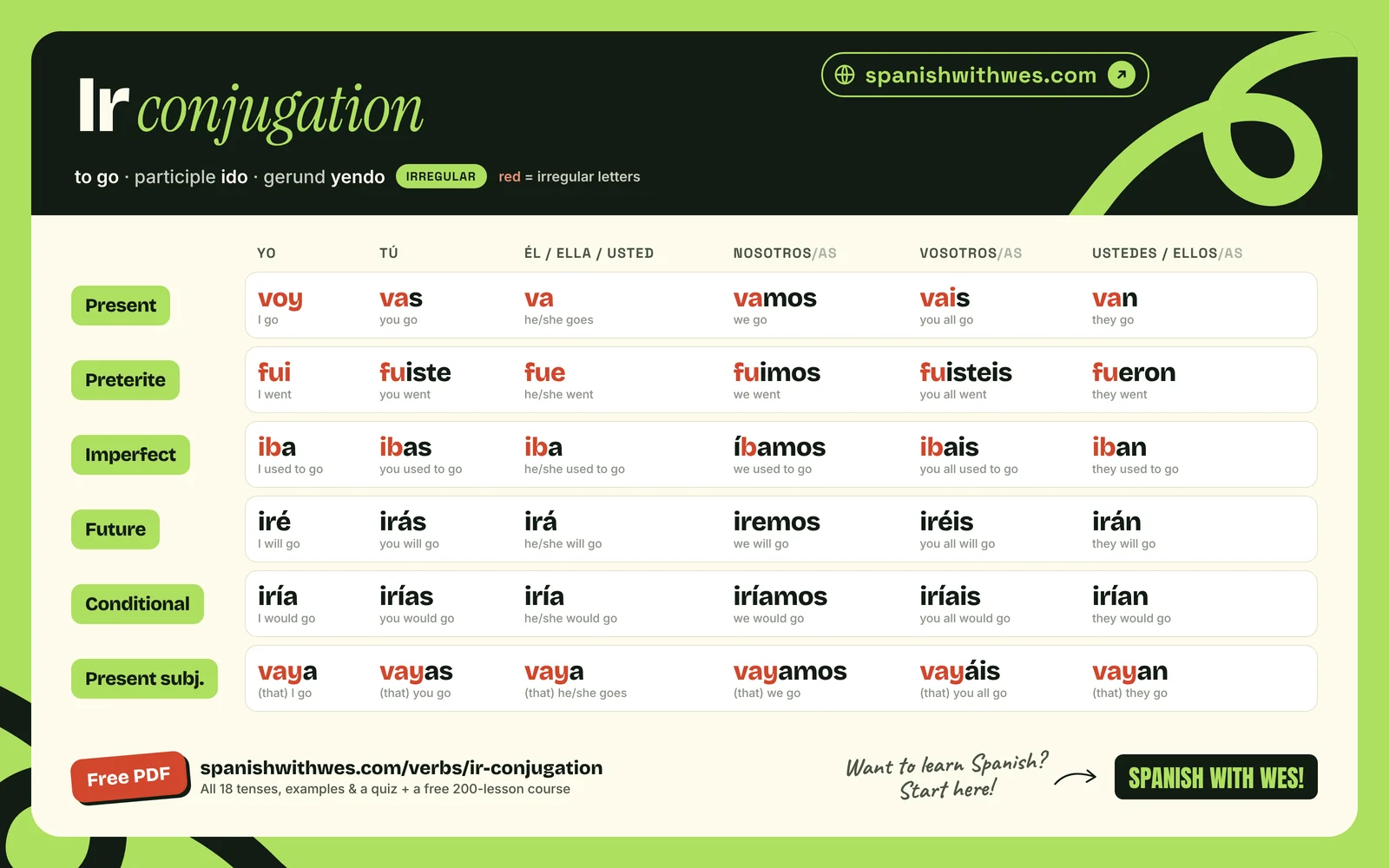
Just like "going to" in English, ir a + infinitive talks about the future: voy a estudiar (I'm going to study), vamos a ver (we'll see). In everyday Spanish it's used more often than the real future tense, so learn the present of ir first: voy, vas, va, vamos, vais, van.
Indicative tenses of ir
Facts and things that happen: the tenses you'll use most.
Present indicative
| yo | voyI go |
|---|---|
| tú | vasyou go |
| él/ella/usted | vahe/she goes |
| nosotros/as | vamoswe go |
| vosotros/as | vaisyou all go |
| ellos/ellas/ustedes | vanthey go |
Preterite indicative
| yo | fuiI went |
|---|---|
| tú | fuisteyou went |
| él/ella/usted | fuehe/she went |
| nosotros/as | fuimoswe went |
| vosotros/as | fuisteisyou all went |
| ellos/ellas/ustedes | fueronthey went |
Ir and ser share the same preterite: fui can mean "I went" or "I was".
Imperfect indicative
| yo | ibaI used to go |
|---|---|
| tú | ibasyou used to go |
| él/ella/usted | ibahe/she used to go |
| nosotros/as | íbamoswe used to go |
| vosotros/as | ibaisyou all used to go |
| ellos/ellas/ustedes | ibanthey used to go |
One of only three irregular imperfects in Spanish (with ser and ver).
Present continuous indicative
| yo | estoy yendoI am going |
|---|---|
| tú | estás yendoyou are going |
| él/ella/usted | está yendohe/she is going |
| nosotros/as | estamos yendowe are going |
| vosotros/as | estáis yendoyou all are going |
| ellos/ellas/ustedes | están yendothey are going |
estar + gerund
Informal future indicative
| yo | voy a irI am going to go |
|---|---|
| tú | vas a iryou are going to go |
| él/ella/usted | va a irhe/she is going to go |
| nosotros/as | vamos a irwe are going to go |
| vosotros/as | vais a iryou all are going to go |
| ellos/ellas/ustedes | van a irthey are going to go |
ir a + infinitive
Future indicative
| yo | iréI will go |
|---|---|
| tú | irásyou will go |
| él/ella/usted | iráhe/she will go |
| nosotros/as | iremoswe will go |
| vosotros/as | iréisyou all will go |
| ellos/ellas/ustedes | iránthey will go |
Conditional indicative
| yo | iríaI would go |
|---|---|
| tú | iríasyou would go |
| él/ella/usted | iríahe/she would go |
| nosotros/as | iríamoswe would go |
| vosotros/as | iríaisyou all would go |
| ellos/ellas/ustedes | iríanthey would go |
Present perfect indicative
| yo | he idoI have gone |
|---|---|
| tú | has idoyou have gone |
| él/ella/usted | ha idohe/she has gone |
| nosotros/as | hemos idowe have gone |
| vosotros/as | habéis idoyou all have gone |
| ellos/ellas/ustedes | han idothey have gone |
haber (present) + past participle
Past perfect indicative
| yo | había idoI had gone |
|---|---|
| tú | habías idoyou had gone |
| él/ella/usted | había idohe/she had gone |
| nosotros/as | habíamos idowe had gone |
| vosotros/as | habíais idoyou all had gone |
| ellos/ellas/ustedes | habían idothey had gone |
haber (imperfect) + past participle
Future perfect indicative
| yo | habré idoI will have gone |
|---|---|
| tú | habrás idoyou will have gone |
| él/ella/usted | habrá idohe/she will have gone |
| nosotros/as | habremos idowe will have gone |
| vosotros/as | habréis idoyou all will have gone |
| ellos/ellas/ustedes | habrán idothey will have gone |
haber (future) + past participle
Conditional perfect indicative
| yo | habría idoI would have gone |
|---|---|
| tú | habrías idoyou would have gone |
| él/ella/usted | habría idohe/she would have gone |
| nosotros/as | habríamos idowe would have gone |
| vosotros/as | habríais idoyou all would have gone |
| ellos/ellas/ustedes | habrían idothey would have gone |
haber (conditional) + past participle
Subjunctive tenses of ir
Wishes, doubts, emotions and "if" sentences.
Present subjunctive
| yo | vaya(that) I go |
|---|---|
| tú | vayas(that) you go |
| él/ella/usted | vaya(that) he/she goes |
| nosotros/as | vayamos(that) we go |
| vosotros/as | vayáis(that) you all go |
| ellos/ellas/ustedes | vayan(that) they go |
Imperfect subjunctive
| yo | fuera / fuese(if) I went |
|---|---|
| tú | fueras / fueses(if) you went |
| él/ella/usted | fuera / fuese(if) he/she went |
| nosotros/as | fuéramos / fuésemos(if) we went |
| vosotros/as | fuerais / fueseis(if) you all went |
| ellos/ellas/ustedes | fueran / fuesen(if) they went |
Future subjunctive
| yo | fuere(if) I go |
|---|---|
| tú | fueres(if) you go |
| él/ella/usted | fuere(if) he/she goes |
| nosotros/as | fuéremos(if) we go |
| vosotros/as | fuereis(if) you all go |
| ellos/ellas/ustedes | fueren(if) they go |
rarely used: legal & formal texts
Present perfect subjunctive
| yo | haya ido(that) I have gone |
|---|---|
| tú | hayas ido(that) you have gone |
| él/ella/usted | haya ido(that) he/she has gone |
| nosotros/as | hayamos ido(that) we have gone |
| vosotros/as | hayáis ido(that) you all have gone |
| ellos/ellas/ustedes | hayan ido(that) they have gone |
haber (present subj.) + past participle
Past perfect subjunctive
| yo | hubiera ido(if) I had gone |
|---|---|
| tú | hubieras ido(if) you had gone |
| él/ella/usted | hubiera ido(if) he/she had gone |
| nosotros/as | hubiéramos ido(if) we had gone |
| vosotros/as | hubierais ido(if) you all had gone |
| ellos/ellas/ustedes | hubieran ido(if) they had gone |
haber (imperfect subj.) + past participle
Future perfect subjunctive
| yo | hubiere ido(if) I will have gone |
|---|---|
| tú | hubieres ido(if) you will have gone |
| él/ella/usted | hubiere ido(if) he/she will have gone |
| nosotros/as | hubiéremos ido(if) we will have gone |
| vosotros/as | hubiereis ido(if) you all will have gone |
| ellos/ellas/ustedes | hubieren ido(if) they will have gone |
rarely used: legal & formal texts
Imperative tenses of ir
Commands and instructions.
Affirmative imperative
| tú | vego! |
|---|---|
| usted | vayago! (formal) |
| nosotros/as | vamoslet's go! |
| vosotros/as | idgo! (you all) |
| ustedes | vayango! (you all, formal) |
For "let's go!", everyone says ¡vamos! (not vayamos). Vete = go away.
Negative imperative
| tú | no vayasdon't go! |
|---|---|
| usted | no vayadon't go! (formal) |
| nosotros/as | no vayamoslet's not go! |
| vosotros/as | no vayáisdon't go! (you all) |
| ustedes | no vayandon't go! (you all, formal) |
Practice ir
Two quick exercises. No sign-up, no app: just you and ir.
How to use ir
Voy al supermercado.
I'm going to the supermarket.
Vamos a cenar fuera.
We're going to eat out.
¡Vamos a la playa!
Let's go to the beach!
¿Cómo te va?
How's it going?
Me voy, ¡hasta mañana!
I'm off, see you tomorrow!
Example sentences with ir
- ¿Adónde vas?Where are you going?
- Voy a llamarte luego.I'm going to call you later.
- Ayer fuimos al cine.Yesterday we went to the movies.
- De pequeño iba a la playa cada verano.As a kid I went to the beach every summer.
- Iré a México el año que viene.I'll go to Mexico next year.
- ¿Irías conmigo?Would you go with me?
- Quiero que vayas tú.I want you to go.
- ¡Vamos!Let's go!
Verbs like ir
Ser shares its preterite with ir (fui). Like voy, dar and estar end in -oy. And ser and ver are the only other verbs with an irregular imperfect.
Frequently asked questions about ir
Is ir regular or irregular?
Ir is completely irregular: voy (present), fui (preterite), iba (imperfect), vaya (subjunctive), ve (command) and the gerund yendo. Only the future (iré) and conditional (iría) are regular.
How do you conjugate ir in the present tense?
voy, vas, va, vamos, vais, van.
How do you conjugate ir in the preterite?
fui, fuiste, fue, fuimos, fuisteis, fueron. These are the same forms as the preterite of ser, so the context tells you if it means "went" or "was".
What does "ir a" + infinitive mean?
It's the informal future, like "going to" in English: voy a comer (I'm going to eat), va a llover (it's going to rain).
What is the difference between ir and irse?
Ir is to go somewhere: voy a la playa. Irse is to leave: me voy (I'm leaving), ¡vete! (go away!).
What is the past participle of ir?
The past participle is ido (he ido, I have gone) and the gerund is yendo.
Free cheat sheet
All 18 tenses of ir, on one page.
Print it, stick it on your fridge, or keep it on your phone. Fill in your name and email and I'll send it straight to your inbox.
📩 Check your inbox! The ir cheat sheet is on its way.
Paid courses
Ready to actually speak?
Knowing the conjugations is step one. My paid courses take you from tables to real conversations: structured, step by step, with practice built in.
- Conversational courseStop freezing in real conversations
- Verb tenses courseEvery tense, finally clear

Hola, soy Wes!
Your Spanish teacher
A Dutchie who learned Spanish from scratch. I make the lessons I wish I'd had: clear, practical and free.
My story →Support Spanish with Wes!
Did this page help you?
All my lessons, verb charts and cheat sheets are free, and I want to keep it that way. If you'd like to help me make more, you can support me here. Think of it as buying me a café con leche ☕
More Spanish verbs
Verb search
Find any Spanish verb.
Type a verb, an English word or a conjugated form like fui or hubo.