¿Cómo se dice…?
The most useful phrase for learners: ¿cómo se dice … en español? (how do you say … in Spanish?). And when someone tells you something: me dijo que… (he/she told me that…). On the phone in Spain you'll hear ¿diga? or ¿dígame? (hello?).
Indicative tenses of decir
Facts and things that happen: the tenses you'll use most.
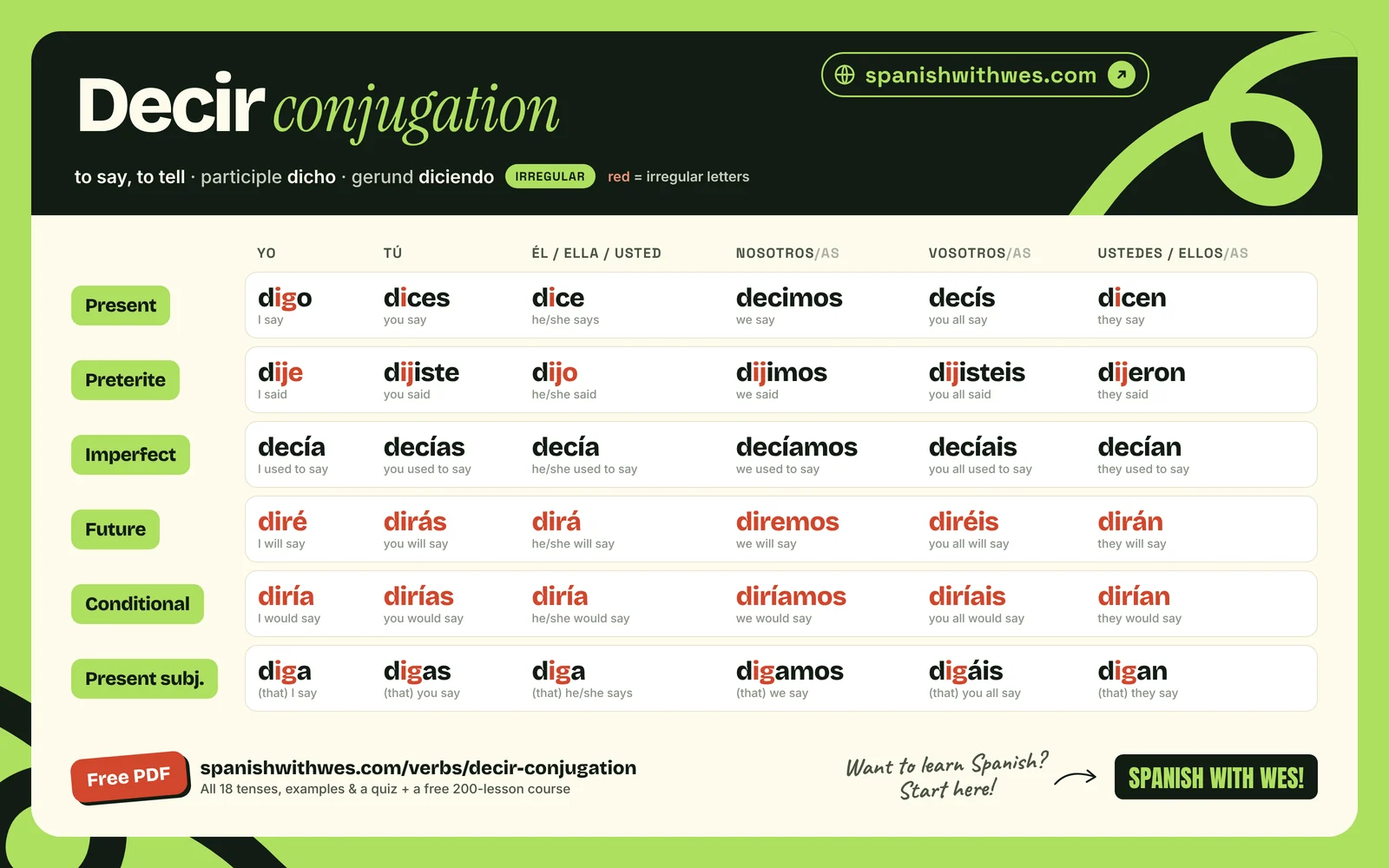
Present indicative
| yo | digoI say |
|---|---|
| tú | dicesyou say |
| él/ella/usted | dicehe/she says |
| nosotros/as | decimoswe say |
| vosotros/as | decísyou all say |
| ellos/ellas/ustedes | dicenthey say |
Stem change e → i (dices) and a g in the yo form: digo.
Preterite indicative
| yo | dijeI said |
|---|---|
| tú | dijisteyou said |
| él/ella/usted | dijohe/she said |
| nosotros/as | dijimoswe said |
| vosotros/as | dijisteisyou all said |
| ellos/ellas/ustedes | dijeronthey said |
Note dijeron, not "dijieron": after j the i drops.
Imperfect indicative
| yo | decíaI used to say |
|---|---|
| tú | decíasyou used to say |
| él/ella/usted | decíahe/she used to say |
| nosotros/as | decíamoswe used to say |
| vosotros/as | decíaisyou all used to say |
| ellos/ellas/ustedes | decíanthey used to say |
Present continuous indicative
| yo | estoy diciendoI am saying |
|---|---|
| tú | estás diciendoyou are saying |
| él/ella/usted | está diciendohe/she is saying |
| nosotros/as | estamos diciendowe are saying |
| vosotros/as | estáis diciendoyou all are saying |
| ellos/ellas/ustedes | están diciendothey are saying |
estar + gerund
Informal future indicative
| yo | voy a decirI am going to say |
|---|---|
| tú | vas a deciryou are going to say |
| él/ella/usted | va a decirhe/she is going to say |
| nosotros/as | vamos a decirwe are going to say |
| vosotros/as | vais a deciryou all are going to say |
| ellos/ellas/ustedes | van a decirthey are going to say |
ir a + infinitive
Future indicative
| yo | diréI will say |
|---|---|
| tú | dirásyou will say |
| él/ella/usted | diráhe/she will say |
| nosotros/as | diremoswe will say |
| vosotros/as | diréisyou all will say |
| ellos/ellas/ustedes | diránthey will say |
Short irregular stem dir-: diré, not "deciré".
Conditional indicative
| yo | diríaI would say |
|---|---|
| tú | diríasyou would say |
| él/ella/usted | diríahe/she would say |
| nosotros/as | diríamoswe would say |
| vosotros/as | diríaisyou all would say |
| ellos/ellas/ustedes | diríanthey would say |
Present perfect indicative
| yo | he dichoI have said |
|---|---|
| tú | has dichoyou have said |
| él/ella/usted | ha dichohe/she has said |
| nosotros/as | hemos dichowe have said |
| vosotros/as | habéis dichoyou all have said |
| ellos/ellas/ustedes | han dichothey have said |
haber (present) + past participle
Past perfect indicative
| yo | había dichoI had said |
|---|---|
| tú | habías dichoyou had said |
| él/ella/usted | había dichohe/she had said |
| nosotros/as | habíamos dichowe had said |
| vosotros/as | habíais dichoyou all had said |
| ellos/ellas/ustedes | habían dichothey had said |
haber (imperfect) + past participle
Future perfect indicative
| yo | habré dichoI will have said |
|---|---|
| tú | habrás dichoyou will have said |
| él/ella/usted | habrá dichohe/she will have said |
| nosotros/as | habremos dichowe will have said |
| vosotros/as | habréis dichoyou all will have said |
| ellos/ellas/ustedes | habrán dichothey will have said |
haber (future) + past participle
Conditional perfect indicative
| yo | habría dichoI would have said |
|---|---|
| tú | habrías dichoyou would have said |
| él/ella/usted | habría dichohe/she would have said |
| nosotros/as | habríamos dichowe would have said |
| vosotros/as | habríais dichoyou all would have said |
| ellos/ellas/ustedes | habrían dichothey would have said |
haber (conditional) + past participle
Subjunctive tenses of decir
Wishes, doubts, emotions and "if" sentences.
Present subjunctive
| yo | diga(that) I say |
|---|---|
| tú | digas(that) you say |
| él/ella/usted | diga(that) he/she says |
| nosotros/as | digamos(that) we say |
| vosotros/as | digáis(that) you all say |
| ellos/ellas/ustedes | digan(that) they say |
Imperfect subjunctive
| yo | dijera / dijese(if) I said |
|---|---|
| tú | dijeras / dijeses(if) you said |
| él/ella/usted | dijera / dijese(if) he/she said |
| nosotros/as | dijéramos / dijésemos(if) we said |
| vosotros/as | dijerais / dijeseis(if) you all said |
| ellos/ellas/ustedes | dijeran / dijesen(if) they said |
Future subjunctive
| yo | dijere(if) I say |
|---|---|
| tú | dijeres(if) you say |
| él/ella/usted | dijere(if) he/she says |
| nosotros/as | dijéremos(if) we say |
| vosotros/as | dijereis(if) you all say |
| ellos/ellas/ustedes | dijeren(if) they say |
rarely used: legal & formal texts
Present perfect subjunctive
| yo | haya dicho(that) I have said |
|---|---|
| tú | hayas dicho(that) you have said |
| él/ella/usted | haya dicho(that) he/she has said |
| nosotros/as | hayamos dicho(that) we have said |
| vosotros/as | hayáis dicho(that) you all have said |
| ellos/ellas/ustedes | hayan dicho(that) they have said |
haber (present subj.) + past participle
Past perfect subjunctive
| yo | hubiera dicho(if) I had said |
|---|---|
| tú | hubieras dicho(if) you had said |
| él/ella/usted | hubiera dicho(if) he/she had said |
| nosotros/as | hubiéramos dicho(if) we had said |
| vosotros/as | hubierais dicho(if) you all had said |
| ellos/ellas/ustedes | hubieran dicho(if) they had said |
haber (imperfect subj.) + past participle
Future perfect subjunctive
| yo | hubiere dicho(if) I will have said |
|---|---|
| tú | hubieres dicho(if) you will have said |
| él/ella/usted | hubiere dicho(if) he/she will have said |
| nosotros/as | hubiéremos dicho(if) we will have said |
| vosotros/as | hubiereis dicho(if) you all will have said |
| ellos/ellas/ustedes | hubieren dicho(if) they will have said |
rarely used: legal & formal texts
Imperative tenses of decir
Commands and instructions.
Affirmative imperative
| tú | disay! |
|---|---|
| usted | digasay! (formal) |
| nosotros/as | digamoslet's say! |
| vosotros/as | decidsay! (you all) |
| ustedes | digansay! (you all, formal) |
Negative imperative
| tú | no digasdon't say! |
|---|---|
| usted | no digadon't say! (formal) |
| nosotros/as | no digamoslet's not say! |
| vosotros/as | no digáisdon't say! (you all) |
| ustedes | no digandon't say! (you all, formal) |
Practice decir
Two quick exercises. No sign-up, no app: just you and decir.
How to use decir
Siempre dice la verdad.
He always tells the truth.
Te digo una cosa.
I'll tell you something.
Me dijo que estaba cansado.
He told me he was tired.
¿Cómo se dice "dog" en español?
How do you say "dog" in Spanish?
¿Diga?
Hello?
Example sentences with decir
- ¿Qué dices?What are you saying?
- Te lo digo en serio.I'm telling you seriously.
- ¿Qué te dijo?What did he tell you?
- Mi abuela siempre decía eso.My grandma always used to say that.
- No se lo diré a nadie.I won't tell anyone.
- ¿Qué dirías tú?What would you say?
- Dime la verdad.Tell me the truth.
- No me digas.No way! (lit. don't tell me)
Verbs like decir
Verbs ending in -decir (predecir, contradecir) follow decir. Traer and conducir share the -je preterite: traje, conduje, dije.
Frequently asked questions about decir
Is decir regular or irregular?
Decir is very irregular: digo (present), dije (preterite), diré (future), diga (subjunctive), di (command), and the irregular gerund and participle diciendo and dicho. Only the imperfect (decía) is fully regular.
How do you conjugate decir in the present tense?
digo, dices, dice, decimos, decís, dicen.
How do you conjugate decir in the preterite?
dije, dijiste, dijo, dijimos, dijisteis, dijeron.
What is the difference between decir and hablar?
Decir is to say or tell something specific: dijo que sí (he said yes). Hablar is to speak or talk in general: hablamos mucho (we talked a lot).
Is it "dijeron" or "dijieron"?
Always dijeron. After the j, the i of the ending drops: dijeron, trajeron, condujeron.
What is the past participle of decir?
The past participle is irregular: dicho (he dicho, I have said). The gerund is diciendo.
Free cheat sheet
All 18 tenses of decir, on one page.
Print it, stick it on your fridge, or keep it on your phone. Fill in your name and email and I'll send it straight to your inbox.
📩 Check your inbox! The decir cheat sheet is on its way.
Paid courses
Ready to actually speak?
Knowing the conjugations is step one. My paid courses take you from tables to real conversations: structured, step by step, with practice built in.
- Conversational courseStop freezing in real conversations
- Verb tenses courseEvery tense, finally clear

Hola, soy Wes!
Your Spanish teacher
A Dutchie who learned Spanish from scratch. I make the lessons I wish I'd had: clear, practical and free.
My story →Support Spanish with Wes!
Did this page help you?
All my lessons, verb charts and cheat sheets are free, and I want to keep it that way. If you'd like to help me make more, you can support me here. Think of it as buying me a café con leche ☕
More Spanish verbs
Verb search
Find any Spanish verb.
Type a verb, an English word or a conjugated form like fui or hubo.