¡Nos vemos!
Some of the most common phrases in Spanish use ver: ¡nos vemos! (see you!), a ver… (let's see…), ya veremos (we'll see), and no tiene nada que ver (it has nothing to do with it). For watching TV or a movie, Spanish also uses ver: ver una película.
Indicative tenses of ver
Facts and things that happen: the tenses you'll use most.
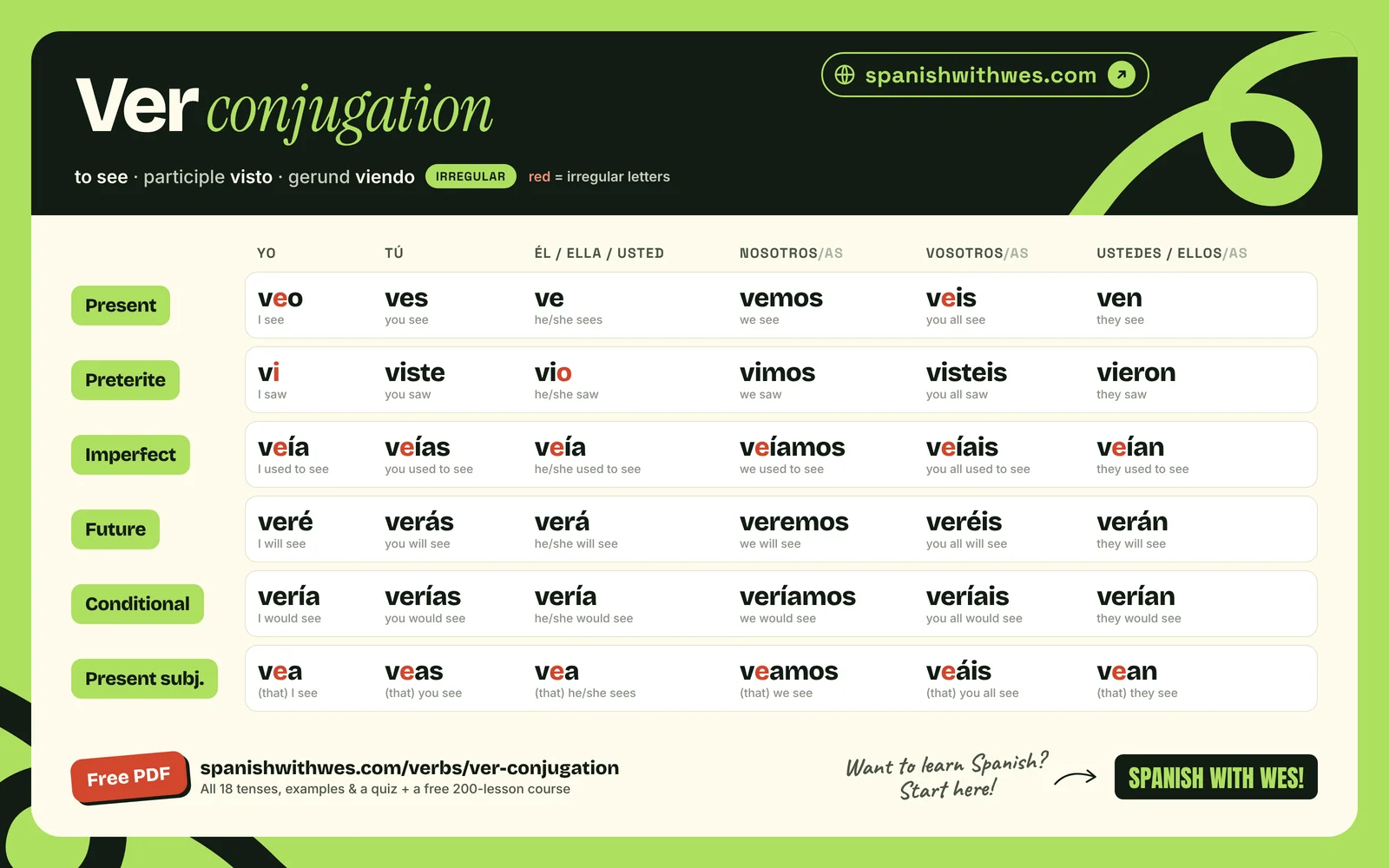
Present indicative
| yo | veoI see |
|---|---|
| tú | vesyou see |
| él/ella/usted | vehe/she sees |
| nosotros/as | vemoswe see |
| vosotros/as | veisyou all see |
| ellos/ellas/ustedes | venthey see |
Only the yo form adds an e: veo. Note veis without an accent.
Preterite indicative
| yo | viI saw |
|---|---|
| tú | visteyou saw |
| él/ella/usted | viohe/she saw |
| nosotros/as | vimoswe saw |
| vosotros/as | visteisyou all saw |
| ellos/ellas/ustedes | vieronthey saw |
No accents: vi, vio (one-syllable words don't need one).
Imperfect indicative
| yo | veíaI used to see |
|---|---|
| tú | veíasyou used to see |
| él/ella/usted | veíahe/she used to see |
| nosotros/as | veíamoswe used to see |
| vosotros/as | veíaisyou all used to see |
| ellos/ellas/ustedes | veíanthey used to see |
One of only three irregular imperfects (with ser and ir): it keeps the e.
Present continuous indicative
| yo | estoy viendoI am seeing |
|---|---|
| tú | estás viendoyou are seeing |
| él/ella/usted | está viendohe/she is seeing |
| nosotros/as | estamos viendowe are seeing |
| vosotros/as | estáis viendoyou all are seeing |
| ellos/ellas/ustedes | están viendothey are seeing |
estar + gerund
Informal future indicative
| yo | voy a verI am going to see |
|---|---|
| tú | vas a veryou are going to see |
| él/ella/usted | va a verhe/she is going to see |
| nosotros/as | vamos a verwe are going to see |
| vosotros/as | vais a veryou all are going to see |
| ellos/ellas/ustedes | van a verthey are going to see |
ir a + infinitive
Future indicative
| yo | veréI will see |
|---|---|
| tú | verásyou will see |
| él/ella/usted | veráhe/she will see |
| nosotros/as | veremoswe will see |
| vosotros/as | veréisyou all will see |
| ellos/ellas/ustedes | veránthey will see |
Conditional indicative
| yo | veríaI would see |
|---|---|
| tú | veríasyou would see |
| él/ella/usted | veríahe/she would see |
| nosotros/as | veríamoswe would see |
| vosotros/as | veríaisyou all would see |
| ellos/ellas/ustedes | veríanthey would see |
Present perfect indicative
| yo | he vistoI have seen |
|---|---|
| tú | has vistoyou have seen |
| él/ella/usted | ha vistohe/she has seen |
| nosotros/as | hemos vistowe have seen |
| vosotros/as | habéis vistoyou all have seen |
| ellos/ellas/ustedes | han vistothey have seen |
haber (present) + past participle
The past participle is irregular: visto.
Past perfect indicative
| yo | había vistoI had seen |
|---|---|
| tú | habías vistoyou had seen |
| él/ella/usted | había vistohe/she had seen |
| nosotros/as | habíamos vistowe had seen |
| vosotros/as | habíais vistoyou all had seen |
| ellos/ellas/ustedes | habían vistothey had seen |
haber (imperfect) + past participle
Future perfect indicative
| yo | habré vistoI will have seen |
|---|---|
| tú | habrás vistoyou will have seen |
| él/ella/usted | habrá vistohe/she will have seen |
| nosotros/as | habremos vistowe will have seen |
| vosotros/as | habréis vistoyou all will have seen |
| ellos/ellas/ustedes | habrán vistothey will have seen |
haber (future) + past participle
Conditional perfect indicative
| yo | habría vistoI would have seen |
|---|---|
| tú | habrías vistoyou would have seen |
| él/ella/usted | habría vistohe/she would have seen |
| nosotros/as | habríamos vistowe would have seen |
| vosotros/as | habríais vistoyou all would have seen |
| ellos/ellas/ustedes | habrían vistothey would have seen |
haber (conditional) + past participle
Subjunctive tenses of ver
Wishes, doubts, emotions and "if" sentences.
Present subjunctive
| yo | vea(that) I see |
|---|---|
| tú | veas(that) you see |
| él/ella/usted | vea(that) he/she sees |
| nosotros/as | veamos(that) we see |
| vosotros/as | veáis(that) you all see |
| ellos/ellas/ustedes | vean(that) they see |
Imperfect subjunctive
| yo | viera / viese(if) I saw |
|---|---|
| tú | vieras / vieses(if) you saw |
| él/ella/usted | viera / viese(if) he/she saw |
| nosotros/as | viéramos / viésemos(if) we saw |
| vosotros/as | vierais / vieseis(if) you all saw |
| ellos/ellas/ustedes | vieran / viesen(if) they saw |
Future subjunctive
| yo | viere(if) I see |
|---|---|
| tú | vieres(if) you see |
| él/ella/usted | viere(if) he/she sees |
| nosotros/as | viéremos(if) we see |
| vosotros/as | viereis(if) you all see |
| ellos/ellas/ustedes | vieren(if) they see |
rarely used: legal & formal texts
Present perfect subjunctive
| yo | haya visto(that) I have seen |
|---|---|
| tú | hayas visto(that) you have seen |
| él/ella/usted | haya visto(that) he/she has seen |
| nosotros/as | hayamos visto(that) we have seen |
| vosotros/as | hayáis visto(that) you all have seen |
| ellos/ellas/ustedes | hayan visto(that) they have seen |
haber (present subj.) + past participle
Past perfect subjunctive
| yo | hubiera visto(if) I had seen |
|---|---|
| tú | hubieras visto(if) you had seen |
| él/ella/usted | hubiera visto(if) he/she had seen |
| nosotros/as | hubiéramos visto(if) we had seen |
| vosotros/as | hubierais visto(if) you all had seen |
| ellos/ellas/ustedes | hubieran visto(if) they had seen |
haber (imperfect subj.) + past participle
Future perfect subjunctive
| yo | hubiere visto(if) I will have seen |
|---|---|
| tú | hubieres visto(if) you will have seen |
| él/ella/usted | hubiere visto(if) he/she will have seen |
| nosotros/as | hubiéremos visto(if) we will have seen |
| vosotros/as | hubiereis visto(if) you all will have seen |
| ellos/ellas/ustedes | hubieren visto(if) they will have seen |
rarely used: legal & formal texts
Imperative tenses of ver
Commands and instructions.
Affirmative imperative
| tú | vesee! |
|---|---|
| usted | veasee! (formal) |
| nosotros/as | veamoslet's see! |
| vosotros/as | vedsee! (you all) |
| ustedes | veansee! (you all, formal) |
Negative imperative
| tú | no veasdon't see! |
|---|---|
| usted | no veadon't see! (formal) |
| nosotros/as | no veamoslet's not see! |
| vosotros/as | no veáisdon't see! (you all) |
| ustedes | no veandon't see! (you all, formal) |
Practice ver
Two quick exercises. No sign-up, no app: just you and ver.
How to use ver
No veo nada sin mis gafas.
I can't see anything without my glasses.
Anoche vimos una serie.
Last night we watched a series.
¡Nos vemos el lunes!
See you on Monday!
A ver, ¿qué hacemos?
Let's see, what do we do?
Te ves muy bien.
You look great.
Example sentences with ver
- ¿Ves aquella casa?Do you see that house over there?
- ¡Nos vemos mañana!See you tomorrow!
- ¿Viste el partido ayer?Did you watch the game yesterday?
- De niño veía dibujos animados cada día.As a kid I watched cartoons every day.
- Ya veremos.We'll see.
- ¿Qué verías primero en Madrid?What would you see first in Madrid?
- Espero que lo veas pronto.I hope you see it soon.
- Nunca he visto la nieve.I've never seen snow.
Verbs like ver
Verbs ending in -ver like prever follow ver. Ser and ir are the only other verbs with an irregular imperfect. Poner also has an irregular participle (puesto, like visto).
Frequently asked questions about ver
Is ver regular or irregular?
Ver is irregular in a few places: veo (present yo), veía (imperfect), vea (subjunctive) and the participle visto. The preterite (vi, vio) only loses the accents. The future (veré) and conditional (vería) are regular.
How do you conjugate ver in the present tense?
veo, ves, ve, vemos, veis, ven.
How do you conjugate ver in the preterite?
vi, viste, vio, vimos, visteis, vieron.
What is the difference between ver and mirar?
Ver is to see (with your eyes, often without trying): no veo nada. Mirar is to look at something on purpose: mira esto (look at this). For TV and movies, ver is the most common.
What does "a ver" mean?
A ver means "let's see". Don't confuse it with haber, which sounds exactly the same.
What is the past participle of ver?
The past participle is irregular: visto (he visto, I have seen). The gerund is viendo.
Free cheat sheet
All 18 tenses of ver, on one page.
Print it, stick it on your fridge, or keep it on your phone. Fill in your name and email and I'll send it straight to your inbox.
📩 Check your inbox! The ver cheat sheet is on its way.
Paid courses
Ready to actually speak?
Knowing the conjugations is step one. My paid courses take you from tables to real conversations: structured, step by step, with practice built in.
- Conversational courseStop freezing in real conversations
- Verb tenses courseEvery tense, finally clear

Hola, soy Wes!
Your Spanish teacher
A Dutchie who learned Spanish from scratch. I make the lessons I wish I'd had: clear, practical and free.
My story →Support Spanish with Wes!
Did this page help you?
All my lessons, verb charts and cheat sheets are free, and I want to keep it that way. If you'd like to help me make more, you can support me here. Think of it as buying me a café con leche ☕
More Spanish verbs
Verb search
Find any Spanish verb.
Type a verb, an English word or a conjugated form like fui or hubo.