Se me ocurre…
Ocurrírsele algo a alguien = to think of something / come up with an idea: se me ocurre una idea (I've got an idea), ¿no se te ocurrió llamar? (didn't it occur to you to call?). In everyday speech, pasar is more common than ocurrir for "to happen".
Indicative tenses of ocurrir
Facts and things that happen: the tenses you'll use most.
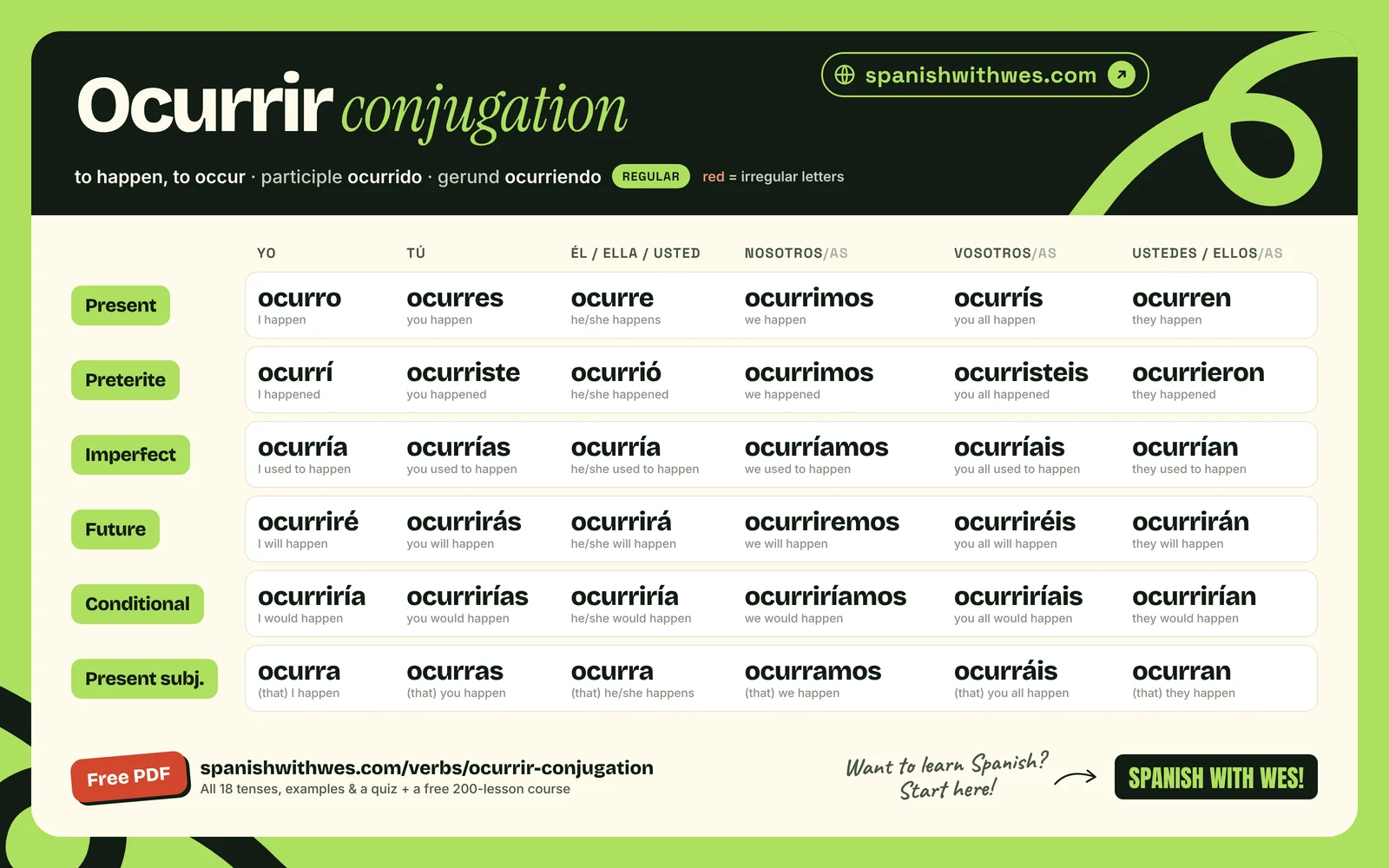
Present indicative
| yo | ocurroI happen |
|---|---|
| tú | ocurresyou happen |
| él/ella/usted | ocurrehe/she happens |
| nosotros/as | ocurrimoswe happen |
| vosotros/as | ocurrísyou all happen |
| ellos/ellas/ustedes | ocurrenthey happen |
Mostly used in the él/ella and ellos forms: ocurre, ocurren.
Preterite indicative
| yo | ocurríI happened |
|---|---|
| tú | ocurristeyou happened |
| él/ella/usted | ocurrióhe/she happened |
| nosotros/as | ocurrimoswe happened |
| vosotros/as | ocurristeisyou all happened |
| ellos/ellas/ustedes | ocurrieronthey happened |
Imperfect indicative
| yo | ocurríaI used to happen |
|---|---|
| tú | ocurríasyou used to happen |
| él/ella/usted | ocurríahe/she used to happen |
| nosotros/as | ocurríamoswe used to happen |
| vosotros/as | ocurríaisyou all used to happen |
| ellos/ellas/ustedes | ocurríanthey used to happen |
Present continuous indicative
| yo | estoy ocurriendoI am happening |
|---|---|
| tú | estás ocurriendoyou are happening |
| él/ella/usted | está ocurriendohe/she is happening |
| nosotros/as | estamos ocurriendowe are happening |
| vosotros/as | estáis ocurriendoyou all are happening |
| ellos/ellas/ustedes | están ocurriendothey are happening |
estar + gerund
Informal future indicative
| yo | voy a ocurrirI am going to happen |
|---|---|
| tú | vas a ocurriryou are going to happen |
| él/ella/usted | va a ocurrirhe/she is going to happen |
| nosotros/as | vamos a ocurrirwe are going to happen |
| vosotros/as | vais a ocurriryou all are going to happen |
| ellos/ellas/ustedes | van a ocurrirthey are going to happen |
ir a + infinitive
Future indicative
| yo | ocurriréI will happen |
|---|---|
| tú | ocurrirásyou will happen |
| él/ella/usted | ocurriráhe/she will happen |
| nosotros/as | ocurriremoswe will happen |
| vosotros/as | ocurriréisyou all will happen |
| ellos/ellas/ustedes | ocurriránthey will happen |
Conditional indicative
| yo | ocurriríaI would happen |
|---|---|
| tú | ocurriríasyou would happen |
| él/ella/usted | ocurriríahe/she would happen |
| nosotros/as | ocurriríamoswe would happen |
| vosotros/as | ocurriríaisyou all would happen |
| ellos/ellas/ustedes | ocurriríanthey would happen |
Present perfect indicative
| yo | he ocurridoI have happened |
|---|---|
| tú | has ocurridoyou have happened |
| él/ella/usted | ha ocurridohe/she has happened |
| nosotros/as | hemos ocurridowe have happened |
| vosotros/as | habéis ocurridoyou all have happened |
| ellos/ellas/ustedes | han ocurridothey have happened |
haber (present) + past participle
Past perfect indicative
| yo | había ocurridoI had happened |
|---|---|
| tú | habías ocurridoyou had happened |
| él/ella/usted | había ocurridohe/she had happened |
| nosotros/as | habíamos ocurridowe had happened |
| vosotros/as | habíais ocurridoyou all had happened |
| ellos/ellas/ustedes | habían ocurridothey had happened |
haber (imperfect) + past participle
Future perfect indicative
| yo | habré ocurridoI will have happened |
|---|---|
| tú | habrás ocurridoyou will have happened |
| él/ella/usted | habrá ocurridohe/she will have happened |
| nosotros/as | habremos ocurridowe will have happened |
| vosotros/as | habréis ocurridoyou all will have happened |
| ellos/ellas/ustedes | habrán ocurridothey will have happened |
haber (future) + past participle
Conditional perfect indicative
| yo | habría ocurridoI would have happened |
|---|---|
| tú | habrías ocurridoyou would have happened |
| él/ella/usted | habría ocurridohe/she would have happened |
| nosotros/as | habríamos ocurridowe would have happened |
| vosotros/as | habríais ocurridoyou all would have happened |
| ellos/ellas/ustedes | habrían ocurridothey would have happened |
haber (conditional) + past participle
Subjunctive tenses of ocurrir
Wishes, doubts, emotions and "if" sentences.
Present subjunctive
| yo | ocurra(that) I happen |
|---|---|
| tú | ocurras(that) you happen |
| él/ella/usted | ocurra(that) he/she happens |
| nosotros/as | ocurramos(that) we happen |
| vosotros/as | ocurráis(that) you all happen |
| ellos/ellas/ustedes | ocurran(that) they happen |
Imperfect subjunctive
| yo | ocurriera(if) I happened |
|---|---|
| tú | ocurrieras(if) you happened |
| él/ella/usted | ocurriera(if) he/she happened |
| nosotros/as | ocurriéramos(if) we happened |
| vosotros/as | ocurrierais(if) you all happened |
| ellos/ellas/ustedes | ocurrieran(if) they happened |
Future subjunctive
| yo | ocurriere(if) I happen |
|---|---|
| tú | ocurrieres(if) you happen |
| él/ella/usted | ocurriere(if) he/she happens |
| nosotros/as | ocurriéremos(if) we happen |
| vosotros/as | ocurriereis(if) you all happen |
| ellos/ellas/ustedes | ocurrieren(if) they happen |
rarely used: legal & formal texts
Present perfect subjunctive
| yo | haya ocurrido(that) I have happened |
|---|---|
| tú | hayas ocurrido(that) you have happened |
| él/ella/usted | haya ocurrido(that) he/she has happened |
| nosotros/as | hayamos ocurrido(that) we have happened |
| vosotros/as | hayáis ocurrido(that) you all have happened |
| ellos/ellas/ustedes | hayan ocurrido(that) they have happened |
haber (present subj.) + past participle
Past perfect subjunctive
| yo | hubiera ocurrido(if) I had happened |
|---|---|
| tú | hubieras ocurrido(if) you had happened |
| él/ella/usted | hubiera ocurrido(if) he/she had happened |
| nosotros/as | hubiéramos ocurrido(if) we had happened |
| vosotros/as | hubierais ocurrido(if) you all had happened |
| ellos/ellas/ustedes | hubieran ocurrido(if) they had happened |
haber (imperfect subj.) + past participle
Future perfect subjunctive
| yo | hubiere ocurrido(if) I will have happened |
|---|---|
| tú | hubieres ocurrido(if) you will have happened |
| él/ella/usted | hubiere ocurrido(if) he/she will have happened |
| nosotros/as | hubiéremos ocurrido(if) we will have happened |
| vosotros/as | hubiereis ocurrido(if) you all will have happened |
| ellos/ellas/ustedes | hubieren ocurrido(if) they will have happened |
rarely used: legal & formal texts
Imperative tenses of ocurrir
Commands and instructions.
Affirmative imperative
| tú | ocurrehappen! |
|---|---|
| usted | ocurrahappen! (formal) |
| nosotros/as | ocurramoslet's happen! |
| vosotros/as | ocurridhappen! (you all) |
| ustedes | ocurranhappen! (you all, formal) |
Negative imperative
| tú | no ocurrasdon't happen! |
|---|---|
| usted | no ocurradon't happen! (formal) |
| nosotros/as | no ocurramoslet's not happen! |
| vosotros/as | no ocurráisdon't happen! (you all) |
| ustedes | no ocurrandon't happen! (you all, formal) |
Practice ocurrir
Two quick exercises. No sign-up, no app: just you and ocurrir.
How to use ocurrir
¿Qué ocurre?
What's happening?
El accidente ocurrió anoche.
The accident happened last night.
Se me ocurrió una idea.
I came up with an idea.
No se me ocurre nada.
I can't think of anything.
Ocurrió en 1992.
It happened in 1992.
Example sentences with ocurrir
- ¿Qué te ocurre?What's wrong with you?
- Esto ocurre a menudo.This happens often.
- ¿Cuándo ocurrió?When did it happen?
- Siempre ocurría lo mismo.The same thing always used to happen.
- No volverá a ocurrir.It won't happen again.
- ¿Qué ocurriría si…?What would happen if…?
- Espero que no ocurra nada.I hope nothing happens.
- Ha ocurrido algo extraño.Something strange has happened.
Verbs like ocurrir
Pasar and suceder also mean "to happen". Ocurrir follows the regular -ir pattern like vivir.
Frequently asked questions about ocurrir
Is ocurrir regular or irregular?
Ocurrir is completely regular. It follows the normal -ir pattern in every tense.
How do you conjugate ocurrir in the present tense?
ocurro, ocurres, ocurre, ocurrimos, ocurrís, ocurren. In practice you'll mostly use ocurre and ocurren.
Ocurrir or pasar?
Both mean "to happen". Pasar is more common in conversation (¿qué pasa?); ocurrir sounds a bit more formal.
What does "se me ocurrió" mean?
"It occurred to me" or "I came up with": se me ocurrió una idea genial.
Is it "ocurrir" or "occurrir"?
Always ocurrir, with one c and double r.
What is the past participle of ocurrir?
The past participle is ocurrido and the gerund is ocurriendo.
Free cheat sheet
All 18 tenses of ocurrir, on one page.
Print it, stick it on your fridge, or keep it on your phone. Fill in your name and email and I'll send it straight to your inbox.
📩 Check your inbox! The ocurrir cheat sheet is on its way.
Paid courses
Ready to actually speak?
Knowing the conjugations is step one. My paid courses take you from tables to real conversations: structured, step by step, with practice built in.
- Conversational courseStop freezing in real conversations
- Verb tenses courseEvery tense, finally clear

Hola, soy Wes!
Your Spanish teacher
A Dutchie who learned Spanish from scratch. I make the lessons I wish I'd had: clear, practical and free.
My story →Support Spanish with Wes!
Did this page help you?
All my lessons, verb charts and cheat sheets are free, and I want to keep it that way. If you'd like to help me make more, you can support me here. Think of it as buying me a café con leche ☕
More Spanish verbs
Verb search
Find any Spanish verb.
Type a verb, an English word or a conjugated form like fui or hubo.