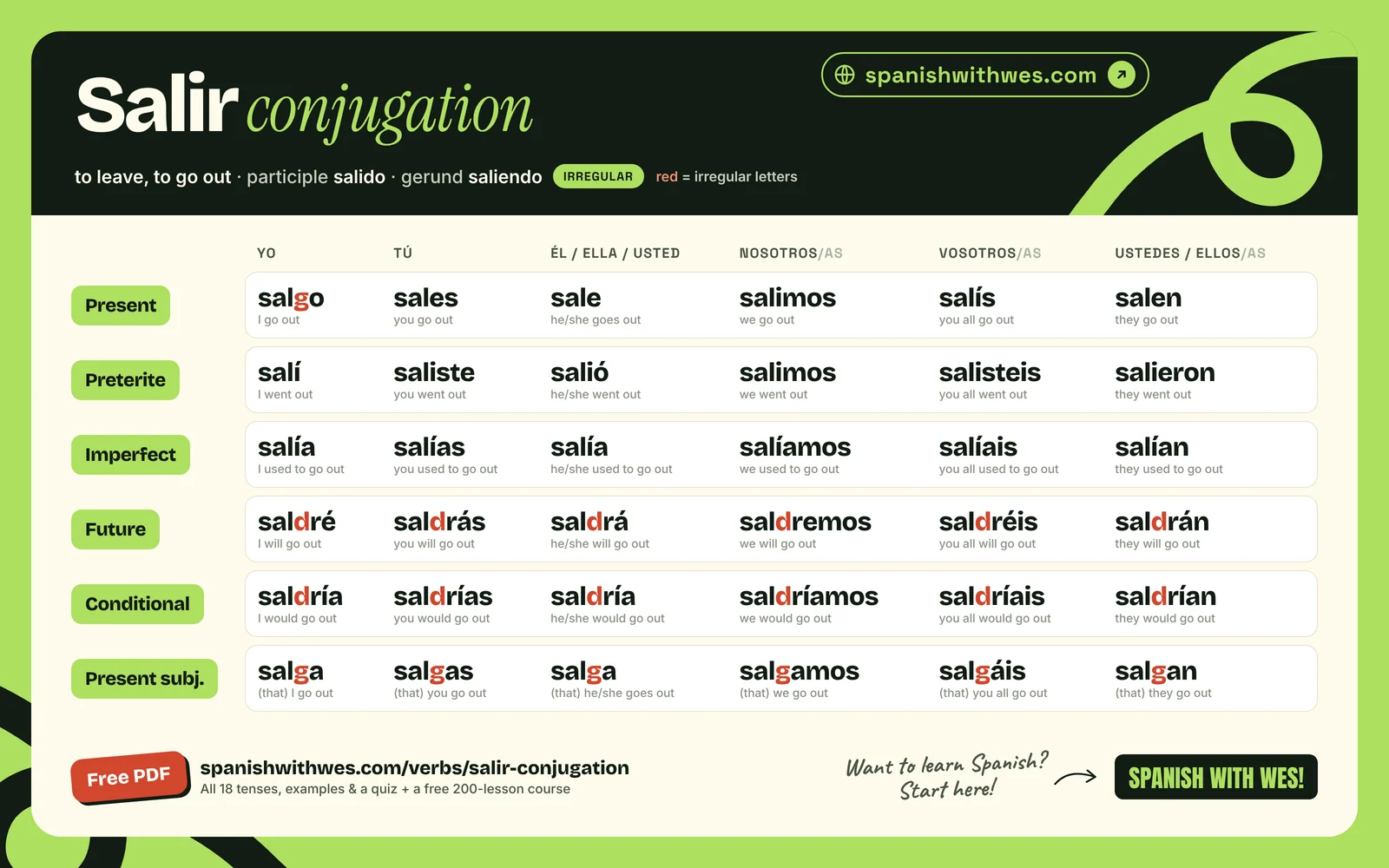
Salir, irse or dejar?
Salir = to go out / leave a place: salgo de casa a las ocho. Irse = to leave, go away (without saying where from): me voy. Dejar = to leave something behind: dejé el móvil. And salir bien / mal = to turn out well / badly.
Indicative tenses of salir
Facts and things that happen: the tenses you'll use most.
Present indicative
| yo | salgoI go out |
|---|---|
| tú | salesyou go out |
| él/ella/usted | salehe/she goes out |
| nosotros/as | salimoswe go out |
| vosotros/as | salísyou all go out |
| ellos/ellas/ustedes | salenthey go out |
Only the yo form is irregular: an extra g (salgo).
Preterite indicative
| yo | salíI went out |
|---|---|
| tú | salisteyou went out |
| él/ella/usted | salióhe/she went out |
| nosotros/as | salimoswe went out |
| vosotros/as | salisteisyou all went out |
| ellos/ellas/ustedes | salieronthey went out |
The preterite is fully regular: salí, saliste, salió.
Imperfect indicative
| yo | salíaI used to go out |
|---|---|
| tú | salíasyou used to go out |
| él/ella/usted | salíahe/she used to go out |
| nosotros/as | salíamoswe used to go out |
| vosotros/as | salíaisyou all used to go out |
| ellos/ellas/ustedes | salíanthey used to go out |
Present continuous indicative
| yo | estoy saliendoI am going out |
|---|---|
| tú | estás saliendoyou are going out |
| él/ella/usted | está saliendohe/she is going out |
| nosotros/as | estamos saliendowe are going out |
| vosotros/as | estáis saliendoyou all are going out |
| ellos/ellas/ustedes | están saliendothey are going out |
estar + gerund
Informal future indicative
| yo | voy a salirI am going to go out |
|---|---|
| tú | vas a saliryou are going to go out |
| él/ella/usted | va a salirhe/she is going to go out |
| nosotros/as | vamos a salirwe are going to go out |
| vosotros/as | vais a saliryou all are going to go out |
| ellos/ellas/ustedes | van a salirthey are going to go out |
ir a + infinitive
Future indicative
| yo | saldréI will go out |
|---|---|
| tú | saldrásyou will go out |
| él/ella/usted | saldráhe/she will go out |
| nosotros/as | saldremoswe will go out |
| vosotros/as | saldréisyou all will go out |
| ellos/ellas/ustedes | saldránthey will go out |
Irregular stem saldr-: saldré, not "saliré".
Conditional indicative
| yo | saldríaI would go out |
|---|---|
| tú | saldríasyou would go out |
| él/ella/usted | saldríahe/she would go out |
| nosotros/as | saldríamoswe would go out |
| vosotros/as | saldríaisyou all would go out |
| ellos/ellas/ustedes | saldríanthey would go out |
Present perfect indicative
| yo | he salidoI have gone out |
|---|---|
| tú | has salidoyou have gone out |
| él/ella/usted | ha salidohe/she has gone out |
| nosotros/as | hemos salidowe have gone out |
| vosotros/as | habéis salidoyou all have gone out |
| ellos/ellas/ustedes | han salidothey have gone out |
haber (present) + past participle
Past perfect indicative
| yo | había salidoI had gone out |
|---|---|
| tú | habías salidoyou had gone out |
| él/ella/usted | había salidohe/she had gone out |
| nosotros/as | habíamos salidowe had gone out |
| vosotros/as | habíais salidoyou all had gone out |
| ellos/ellas/ustedes | habían salidothey had gone out |
haber (imperfect) + past participle
Future perfect indicative
| yo | habré salidoI will have gone out |
|---|---|
| tú | habrás salidoyou will have gone out |
| él/ella/usted | habrá salidohe/she will have gone out |
| nosotros/as | habremos salidowe will have gone out |
| vosotros/as | habréis salidoyou all will have gone out |
| ellos/ellas/ustedes | habrán salidothey will have gone out |
haber (future) + past participle
Conditional perfect indicative
| yo | habría salidoI would have gone out |
|---|---|
| tú | habrías salidoyou would have gone out |
| él/ella/usted | habría salidohe/she would have gone out |
| nosotros/as | habríamos salidowe would have gone out |
| vosotros/as | habríais salidoyou all would have gone out |
| ellos/ellas/ustedes | habrían salidothey would have gone out |
haber (conditional) + past participle
Subjunctive tenses of salir
Wishes, doubts, emotions and "if" sentences.
Present subjunctive
| yo | salga(that) I go out |
|---|---|
| tú | salgas(that) you go out |
| él/ella/usted | salga(that) he/she goes out |
| nosotros/as | salgamos(that) we go out |
| vosotros/as | salgáis(that) you all go out |
| ellos/ellas/ustedes | salgan(that) they go out |
Imperfect subjunctive
| yo | saliera(if) I went out |
|---|---|
| tú | salieras(if) you went out |
| él/ella/usted | saliera(if) he/she went out |
| nosotros/as | saliéramos(if) we went out |
| vosotros/as | salierais(if) you all went out |
| ellos/ellas/ustedes | salieran(if) they went out |
Future subjunctive
| yo | saliere(if) I go out |
|---|---|
| tú | salieres(if) you go out |
| él/ella/usted | saliere(if) he/she goes out |
| nosotros/as | saliéremos(if) we go out |
| vosotros/as | saliereis(if) you all go out |
| ellos/ellas/ustedes | salieren(if) they go out |
rarely used: legal & formal texts
Present perfect subjunctive
| yo | haya salido(that) I have gone out |
|---|---|
| tú | hayas salido(that) you have gone out |
| él/ella/usted | haya salido(that) he/she has gone out |
| nosotros/as | hayamos salido(that) we have gone out |
| vosotros/as | hayáis salido(that) you all have gone out |
| ellos/ellas/ustedes | hayan salido(that) they have gone out |
haber (present subj.) + past participle
Past perfect subjunctive
| yo | hubiera salido(if) I had gone out |
|---|---|
| tú | hubieras salido(if) you had gone out |
| él/ella/usted | hubiera salido(if) he/she had gone out |
| nosotros/as | hubiéramos salido(if) we had gone out |
| vosotros/as | hubierais salido(if) you all had gone out |
| ellos/ellas/ustedes | hubieran salido(if) they had gone out |
haber (imperfect subj.) + past participle
Future perfect subjunctive
| yo | hubiere salido(if) I will have gone out |
|---|---|
| tú | hubieres salido(if) you will have gone out |
| él/ella/usted | hubiere salido(if) he/she will have gone out |
| nosotros/as | hubiéremos salido(if) we will have gone out |
| vosotros/as | hubiereis salido(if) you all will have gone out |
| ellos/ellas/ustedes | hubieren salido(if) they will have gone out |
rarely used: legal & formal texts
Imperative tenses of salir
Commands and instructions.
Affirmative imperative
| tú | salgo out! |
|---|---|
| usted | salgago out! (formal) |
| nosotros/as | salgamoslet's go out! |
| vosotros/as | salidgo out! (you all) |
| ustedes | salgango out! (you all, formal) |
Negative imperative
| tú | no salgasdon't go out! |
|---|---|
| usted | no salgadon't go out! (formal) |
| nosotros/as | no salgamoslet's not go out! |
| vosotros/as | no salgáisdon't go out! (you all) |
| ustedes | no salgandon't go out! (you all, formal) |
Practice salir
Two quick exercises. No sign-up, no app: just you and salir.
How to use salir
¿Salimos esta noche?
Shall we go out tonight?
Salgo de casa a las ocho.
I leave home at eight.
Sale con un chico de Madrid.
She's dating a guy from Madrid.
Todo salió bien.
Everything turned out well.
El tren sale a las diez.
The train leaves at ten.
Example sentences with salir
- ¿A qué hora sales del trabajo?What time do you finish work?
- Salgo en cinco minutos.I'm leaving in five minutes.
- Anoche salimos hasta las tres.Last night we stayed out until three.
- Antes salía todos los fines de semana.I used to go out every weekend.
- El vuelo saldrá con retraso.The flight will leave late.
- ¿Saldrías conmigo?Would you go out with me?
- ¡Sal de ahí!Get out of there!
- Espero que salga bien.I hope it goes well.
Verbs like salir
Like salgo, these verbs have a g in the yo form. Poner, tener and valer also have a -dr- future: pondré, tendré, valdré.
Frequently asked questions about salir
Is salir regular or irregular?
Salir is irregular in the present yo form (salgo), the future and conditional (saldré, saldría), the subjunctive (salga) and the command (sal). The preterite (salí) and imperfect (salía) are regular.
How do you conjugate salir in the present tense?
salgo, sales, sale, salimos, salís, salen.
How do you conjugate salir in the preterite?
salí, saliste, salió, salimos, salisteis, salieron.
What does "salir con" mean?
"To go out with" or "to date" someone: ¿con quién sales? (who are you dating?).
Salir or irse?
Salir focuses on leaving a place (salgo de la oficina). Irse just means "to go away / leave" (me voy).
What is the past participle of salir?
The past participle is salido and the gerund is saliendo.
Free cheat sheet
All 18 tenses of salir, on one page.
Print it, stick it on your fridge, or keep it on your phone. Fill in your name and email and I'll send it straight to your inbox.
📩 Check your inbox! The salir cheat sheet is on its way.
Paid courses
Ready to actually speak?
Knowing the conjugations is step one. My paid courses take you from tables to real conversations: structured, step by step, with practice built in.
- Conversational courseStop freezing in real conversations
- Verb tenses courseEvery tense, finally clear

Hola, soy Wes!
Your Spanish teacher
A Dutchie who learned Spanish from scratch. I make the lessons I wish I'd had: clear, practical and free.
My story →Support Spanish with Wes!
Did this page help you?
All my lessons, verb charts and cheat sheets are free, and I want to keep it that way. If you'd like to help me make more, you can support me here. Think of it as buying me a café con leche ☕
More Spanish verbs
Verb search
Find any Spanish verb.
Type a verb, an English word or a conjugated form like fui or hubo.