Permitirse = to afford
Permitirse means "to afford": no puedo permitirme un coche nuevo. On signs you'll see no se permite fumar (smoking not allowed). ¿Me permite? = may I? And with a person + infinitive: no me permiten salir (they don't let me go out).
Indicative tenses of permitir
Facts and things that happen: the tenses you'll use most.
Present indicative
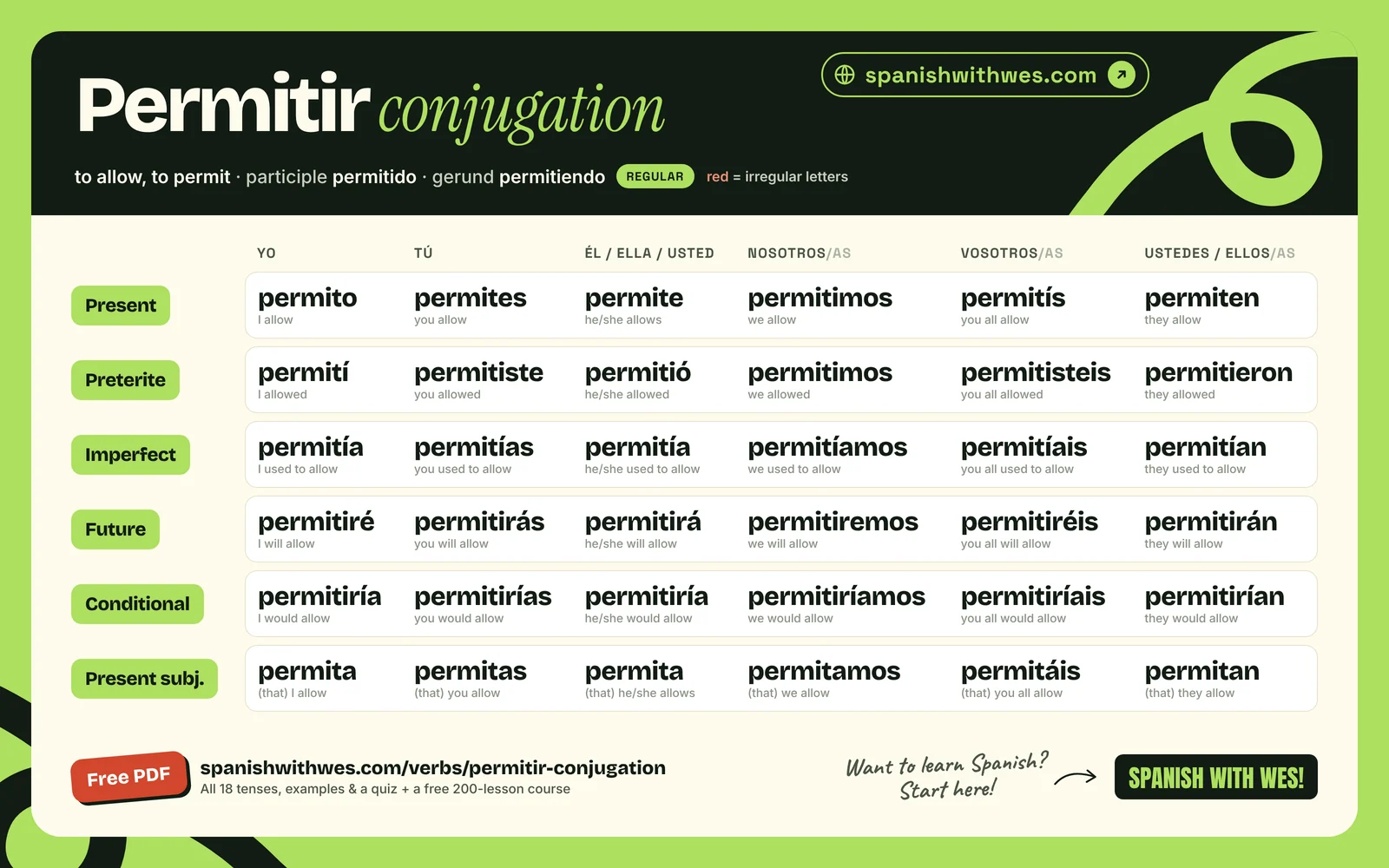
| yo | permitoI allow |
|---|---|
| tú | permitesyou allow |
| él/ella/usted | permitehe/she allows |
| nosotros/as | permitimoswe allow |
| vosotros/as | permitísyou all allow |
| ellos/ellas/ustedes | permitenthey allow |
¿Me permite? = may I? (polite, when passing or taking something).
Preterite indicative
| yo | permitíI allowed |
|---|---|
| tú | permitisteyou allowed |
| él/ella/usted | permitióhe/she allowed |
| nosotros/as | permitimoswe allowed |
| vosotros/as | permitisteisyou all allowed |
| ellos/ellas/ustedes | permitieronthey allowed |
Imperfect indicative
| yo | permitíaI used to allow |
|---|---|
| tú | permitíasyou used to allow |
| él/ella/usted | permitíahe/she used to allow |
| nosotros/as | permitíamoswe used to allow |
| vosotros/as | permitíaisyou all used to allow |
| ellos/ellas/ustedes | permitíanthey used to allow |
Present continuous indicative
| yo | estoy permitiendoI am allowing |
|---|---|
| tú | estás permitiendoyou are allowing |
| él/ella/usted | está permitiendohe/she is allowing |
| nosotros/as | estamos permitiendowe are allowing |
| vosotros/as | estáis permitiendoyou all are allowing |
| ellos/ellas/ustedes | están permitiendothey are allowing |
estar + gerund
Informal future indicative
| yo | voy a permitirI am going to allow |
|---|---|
| tú | vas a permitiryou are going to allow |
| él/ella/usted | va a permitirhe/she is going to allow |
| nosotros/as | vamos a permitirwe are going to allow |
| vosotros/as | vais a permitiryou all are going to allow |
| ellos/ellas/ustedes | van a permitirthey are going to allow |
ir a + infinitive
Future indicative
| yo | permitiréI will allow |
|---|---|
| tú | permitirásyou will allow |
| él/ella/usted | permitiráhe/she will allow |
| nosotros/as | permitiremoswe will allow |
| vosotros/as | permitiréisyou all will allow |
| ellos/ellas/ustedes | permitiránthey will allow |
Conditional indicative
| yo | permitiríaI would allow |
|---|---|
| tú | permitiríasyou would allow |
| él/ella/usted | permitiríahe/she would allow |
| nosotros/as | permitiríamoswe would allow |
| vosotros/as | permitiríaisyou all would allow |
| ellos/ellas/ustedes | permitiríanthey would allow |
Present perfect indicative
| yo | he permitidoI have allowed |
|---|---|
| tú | has permitidoyou have allowed |
| él/ella/usted | ha permitidohe/she has allowed |
| nosotros/as | hemos permitidowe have allowed |
| vosotros/as | habéis permitidoyou all have allowed |
| ellos/ellas/ustedes | han permitidothey have allowed |
haber (present) + past participle
Past perfect indicative
| yo | había permitidoI had allowed |
|---|---|
| tú | habías permitidoyou had allowed |
| él/ella/usted | había permitidohe/she had allowed |
| nosotros/as | habíamos permitidowe had allowed |
| vosotros/as | habíais permitidoyou all had allowed |
| ellos/ellas/ustedes | habían permitidothey had allowed |
haber (imperfect) + past participle
Future perfect indicative
| yo | habré permitidoI will have allowed |
|---|---|
| tú | habrás permitidoyou will have allowed |
| él/ella/usted | habrá permitidohe/she will have allowed |
| nosotros/as | habremos permitidowe will have allowed |
| vosotros/as | habréis permitidoyou all will have allowed |
| ellos/ellas/ustedes | habrán permitidothey will have allowed |
haber (future) + past participle
Conditional perfect indicative
| yo | habría permitidoI would have allowed |
|---|---|
| tú | habrías permitidoyou would have allowed |
| él/ella/usted | habría permitidohe/she would have allowed |
| nosotros/as | habríamos permitidowe would have allowed |
| vosotros/as | habríais permitidoyou all would have allowed |
| ellos/ellas/ustedes | habrían permitidothey would have allowed |
haber (conditional) + past participle
Subjunctive tenses of permitir
Wishes, doubts, emotions and "if" sentences.
Present subjunctive
| yo | permita(that) I allow |
|---|---|
| tú | permitas(that) you allow |
| él/ella/usted | permita(that) he/she allows |
| nosotros/as | permitamos(that) we allow |
| vosotros/as | permitáis(that) you all allow |
| ellos/ellas/ustedes | permitan(that) they allow |
Imperfect subjunctive
| yo | permitiera(if) I allowed |
|---|---|
| tú | permitieras(if) you allowed |
| él/ella/usted | permitiera(if) he/she allowed |
| nosotros/as | permitiéramos(if) we allowed |
| vosotros/as | permitierais(if) you all allowed |
| ellos/ellas/ustedes | permitieran(if) they allowed |
Future subjunctive
| yo | permitiere(if) I allow |
|---|---|
| tú | permitieres(if) you allow |
| él/ella/usted | permitiere(if) he/she allows |
| nosotros/as | permitiéremos(if) we allow |
| vosotros/as | permitiereis(if) you all allow |
| ellos/ellas/ustedes | permitieren(if) they allow |
rarely used: legal & formal texts
Present perfect subjunctive
| yo | haya permitido(that) I have allowed |
|---|---|
| tú | hayas permitido(that) you have allowed |
| él/ella/usted | haya permitido(that) he/she has allowed |
| nosotros/as | hayamos permitido(that) we have allowed |
| vosotros/as | hayáis permitido(that) you all have allowed |
| ellos/ellas/ustedes | hayan permitido(that) they have allowed |
haber (present subj.) + past participle
Past perfect subjunctive
| yo | hubiera permitido(if) I had allowed |
|---|---|
| tú | hubieras permitido(if) you had allowed |
| él/ella/usted | hubiera permitido(if) he/she had allowed |
| nosotros/as | hubiéramos permitido(if) we had allowed |
| vosotros/as | hubierais permitido(if) you all had allowed |
| ellos/ellas/ustedes | hubieran permitido(if) they had allowed |
haber (imperfect subj.) + past participle
Future perfect subjunctive
| yo | hubiere permitido(if) I will have allowed |
|---|---|
| tú | hubieres permitido(if) you will have allowed |
| él/ella/usted | hubiere permitido(if) he/she will have allowed |
| nosotros/as | hubiéremos permitido(if) we will have allowed |
| vosotros/as | hubiereis permitido(if) you all will have allowed |
| ellos/ellas/ustedes | hubieren permitido(if) they will have allowed |
rarely used: legal & formal texts
Imperative tenses of permitir
Commands and instructions.
Affirmative imperative
| tú | permiteallow! |
|---|---|
| usted | permitaallow! (formal) |
| nosotros/as | permitamoslet's allow! |
| vosotros/as | permitidallow! (you all) |
| ustedes | permitanallow! (you all, formal) |
Negative imperative
| tú | no permitasdon't allow! |
|---|---|
| usted | no permitadon't allow! (formal) |
| nosotros/as | no permitamoslet's not allow! |
| vosotros/as | no permitáisdon't allow! (you all) |
| ustedes | no permitandon't allow! (you all, formal) |
Practice permitir
Two quick exercises. No sign-up, no app: just you and permitir.
How to use permitir
No permiten perros.
Dogs aren't allowed.
Mis padres no me permitían salir.
My parents didn't let me go out.
No me lo puedo permitir.
I can't afford it.
No se permite fumar.
No smoking.
¿Me permite pasar?
May I get through?
Example sentences with permitir
- ¿Se permite hacer fotos?Are photos allowed?
- No permito que me hables así.I won't let you talk to me like that.
- Me permitieron entrar.They let me in.
- El profesor no permitía móviles.The teacher didn't allow phones.
- Esto te permitirá ahorrar tiempo.This will let you save time.
- ¿Me permitirías usar tu ordenador?Would you let me use your computer?
- Permíteme ayudarte.Let me help you.
- No está permitido.It's not allowed.
Verbs like permitir
Permitir follows the regular -ir pattern like vivir. In everyday speech, dejar is a common synonym: no me dejan salir.
Frequently asked questions about permitir
Is permitir regular or irregular?
Permitir is completely regular. It follows the normal -ir pattern in every tense.
How do you conjugate permitir in the present tense?
permito, permites, permite, permitimos, permitís, permiten.
Permitir or dejar?
Both mean "to allow / let". Dejar is more common in conversation; permitir sounds more formal.
How do you say "I can't afford it" in Spanish?
No me lo puedo permitir or no puedo permitírmelo.
What does "no se permite" mean?
"It's not allowed": no se permite fumar (no smoking).
What is the past participle of permitir?
The past participle is permitido and the gerund is permitiendo.
Free cheat sheet
All 18 tenses of permitir, on one page.
Print it, stick it on your fridge, or keep it on your phone. Fill in your name and email and I'll send it straight to your inbox.
📩 Check your inbox! The permitir cheat sheet is on its way.
Paid courses
Ready to actually speak?
Knowing the conjugations is step one. My paid courses take you from tables to real conversations: structured, step by step, with practice built in.
- Conversational courseStop freezing in real conversations
- Verb tenses courseEvery tense, finally clear

Hola, soy Wes!
Your Spanish teacher
A Dutchie who learned Spanish from scratch. I make the lessons I wish I'd had: clear, practical and free.
My story →Support Spanish with Wes!
Did this page help you?
All my lessons, verb charts and cheat sheets are free, and I want to keep it that way. If you'd like to help me make more, you can support me here. Think of it as buying me a café con leche ☕
More Spanish verbs
Verb search
Find any Spanish verb.
Type a verb, an English word or a conjugated form like fui or hubo.