Acabar de = to have just
Spanish has no word for "just" in this sense — it uses acabar de. Present: Acabo de verlo (I've just seen it). Imperfect: Acababa de salir (I had just left). Also handy: se acabó (it's over / it ran out) and se me acabó el dinero (I ran out of money).
Indicative tenses of acabar
Facts and things that happen: the tenses you'll use most.
Present indicative
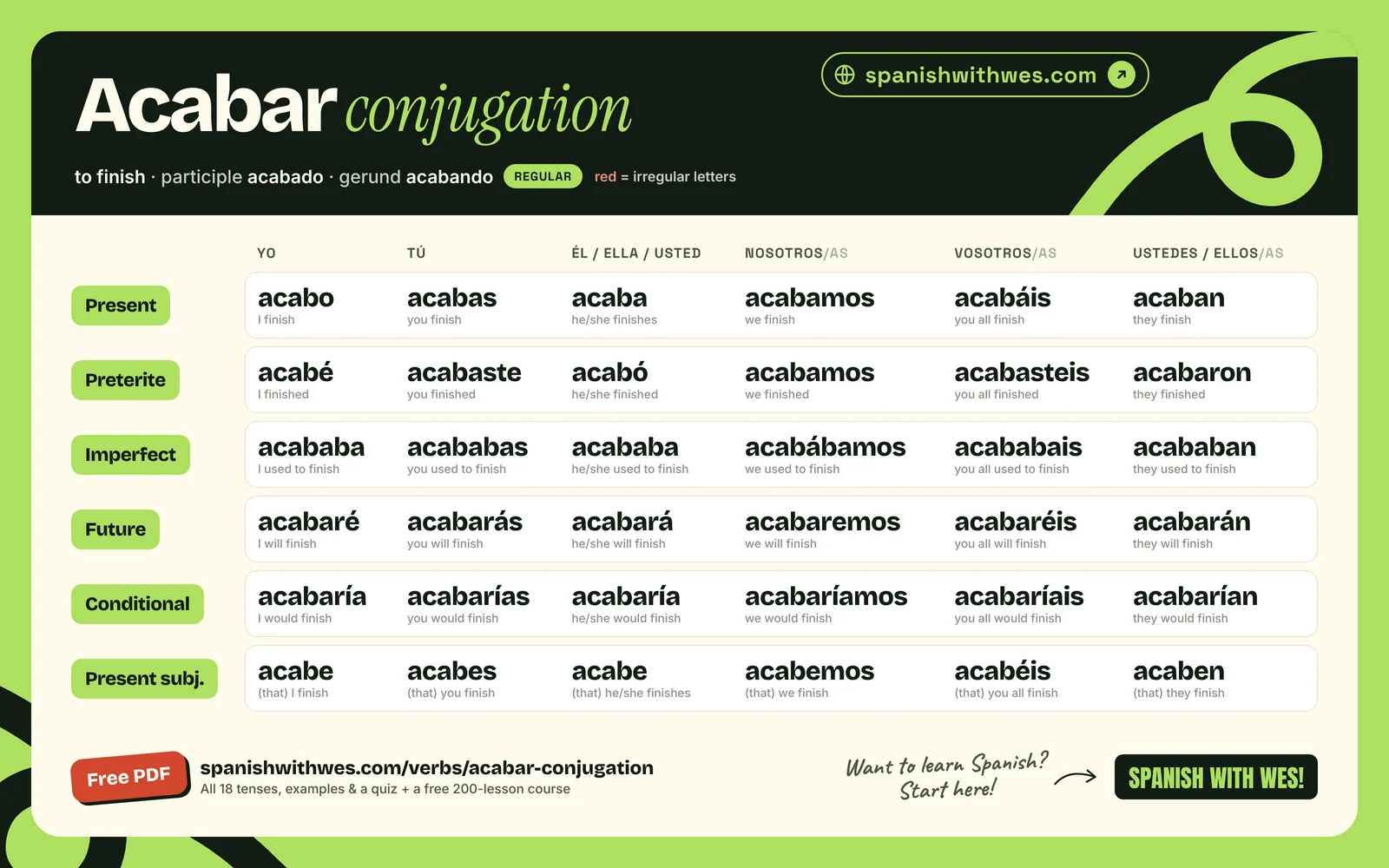
| yo | acaboI finish |
|---|---|
| tú | acabasyou finish |
| él/ella/usted | acabahe/she finishes |
| nosotros/as | acabamoswe finish |
| vosotros/as | acabáisyou all finish |
| ellos/ellas/ustedes | acabanthey finish |
Acabar de + infinitive in the present means "to have just done": acabo de llegar (I've just arrived).
Preterite indicative
| yo | acabéI finished |
|---|---|
| tú | acabasteyou finished |
| él/ella/usted | acabóhe/she finished |
| nosotros/as | acabamoswe finished |
| vosotros/as | acabasteisyou all finished |
| ellos/ellas/ustedes | acabaronthey finished |
Imperfect indicative
| yo | acababaI used to finish |
|---|---|
| tú | acababasyou used to finish |
| él/ella/usted | acababahe/she used to finish |
| nosotros/as | acabábamoswe used to finish |
| vosotros/as | acababaisyou all used to finish |
| ellos/ellas/ustedes | acababanthey used to finish |
Present continuous indicative
| yo | estoy acabandoI am finishing |
|---|---|
| tú | estás acabandoyou are finishing |
| él/ella/usted | está acabandohe/she is finishing |
| nosotros/as | estamos acabandowe are finishing |
| vosotros/as | estáis acabandoyou all are finishing |
| ellos/ellas/ustedes | están acabandothey are finishing |
estar + gerund
Informal future indicative
| yo | voy a acabarI am going to finish |
|---|---|
| tú | vas a acabaryou are going to finish |
| él/ella/usted | va a acabarhe/she is going to finish |
| nosotros/as | vamos a acabarwe are going to finish |
| vosotros/as | vais a acabaryou all are going to finish |
| ellos/ellas/ustedes | van a acabarthey are going to finish |
ir a + infinitive
Future indicative
| yo | acabaréI will finish |
|---|---|
| tú | acabarásyou will finish |
| él/ella/usted | acabaráhe/she will finish |
| nosotros/as | acabaremoswe will finish |
| vosotros/as | acabaréisyou all will finish |
| ellos/ellas/ustedes | acabaránthey will finish |
Conditional indicative
| yo | acabaríaI would finish |
|---|---|
| tú | acabaríasyou would finish |
| él/ella/usted | acabaríahe/she would finish |
| nosotros/as | acabaríamoswe would finish |
| vosotros/as | acabaríaisyou all would finish |
| ellos/ellas/ustedes | acabaríanthey would finish |
Present perfect indicative
| yo | he acabadoI have finished |
|---|---|
| tú | has acabadoyou have finished |
| él/ella/usted | ha acabadohe/she has finished |
| nosotros/as | hemos acabadowe have finished |
| vosotros/as | habéis acabadoyou all have finished |
| ellos/ellas/ustedes | han acabadothey have finished |
haber (present) + past participle
Past perfect indicative
| yo | había acabadoI had finished |
|---|---|
| tú | habías acabadoyou had finished |
| él/ella/usted | había acabadohe/she had finished |
| nosotros/as | habíamos acabadowe had finished |
| vosotros/as | habíais acabadoyou all had finished |
| ellos/ellas/ustedes | habían acabadothey had finished |
haber (imperfect) + past participle
Future perfect indicative
| yo | habré acabadoI will have finished |
|---|---|
| tú | habrás acabadoyou will have finished |
| él/ella/usted | habrá acabadohe/she will have finished |
| nosotros/as | habremos acabadowe will have finished |
| vosotros/as | habréis acabadoyou all will have finished |
| ellos/ellas/ustedes | habrán acabadothey will have finished |
haber (future) + past participle
Conditional perfect indicative
| yo | habría acabadoI would have finished |
|---|---|
| tú | habrías acabadoyou would have finished |
| él/ella/usted | habría acabadohe/she would have finished |
| nosotros/as | habríamos acabadowe would have finished |
| vosotros/as | habríais acabadoyou all would have finished |
| ellos/ellas/ustedes | habrían acabadothey would have finished |
haber (conditional) + past participle
Subjunctive tenses of acabar
Wishes, doubts, emotions and "if" sentences.
Present subjunctive
| yo | acabe(that) I finish |
|---|---|
| tú | acabes(that) you finish |
| él/ella/usted | acabe(that) he/she finishes |
| nosotros/as | acabemos(that) we finish |
| vosotros/as | acabéis(that) you all finish |
| ellos/ellas/ustedes | acaben(that) they finish |
Imperfect subjunctive
| yo | acabara(if) I finished |
|---|---|
| tú | acabaras(if) you finished |
| él/ella/usted | acabara(if) he/she finished |
| nosotros/as | acabáramos(if) we finished |
| vosotros/as | acabarais(if) you all finished |
| ellos/ellas/ustedes | acabaran(if) they finished |
Future subjunctive
| yo | acabare(if) I finish |
|---|---|
| tú | acabares(if) you finish |
| él/ella/usted | acabare(if) he/she finishes |
| nosotros/as | acabáremos(if) we finish |
| vosotros/as | acabareis(if) you all finish |
| ellos/ellas/ustedes | acabaren(if) they finish |
rarely used: legal & formal texts
Present perfect subjunctive
| yo | haya acabado(that) I have finished |
|---|---|
| tú | hayas acabado(that) you have finished |
| él/ella/usted | haya acabado(that) he/she has finished |
| nosotros/as | hayamos acabado(that) we have finished |
| vosotros/as | hayáis acabado(that) you all have finished |
| ellos/ellas/ustedes | hayan acabado(that) they have finished |
haber (present subj.) + past participle
Past perfect subjunctive
| yo | hubiera acabado(if) I had finished |
|---|---|
| tú | hubieras acabado(if) you had finished |
| él/ella/usted | hubiera acabado(if) he/she had finished |
| nosotros/as | hubiéramos acabado(if) we had finished |
| vosotros/as | hubierais acabado(if) you all had finished |
| ellos/ellas/ustedes | hubieran acabado(if) they had finished |
haber (imperfect subj.) + past participle
Future perfect subjunctive
| yo | hubiere acabado(if) I will have finished |
|---|---|
| tú | hubieres acabado(if) you will have finished |
| él/ella/usted | hubiere acabado(if) he/she will have finished |
| nosotros/as | hubiéremos acabado(if) we will have finished |
| vosotros/as | hubiereis acabado(if) you all will have finished |
| ellos/ellas/ustedes | hubieren acabado(if) they will have finished |
rarely used: legal & formal texts
Imperative tenses of acabar
Commands and instructions.
Affirmative imperative
| tú | acabafinish! |
|---|---|
| usted | acabefinish! (formal) |
| nosotros/as | acabemoslet's finish! |
| vosotros/as | acabadfinish! (you all) |
| ustedes | acabenfinish! (you all, formal) |
Negative imperative
| tú | no acabesdon't finish! |
|---|---|
| usted | no acabedon't finish! (formal) |
| nosotros/as | no acabemoslet's not finish! |
| vosotros/as | no acabéisdon't finish! (you all) |
| ustedes | no acabendon't finish! (you all, formal) |
Practice acabar
Two quick exercises. No sign-up, no app: just you and acabar.
How to use acabar
Ya acabé los deberes.
I've already finished my homework.
Acabo de llegar a casa.
I've just got home.
La película acaba a las diez.
The film ends at ten.
Se acabó la leche.
The milk has run out.
Acabamos cenando en un bar.
We ended up having dinner in a bar.
Example sentences with acabar
- ¿Cuándo acabas de trabajar?When do you finish work?
- Acabamos de comer.We've just eaten.
- El partido acabó en empate.The match ended in a draw.
- Acababa de salir cuando llamaste.I had just left when you called.
- Acabaré el libro mañana.I'll finish the book tomorrow.
- Acaba la cena primero.Finish your dinner first.
- Espero que acabes pronto.I hope you finish soon.
- Todavía no he acabado.I haven't finished yet.
Verbs like acabar
Acabar is a regular -ar verb. It means almost the same as terminar; its opposite is empezar or comenzar.
Frequently asked questions about acabar
Is acabar regular or irregular?
Acabar is completely regular in every tense.
How do you conjugate acabar in the present tense?
acabo, acabas, acaba, acabamos, acabáis, acaban.
How do you conjugate acabar in the preterite?
acabé, acabaste, acabó, acabamos, acabasteis, acabaron.
What does "acabar de" mean?
Acabar de + infinitive means "to have just done": acabo de llegar = I've just arrived.
What is the difference between acabar and terminar?
They mostly mean the same. Only acabar is used for "have just" (acabar de).
What does "se acabó" mean?
"It's over" or "it has run out": se acabó el café (the coffee has run out).
Free cheat sheet
All 18 tenses of acabar, on one page.
Print it, stick it on your fridge, or keep it on your phone. Fill in your name and email and I'll send it straight to your inbox.
📩 Check your inbox! The acabar cheat sheet is on its way.
Paid courses
Ready to actually speak?
Knowing the conjugations is step one. My paid courses take you from tables to real conversations: structured, step by step, with practice built in.
- Conversational courseStop freezing in real conversations
- Verb tenses courseEvery tense, finally clear

Hola, soy Wes!
Your Spanish teacher
A Dutchie who learned Spanish from scratch. I make the lessons I wish I'd had: clear, practical and free.
My story →Support Spanish with Wes!
Did this page help you?
All my lessons, verb charts and cheat sheets are free, and I want to keep it that way. If you'd like to help me make more, you can support me here. Think of it as buying me a café con leche ☕
More Spanish verbs
Verb search
Find any Spanish verb.
Type a verb, an English word or a conjugated form like fui or hubo.